

On Insistent Resistance: Baaraan Ijlal’s The Hour of Shadows
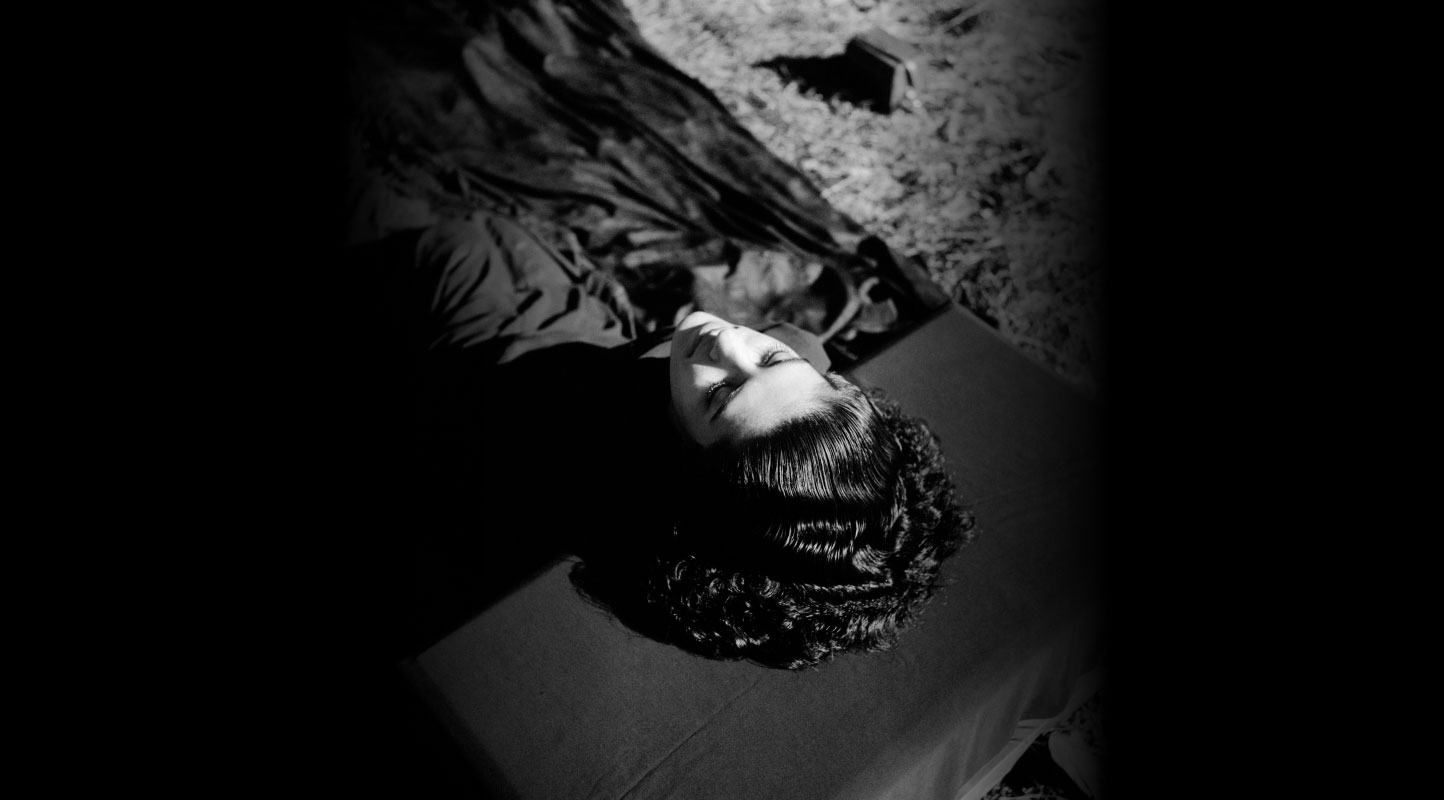
The thing about regimes—good or bad—is that the sun always sets on them, and in that inevitability, there is hope to be found. The fight that births itself from said hope is the metal that strengthens Baaraan Ijlal’s series of six paintings titled The Hour of Shadows (2026), displayed as part of the group exhibition, प्रक्रिया / Process at Shrine Empire Gallery, New Delhi, from 22 April to 23 May 2026. Inspired by her father and Urdu poet Ijlal Majeed’s couplet, Baaraan Ijlal creates a hexaptych of insistent resistance in the face of what she calls the “structures designed to keep ordinary people at a distance.” This series approaches large and imposing architectures of exclusion from the position of a witness, nodding to her broader practice and previous projects such as Hostile Witness (2014-2020 and 2021) and Mourners and Witnesses (2022).
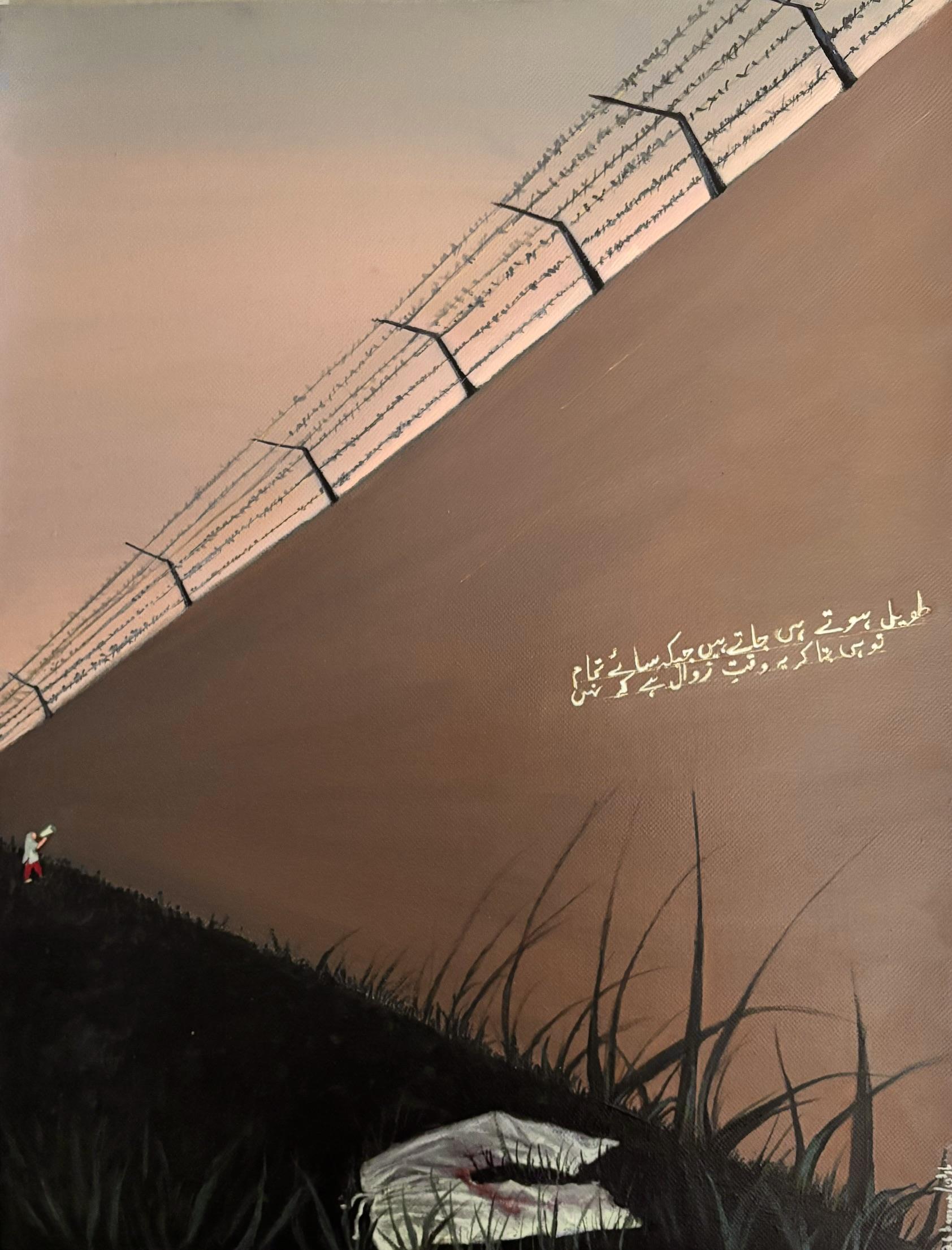
The first painting shows a woman in an ivory salwar suit far in the background, with a speaker pointed towards a tall tangerine wall lined with barbed wire. In the foreground lies a bloodied salwar—on uninhibited grass trying to climb the violent wall of exclusion; upon this wall, and against the ochre of a setting sun is written Ijlal Majeed’s couplet:
طویل ہوتے ہی جاتے ہیں جبکہ سائے تمام
تو ہی بتا کہ یہ وقتِ زوال ہے کہ نہی
Taveel hote hi jaate hain jabke saaye tamām,
tu hi bata ke yeh waqt-e-zawāl hai ki nahi
When all shadows stretch and stretch longer
tell me if that is the hour of decline or not.
Much like her father’s poetry, there is an essence of literariness in Baaraan’s images which is reminiscent of Partition and post-apocalyptic literature. In the painting, the woman with the speaker appears to seek justice for a female relative, who might have been tortured and stripped of her life, and whose bloodied salwar takes you to Saadat Hasan Manto’s short story “Khol Do” (1948), in which a salwar becomes the object of trauma of a girl who is lost during Partition and sexually violated. The plain sanitised wall of oppression is a spitting image of the book cover of Margaret Atwood’s The Handmaid’s Tale (1985) that shows two hooded women—enslaved and forced into surrogacy—walking along a walled border of confinement. The literariness here is twofold owing to her father’s couplet, which echoes hauntingly throughout the series and reminds us, in our inept reading, of a script dying—succumbing to bigotry and time. And in contemplation, she notes:
“A world is declining, therefore another world might become possible. Although in Urdu poetry, zawāl refers to the decline of a civilisation or moral culture, zawāl is not inherently a bad thing. مشکل وقت کا بھی زوال ہوتا ہے / Mushkil waqt ka bhi zawāl hota hai / There’s a decline of hard times as well. The couplet also never explicitly promises dawn; that tension between mourning and possibility is what the couplet inspired in me.”
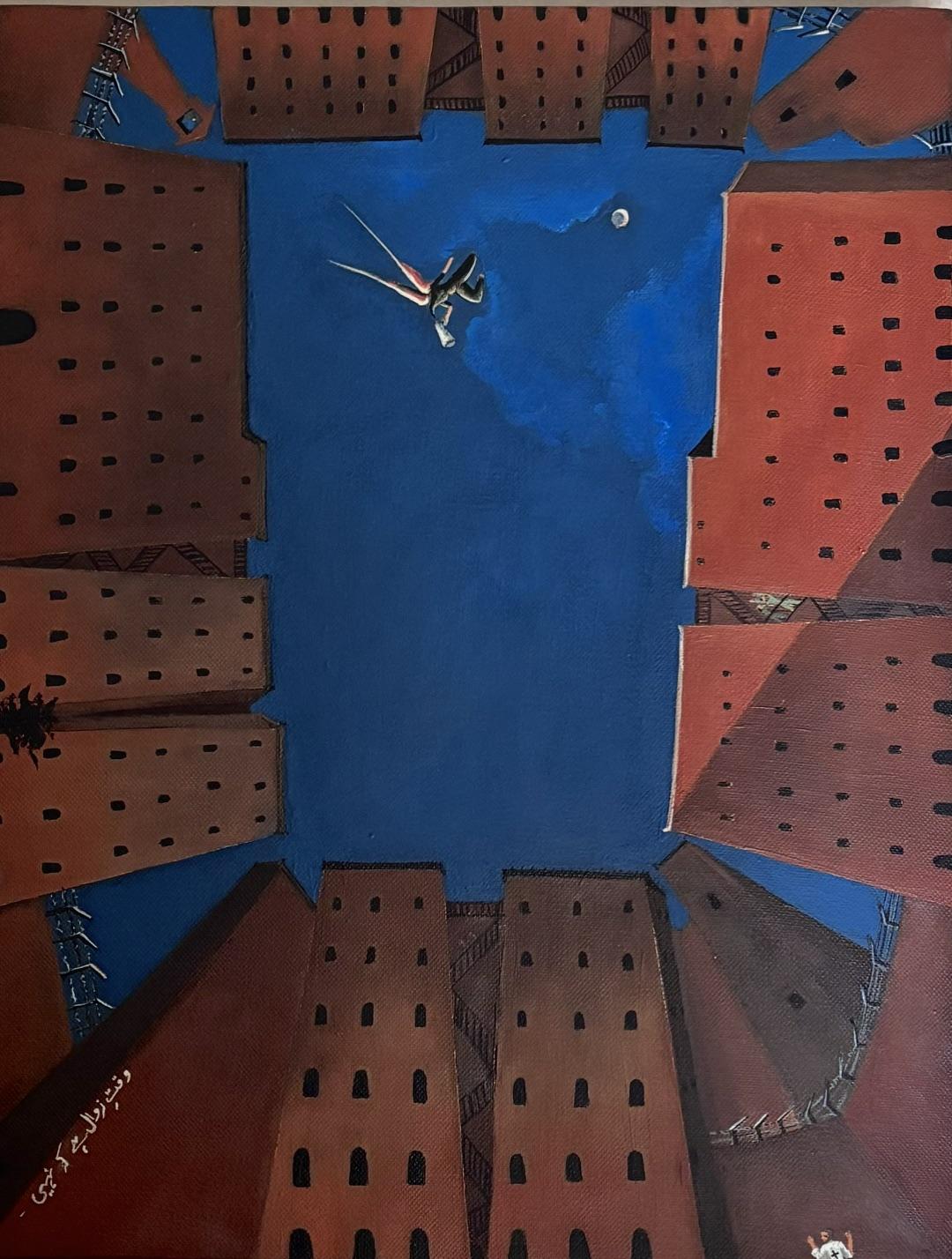
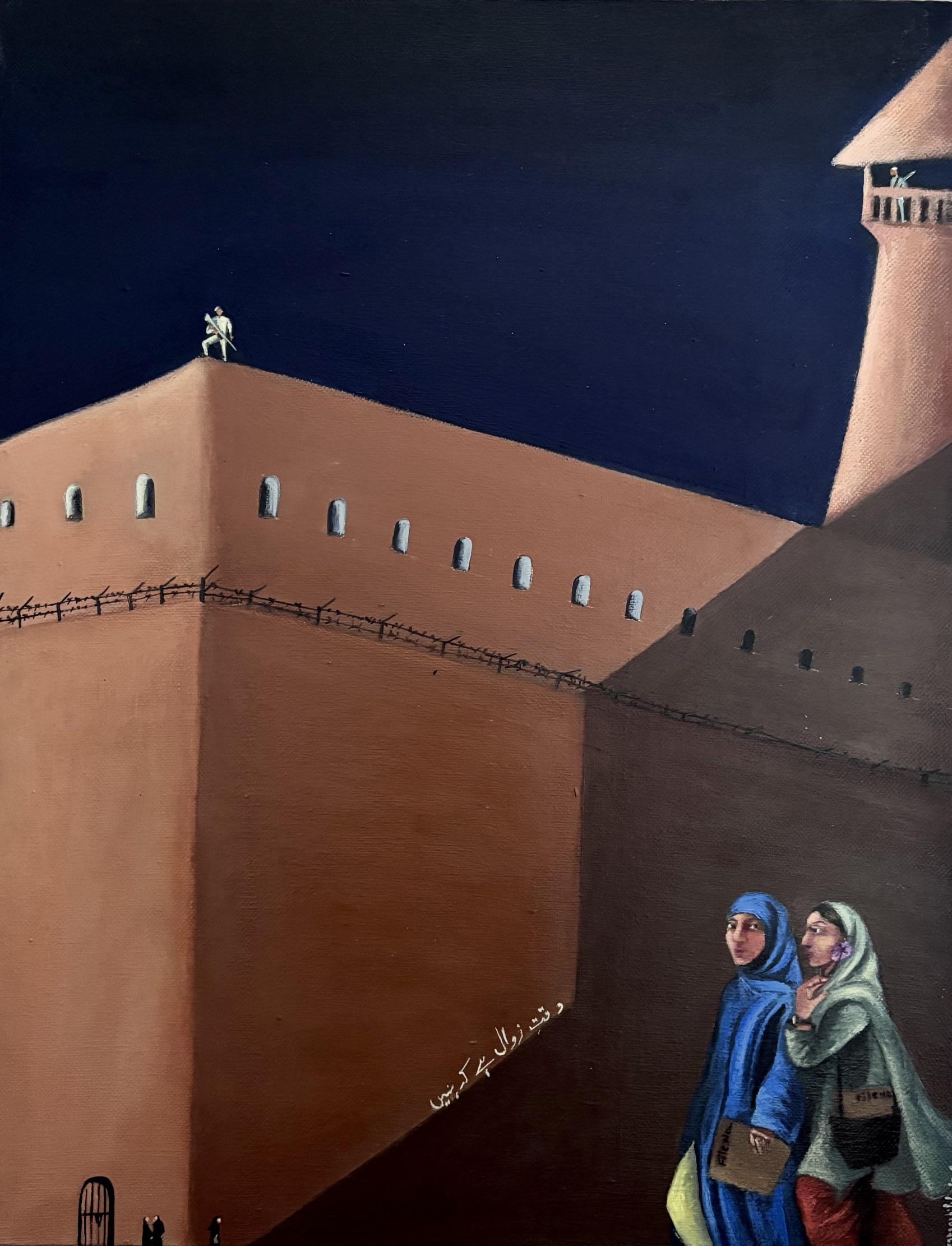
The Hour of Shadows imprisons your gaze within its restricted yet limitless worlds and confines it to an inescapable infinity. Elements such as looming, intimidating walls; alert watchtowers; unending sinister corridors; and eerily vast yards—all painted in each frame with different, skewed perspectives induce a choking effect that makes one uneasy despite the neat geometrical arrangement of their red sandstone universe. Probing the contradictions of such landscapes, Baaraan observes, “There is an insidious violence in the planning of cities. The decluttered geometry and its vastness in this series are intentional. The architecture overwhelms the body, the emptied environments strip the inhabitants naked and leave nowhere to retreat.” In that sense, the architecture of exclusion benefits no one—not the patrollers, not the tools of surveillance. It only lengthens the scales of institutional power. And yet, hope arrives in the space between the totalitarian envelope of earthy red buildings in the form of Zagh-e-Zaman. Zagh is the physical manifestation of resistance in the world, conceived in the shape of a crow-woman: her beak pointy, her wings sharp and her mode of speech, a good ol’ speaker (megaphone). While talking about Zagh’s characterisation, Baraan recalls:
“I used to paint crows because I was fascinated by their gathering. When a crow dies, the flock doesn't abandon it, they gather around the dead crow to honour it, investigate its death and spread the message of possible danger to their community. Similarly, Zagh is the upholder of natural order—the keeper of secrets; the provider of safe passage; and a reminder to keep voicing our opinions.”
The innate sensibilities of Baaraan’s practice are a reflection of an early life spent in the city of lakes, Bhopal. Her father, besides being a remarkable poet, is a professor of history and her “superhero” mother, a teacher of fine arts. With weekends occupied by diligent poetry sessions of elders, at her home, matters of politics were discussed with earnest sincerity without the fear of imminent judgment. While remembering her time in the city, Baaraan mentions:
“In the 1980s, Bhopal was a vibrant place—it was the time of Habib Tanvir; Narmada Bachao Andolan; the Museum of Man had just opened up; and free entry mushairas [Urdu poetry gatherings] were a regular event. But it was also the time when Bhopal suffered immensely; I was seven years old when the Gas Disaster and 1984 [anti-Sikh] riots happened.”
At a young age then, Baaraan realised what it meant to live as a minority and began to recognise the struggles of other minorities in a deeply personal way. She says, “Protests happened but nobody listened. Bhopal was emerging as a city during that period and there wasn’t much coverage of everyday injustices, which suggested to the world that they didn’t happen at all.”
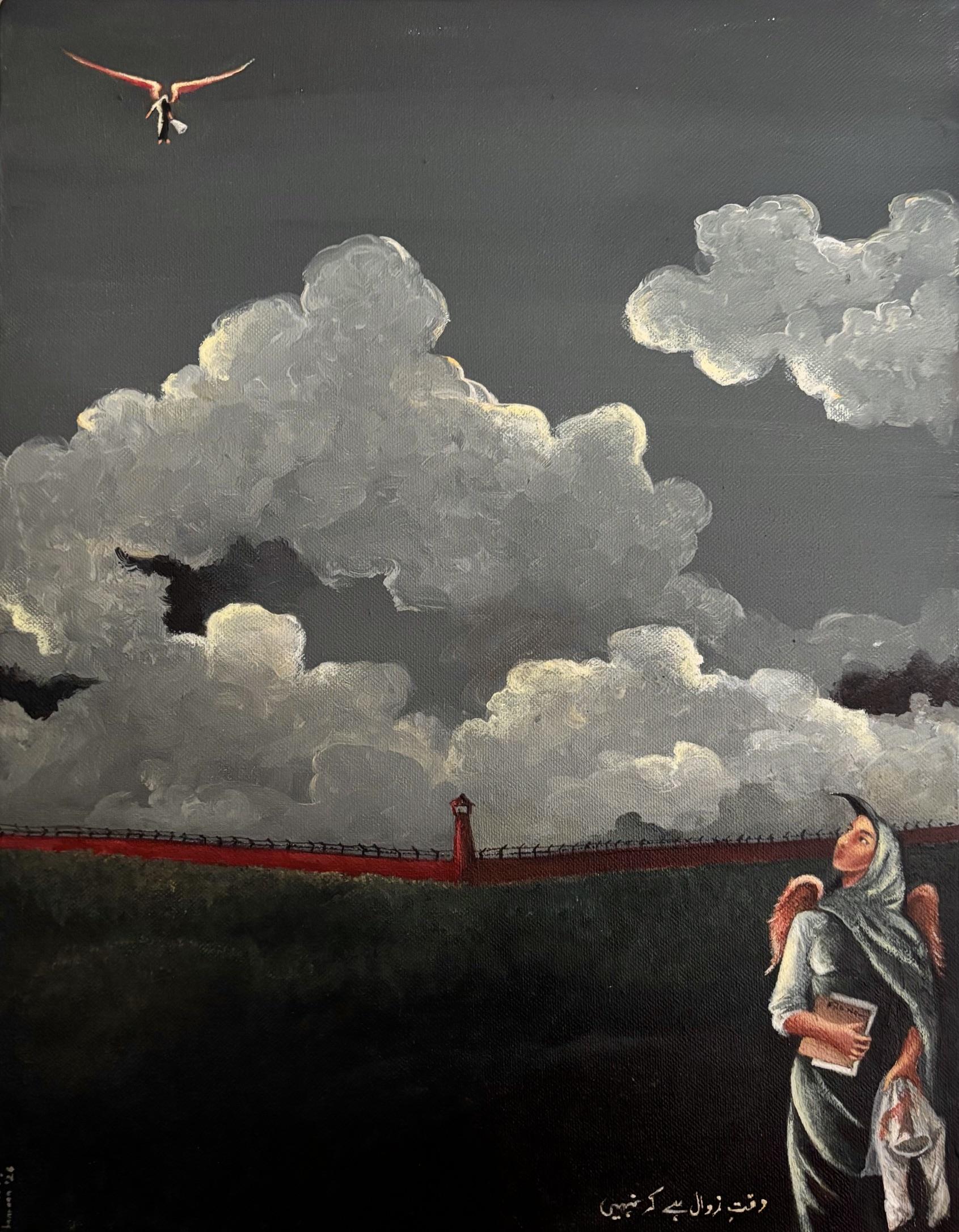
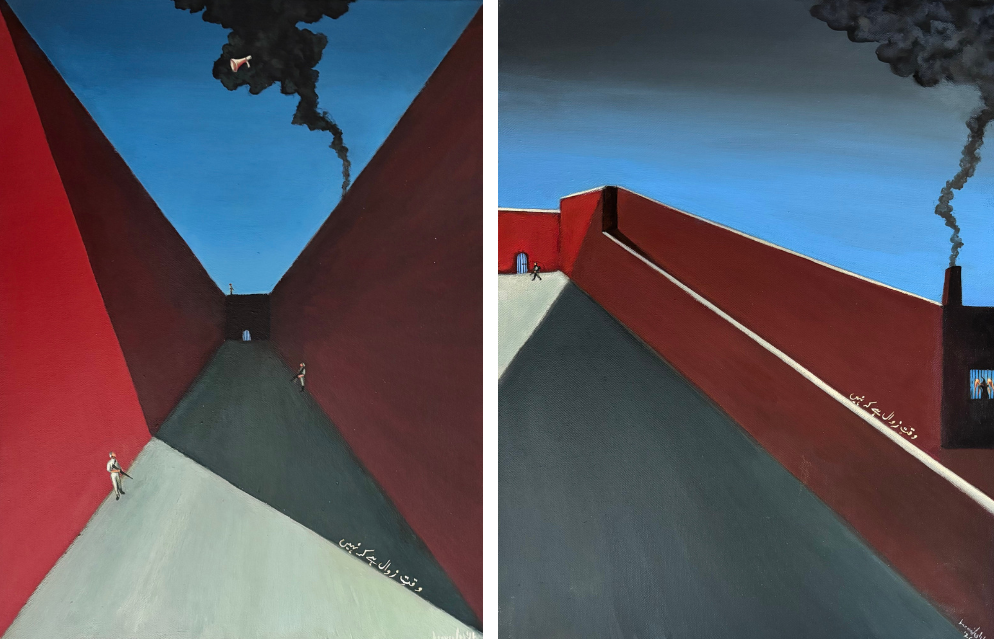
The couplet by Baaraan’s father resists closure, much like the metamorphosis of the justice-seeking woman clad in an ivory-coloured salwar suit, who, by the end of the series, grows a beak—with her back bearing the lightness of fresh wings and her head held high. Fire ignites and ashens the plain blue sky; a shadow emerges and lengthens in the promise of a setting sun. The deepening shadow creeps slowly over the intimidating architecture and from the smoke a speaker emerges—persistent, resilient, loud. On her creation of the figure of Zagh, Baaraan meditates:
“I learnt in my early years that the collective witnessing of an entire city is not enough. The concrete walls absorb the sound of our lamentations; no one is listening, and no comfort is given or promised, despite the speaker in Zagh’s hand. But I want to be hopeful and believe that the zenith of oppression shall begin its downfall, and that times are going to change.”
To learn more about artists tracing minoritisation and marginalisation of Muslim communities in India, read Sumaiya Mustafa’s review of Arun Karthick’s Nasir (2020), which traces ghettoised lives in a working-class Muslim neighbourhood, Kshiraja’s article on the exhibition The Imaginary Institution of India: Art 1975–1998 (2025), Najrin Islam’s reflections on Ritesh Sharma’s Jhini Bini Chadariya (2021), Ankan Kazi’s observations on a photo project around the anti-Citizenship Amendment Act (CAA) protests in Shaheen Bagh and Ketaki Varma’s interview with Masrat Zahra on her documentation of conflict in Kashmir.
To learn more about women’s resistance in the face of gendered violence, read Alfa M. Shakya’s essay on Lhakpa Choedon Lama’s Home is Not a Place (2026), Abdul Basit’s reflections on Iffat Fatima’s Khoon Diy Baarav (Blood Leaves Its Trail, 2015), Dev Saraswat’s review of Karan Tejpal’s Stolen (2023), and Najrin Islam’s exploration of Indu Antony’s art practice and Somaya Abdelrahman’s photo-documentation of female genital mutilation in Egypt.
All images are paintings (acrylic on canvas, 18 x 14 inches [each]) from the series The Hour of Shadows (2026) by Baaraan Ijlal. Images courtesy of the artist and Shrine Empire Gallery.