
All That is Solid: Materiality and the Memory of Babri Masjid
As the curated walk through of The Imaginary Institution of India: Art 1975–1998 exhibit (held at the Barbican Centre in London from October 2024–January 2025) takes its chronological turn to the 1990s, Rummana Hussain’s “Dissected Projection” (1993) draws the viewer into its illuminated orbit. The year of its creation unravels, in a blink, the inscrutability often attributed to conceptual art.
Upon a mirror-topped rectangular block lie six fragments of an earthen pot, invoking the shards of the dome of the Babri Masjid, the sixteenth-century mosque in Ayodhya demolished on 6th December 1992, by organised right-wing Hindu nationalists. The terracotta fragments frame the reflection of another dome—not broken as much as halved, protruding from the wall looming over the block. A beam of light on this wall throws up distorted shadows of the two domes—halved and shattered—which one cannot help but read as fractured bones, ephemeral yet material reminders of the violent anti-Muslim pogroms, in particular, the riots in Bombay (December 1992–January 1993) in the aftermath of the demolition. Between the block and the viewer sits a transparent acrylic box holding a pile of earth, forcing in us a reckoning of the destruction of the events and the disintegration of the collective imagination of India.
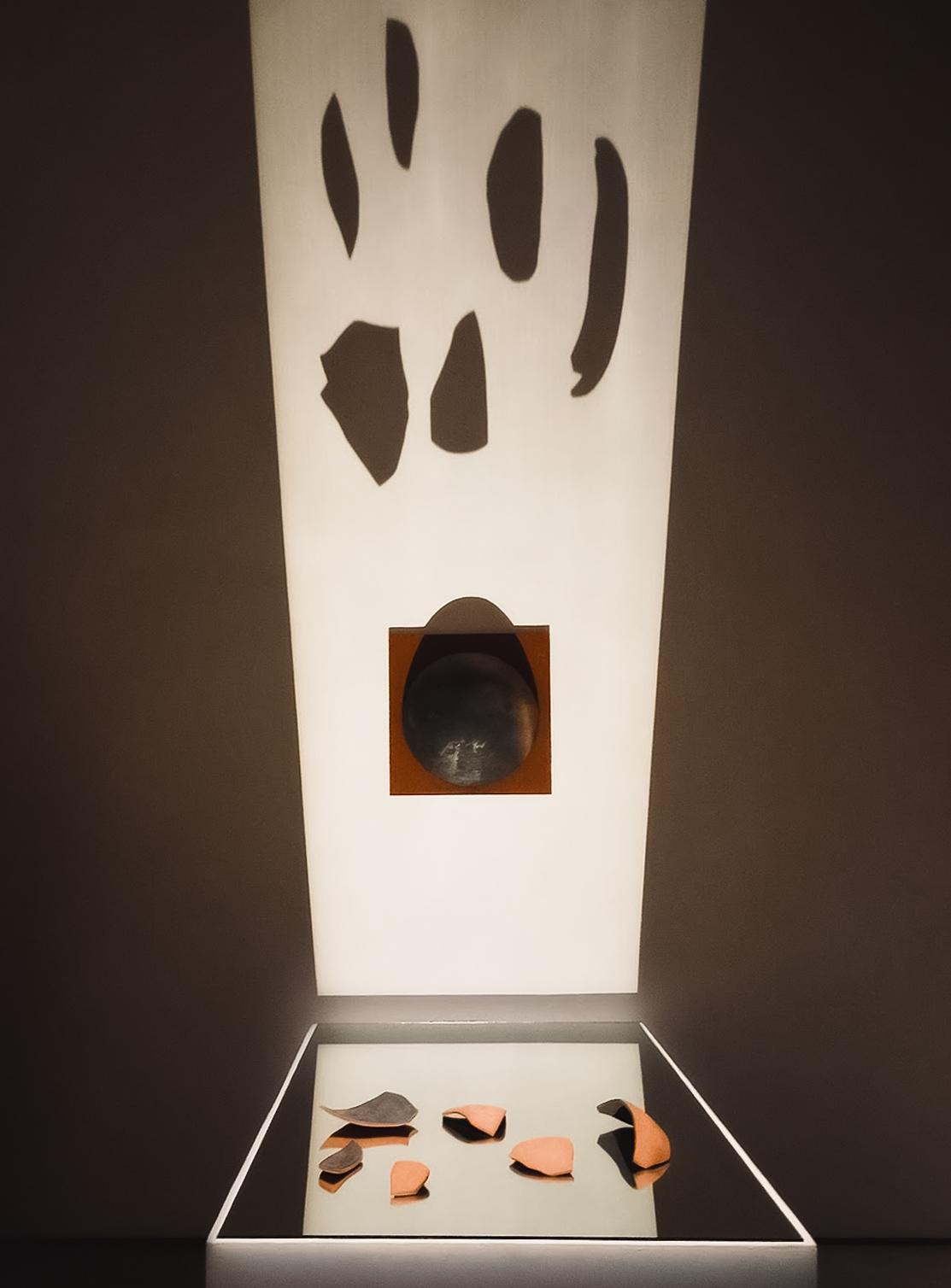
Dissected Projection (Rummana Hussain, 1993.)
With over a hundred artworks by thirty artists, The Imaginary Institution of India, curated by Shanay Jhaveri, explored artistic production during a twenty-three-year period in India’s postcolonial history marred by socio-political turbulence, instability and upheaval. The framing of the exhibit’s period of focus—between the declaration of the Emergency in 1975 and the nuclear tests in Pokhran in 1998, two events that belied the ideals upheld in the Indian Constitution—symbolises the curatorial spirit that connects the artworks to the context of their creation. Structured around the thematic axes of communal violence, gender and sexuality, urbanisation and class structures, and a growing connection with indigenism, the exhibit approaches the early 1990s by foregrounding artistic responses to the destruction of the Babri Masjid and the imagination of a secular nation.
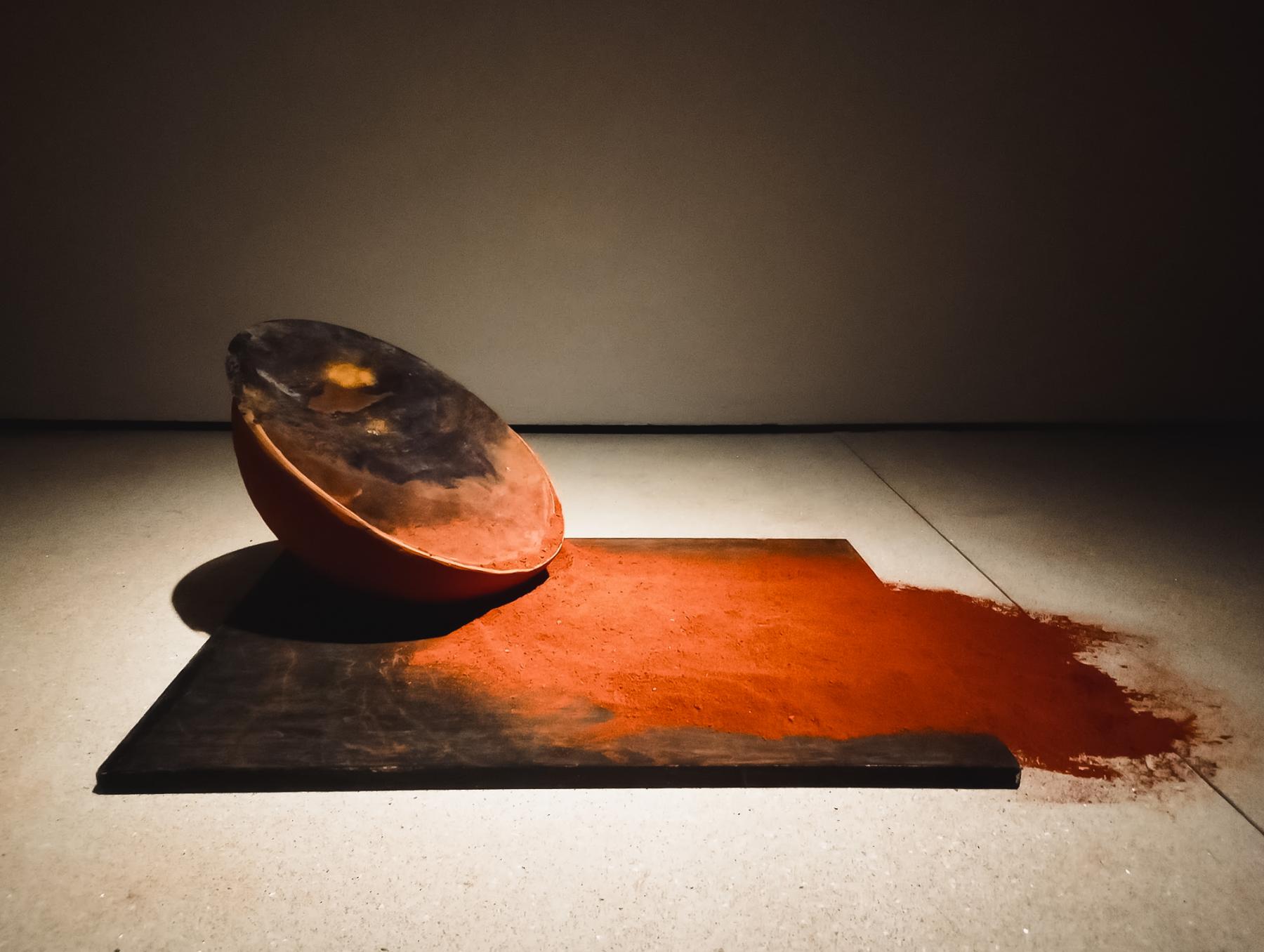
Conflux (Rummana Hussain, 1993.)
There is a distinct texture to this section of the exhibit. Hussain’s “Dissected Projection” is flanked by installations she made in the same year, originally presented as her first solo show Fragments/Multiples in 1994. The terracotta pots, wood and mirrors in “Dissected Projection” form recurring motifs across works like “Conflux,” “Resonance” and “Fragment from Splitting” (all c. 1993). The works also feature other everyday materials that allude to the disintegration of social harmony, be it the spilled gheru (a red-ochre clay pigment) in “Conflux,” or the stoic, segregated elements of rice, water, rock and shell in “Resonance.”
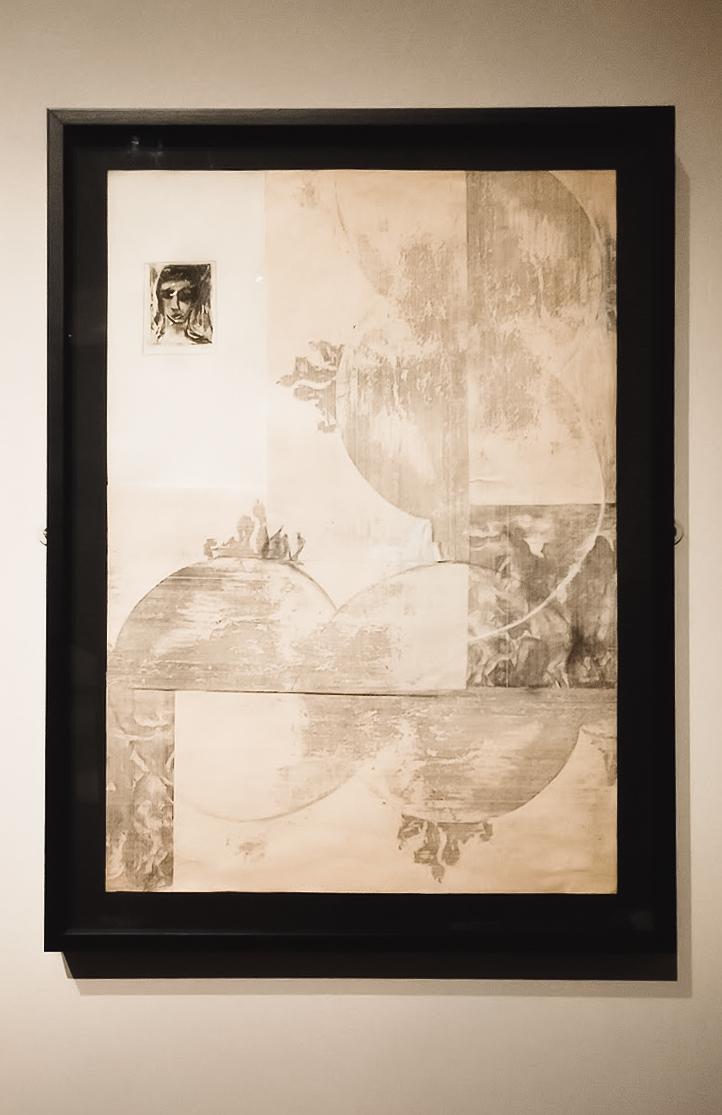
Behind a Thin Film (Rummana Hussain, 1993.)
Hussain, who began her career in the 1980s with oil and watercolour on paper and canvas, was forced, with her family, to temporarily flee her home in erstwhile Bombay during the anti-Muslim pogroms that took place in the wake of the demolition of Babri. The firsthand experience of the violence radically transformed her artwork, moving it towards media that captured her expression through their palpable materiality. Many of her subsequent canvas- and paper-based pieces, too, incorporated this tactility. In “Behind a Thin Film” (1993), for instance, Hussain used indigo and earth pigment, along with tiles of layered paper with Xerox prints of the Hindu mob standing atop the Babri Masjid.
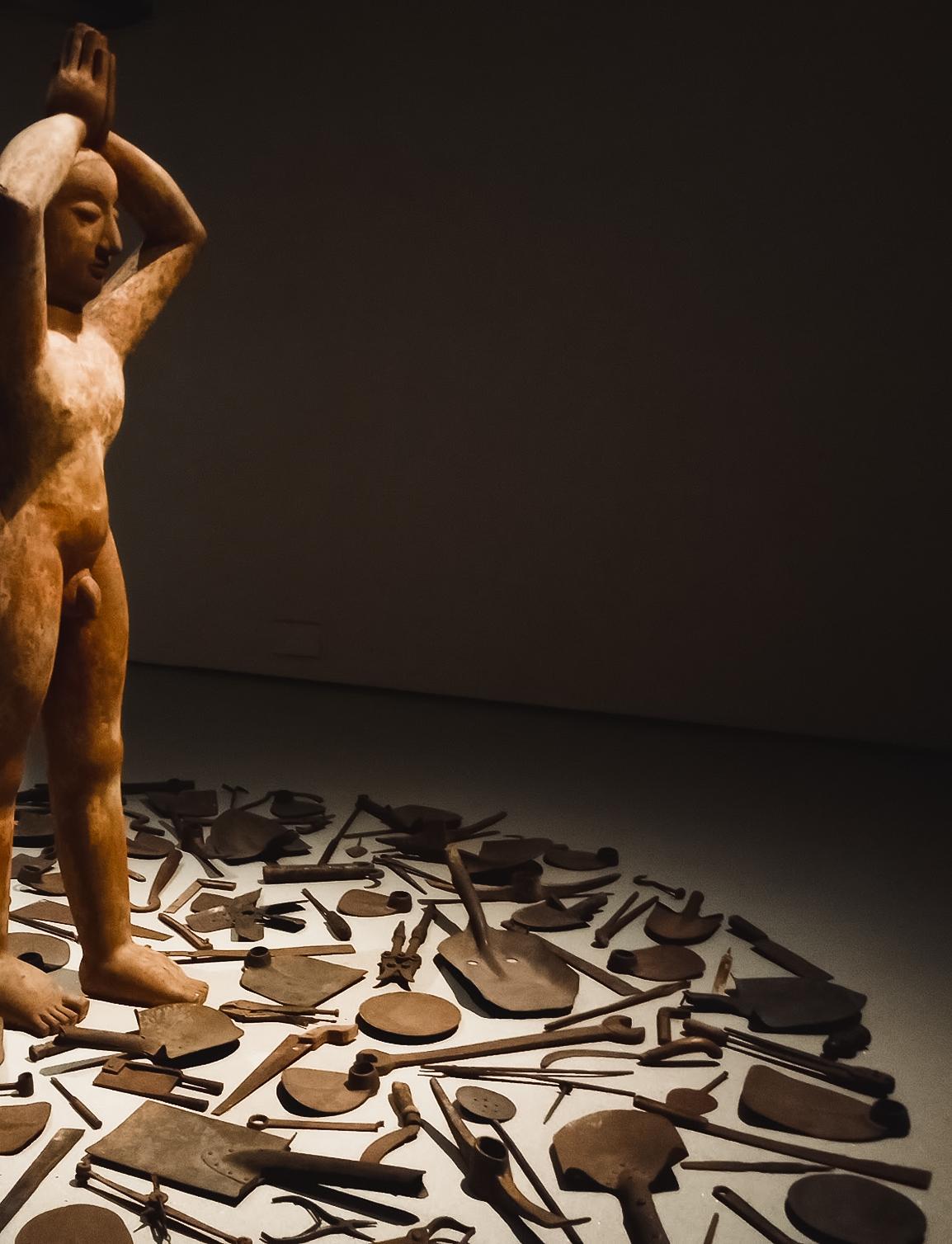
The Tools (N.N. Rimzon, 1993.)
This turn to the ‘material’ as an artistic tool to navigate unbridled destruction—both material and metaphorical—is by no means a feature of Hussain’s work alone. Already building his practice in sculpture, N.N. Rimzon moved to installation with “The Tools” (1993), in which a tranquil figure made of resin and fibreglass meditates within a circle filled with iron tools, provoking the choice of peace in violent times.
Vivan Sundaram’s “House” (1994) takes the approach even further by circumscribing a space of refuge through a deliberate choice of tactile materials. A steel frame is covered with kalamkhush paper, hand-made from scraps of khadi in the Gandhi Ashram in Ahmedabad, in an enterprise that began during Gandhi’s stay—making the symbolism unmistakable. The paper is embossed with forms of tools, a nod to Sundaram’s own Marxist leanings. The brake grease smeared over this fragile threshold is reminiscent of dried blood, a visceral reminder of the tenuous line between safety and brutality. A kadhai (deep frying pan) placed within these walls simmers with a video projection, a stewing reminder of the ongoing injustices.
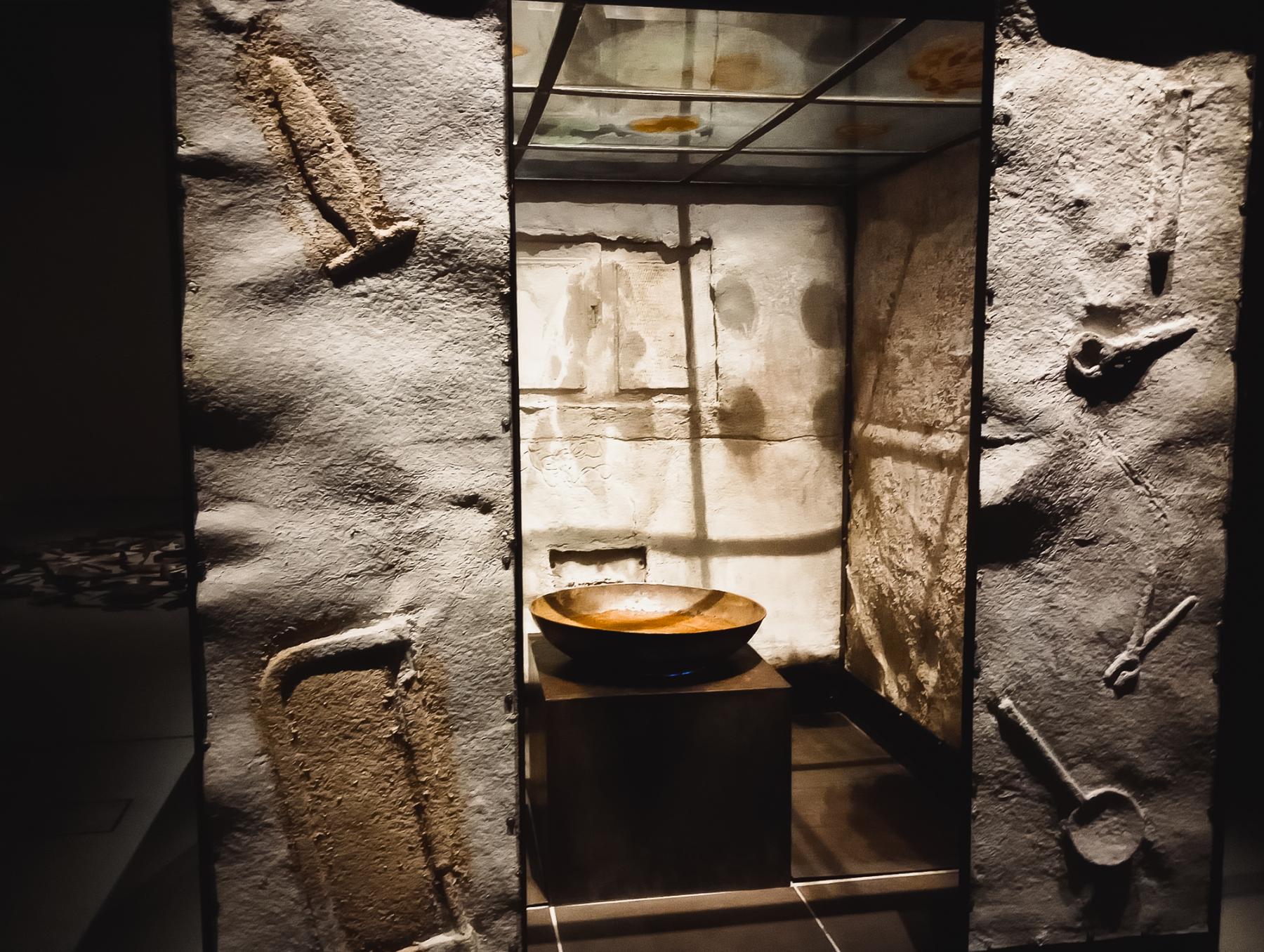
House (Vivan Sundaram, 1994.)
“House” came a year after Sundaram’s “Memorial” (1993), which, although not part of the Imaginary Institution exhibit, bears mention as the artist’s breakaway from his painting practice to installation. “Memorial,” too, responds to the wave of anti-Muslim violence in India, anchoring a room-sized installation around a newspaper photograph of an unidentified riot victim on a Bombay street, as captured by photojournalist Hoshi Jal.
The shift towards installation and material-based approaches in the 1990s could be attributed to a range of factors, including newly forming artistic networks and institutions in the era of globalisation. In these works, and the artists’ responses to the brutal material destruction that engulfed these years, we can discern the need to grasp at, reclaim and reappropriate materiality itself. The labour of creating these works of art—building, arranging, shaping, moulding and structuring—is an act of construction of solid monuments to all that has been melted, dissolved or disappeared.
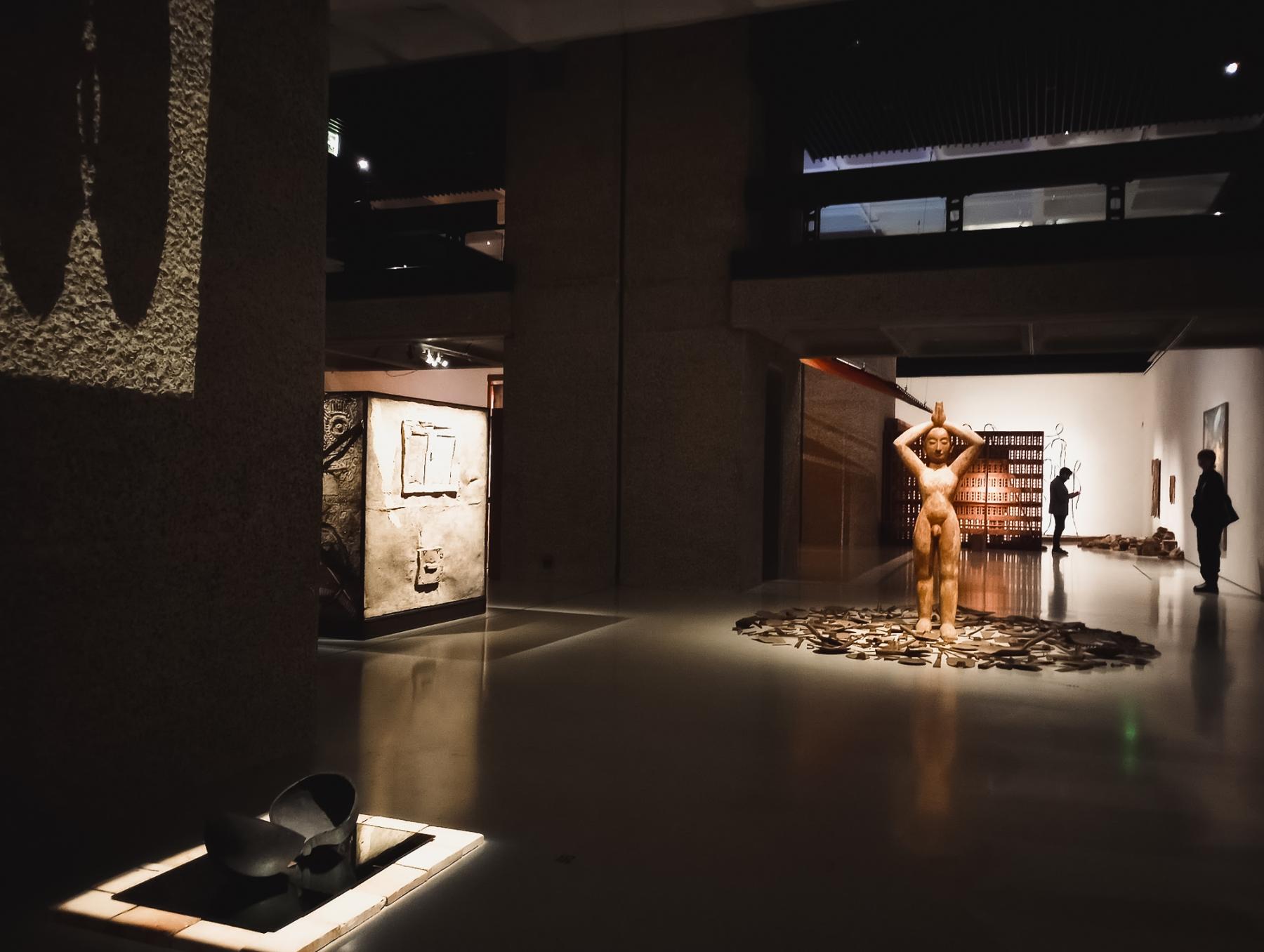
Hussain’s “Fragment from Splitting,” Rimzon’s “The Tools” and Sundaram’s “House” at the Barbican Centre in London, as part of The Imaginary Institution of India exhibition.
This push to go beyond the ‘seeing’ is not merely a detached artistic movement. After the assassination of playwright and activist Safdar Hashmi in 1989, Hussain and Sundaram, along with other artists, curators and educators, formed the Sahmat Collective (also the Safdar Hashmi Memorial Trust). Through this collective, they organised cultural and political events to advocate for communal harmony. One notable example was the exhibit Hum Sab Ayodhya (1993) that opened publicly across multiple cities in India and was eventually disbanded after attacks by the Hindu right. In these artworks, we see a rejection of the devastation and an acknowledgement of the faultlines in the idea of India. They offer a critique of the institutional power that not only witnesses but facilitates a targeted dehumanisation of the citizens it is meant to serve.
Over three decades since, a Hindu temple, inaugurated by the Prime Minister of India, has been built over the site where the Babri Masjid once stood. The fight against authoritarianism continues, perhaps with a new conception of what is solid, what is holy and what continues to be profaned.
To learn more about the aftermath and impact of the demolition of the Babri Masjid, read Asim Rafiqui’s essay on the Sufi shrines in Ayodhya, Prabhakar Duwarah’s article on Prashant Panjiar’s photography, Arushi Vats’ essay on the Sahmat Collective, Vishal Singh Deo’s reading of the rise of majoritarianism among peasant castes, Akash Sarraf’s observations on Mani Ratnam’s Bombay (1995) and Akanksha Maglani’s reflections on the panel “Rights as Public Rehearsal” as part of the exhibition Re:Staging the 1990s.
Also read Kshiraja’s essay on John Abraham’s Amma Ariyan (1986) and Sanjita Majumder’s reflections on G. Aravindan’s Thamp̄ (1978), screened as part of Rewriting the Rules: Pioneering Indian Cinema after 1970 in conjunction with The Imaginary Institution of India exhibition.
All images are installation views of the exhibition The Imaginary Institution of India: Art 1975–1998 at the Barbican, London. Images by and courtesy of the author.