


Beyond the Factory: Industrial Imagery and the Noida Workers’ Strike
The first part of this essay explored how Noida, the site of widespread labour agitations in April this year, produces its developmental imaginary. Continuing this reading further, this part looks at how labour is depicted in corporate visuals and discusses the duality of labour’s existence in the city’s industrial landscape, from which both the promotional imagery as well as protest images emerge.
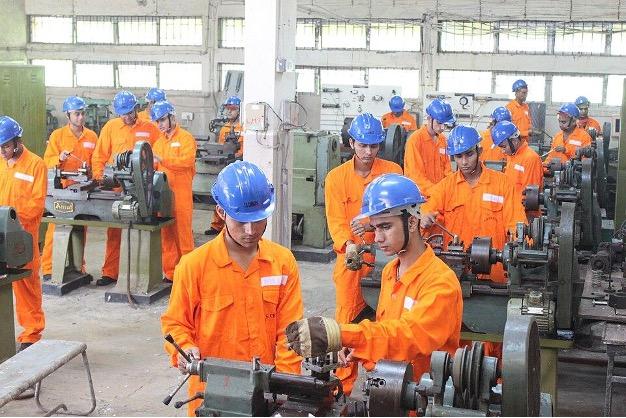
As one zooms into the visual imagery of the urban-industrial landscape of Noida, labour enters the frame of corporations in sizable proportions—in close-ups—albeit in meticulously choreographed arrangements. For instance, in an image from the Annual Report of Motherson Group (2024-2025), whose workers participated in the strike, a worker is shown standing next to a long industrial machine on a factory floor, with another worker placed behind him, partly out of focus. Large columns and other infrastructural material can be seen in the background, signalling the manufacturing environment the workers are submitted to. The length of the conveyor machine commands the foreground space, running across the image and directing our eye towards the worker. A sense of reciprocity and harmony punctures and suffuses the image. The determined worker, appearing to be in complete control—working with both his hands and subordinating a straight and orderly machine whose length remains outside the frame—can only be imagined.
The centering of a single worker, consumed, joyously, by the task of operating a machine, proposes an integration or enmeshment of the worker with the machine and surrounding space, adopting what Allan Sekula calls instrumental realism.
In his essay “Reading an Archive: Photography Between Labour and Capital,” (1983), Sekula notes:
“[Certain images are] commissioned, executed, displayed, and viewed in a spirit of calculation and rationality. Such pictures seem to offer unambiguous truths, the useful truths of applied science. But a zone of virtually unacknowledged affects can also be reached by photographs such as these, touching on anesthetics of power, mastery, and control.”
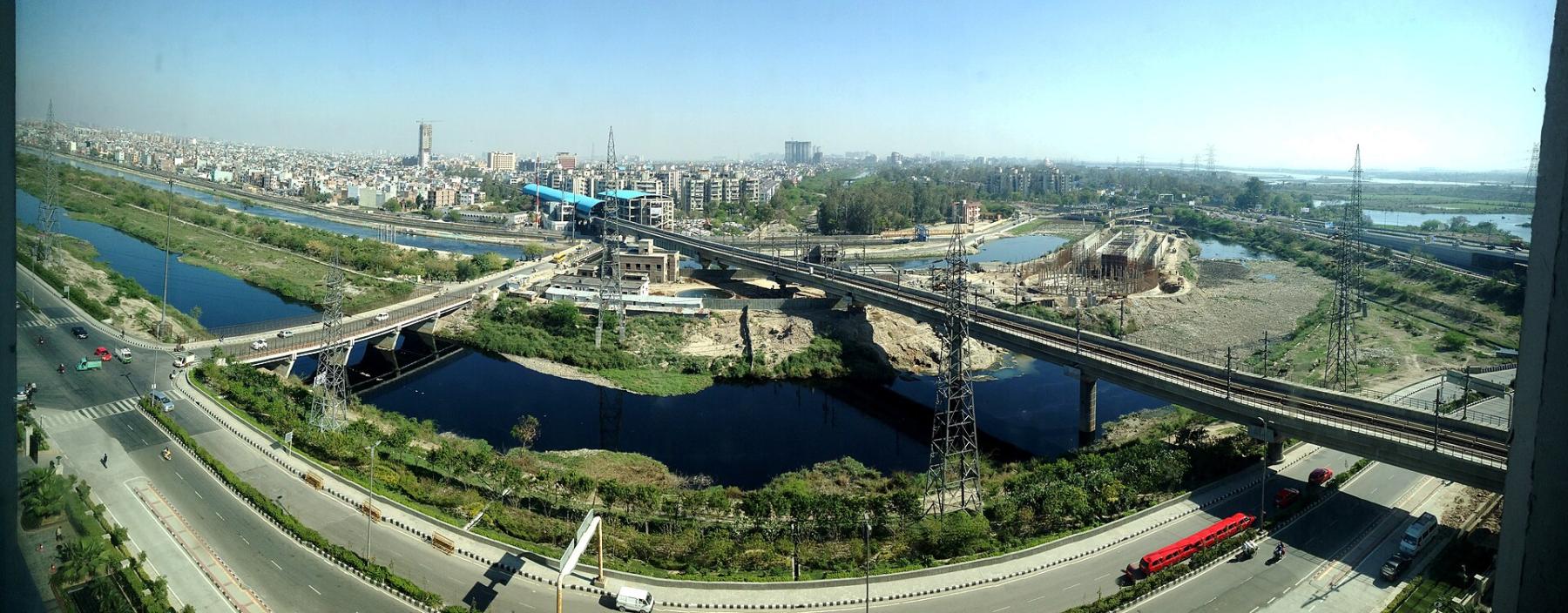
Perhaps in a rather surfacial manner, the factory image can echo the city itself: the elongated assembly line belts, like the seamless highways enabling mobility; the repetitive grids and columns, akin to the city’s cleaving; and the factory as an analogue of the industrial township. However, the factory image is innately required to depict the labour that animates it. Subsumed within the ordered, rationalised uniformity of the factory (or the township), labour—often condensed in the figure of a single worker—enters the frame in line with the seamless order of production posited by the township and factory. The promotional images of the cityscape abstracts infrastructure from labour but the factory image momentarily reveals the industrial and corporeal processes through which the former is sustained. However, the attractive and reassuring image of controlled factory work acts as what Sekula calls an “ideologically necessary substitute for deeper feelings—the cloak for an aesthetics of exploitation.”
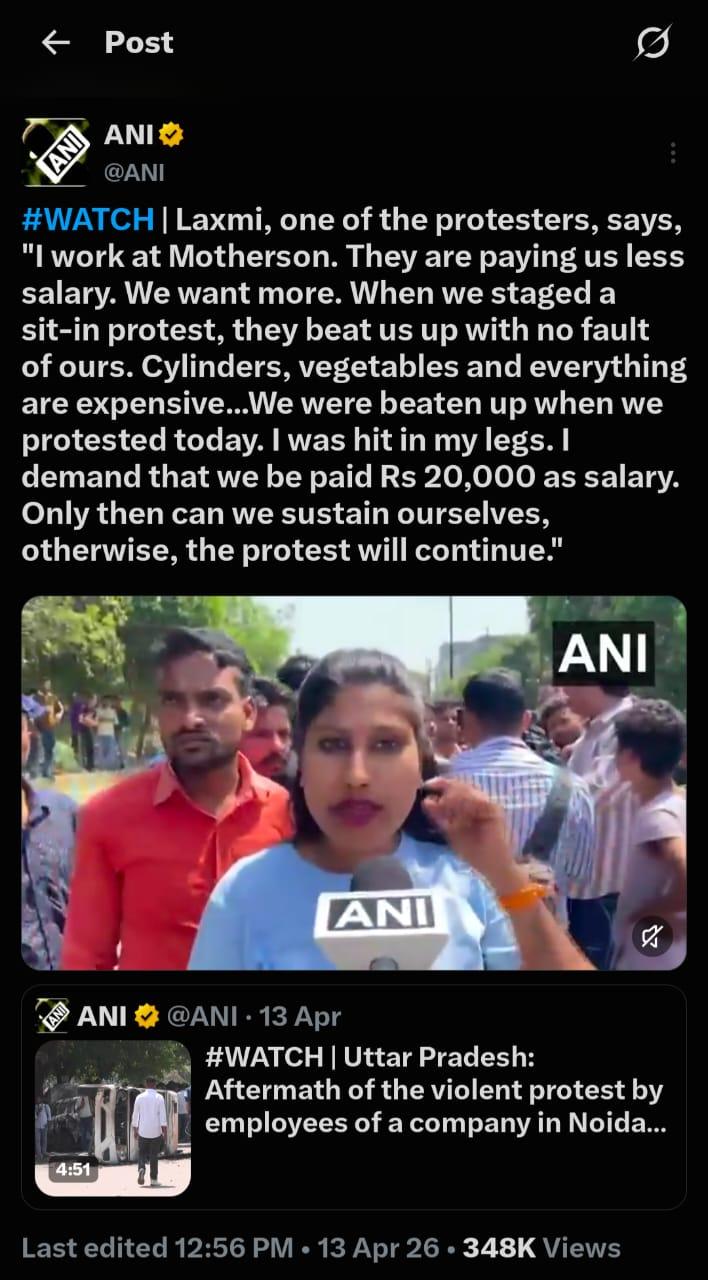
It is within this industrial and profit-driven visual milieu that the images of the Noida strike emerge. A news video features an employee of the Motherson group, speaking about the grossly inadequate wages and the brutality that was inflicted on the workers as a consequence of demanding fair compensation. In many news reports, groups of workers, including children, are seen running down a road—some of them holding palm-sized rocks in their hands. An image shows a young worker being escorted by police in riot gear, appearing isolated amidst their heavy presence, while another captures individuals in a moment of tussle with authorities as they all turn their backs to the camera, looking down at a wide road scattered with stones and debris, and cueing the aftermath or continuum of the protest.
In these images, workers appear as an excess; what surfaces is, in Sekula’s terms, a “radical antagonism” that can be used to describe different gazes on photographs of factory workers, such as a stockholder's economic gaze on an annual report or a family member's personal gaze on a loved one, both of which can be flattened within an archive. In this case, images of labour emerging from opposing positions, i.e., factory and strike respectively, are also radically antagonistic and their dissonance risks being flattened in dominant visual portrayals. Invoking Sekula’s framework of the “shock of montage” allows for a means to disrupt the equilibrium achieved by promotional images of Noida and corporate collaterals. Therefore, it is significant to read the two sets in conjunction to understand how narratives of the working-class in Noida and other similar urban developments are preserved, modified or even made invisible by photographs.
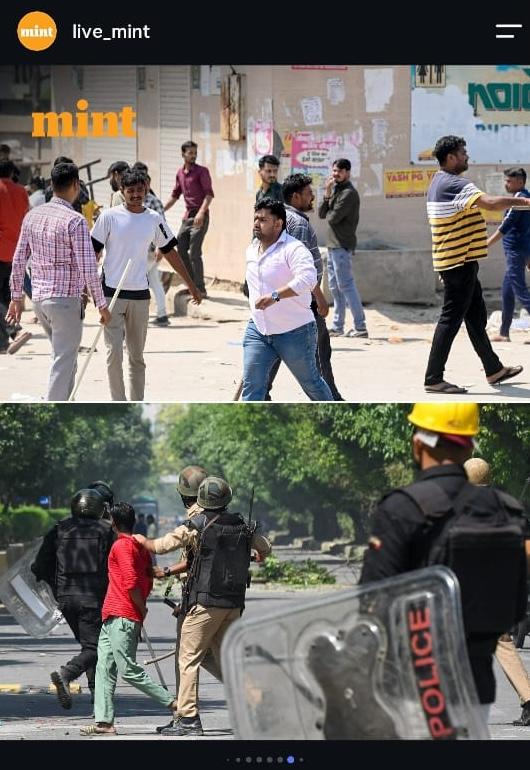
Further, Sekula observes how “pictorial histories offer an extraordinarily reductive view of causality”; it is through these kinds of images that the Noida strike appears to have “turned violent.” However, the strike actually began with other diffused, systemic violences of state and capital that precede this moment. As Anand Teltumbde highlights in his essay, “Wages of Fury: Noida’s Wake-Up Call” (2026), the “Noida uprising did not emerge in isolation. It is the cumulative outcome of conditions that have steadily worsened over more than a decade of BJP [Bharatiya Janata Party] rule at the Centre and, in Uttar Pradesh, under Adityanath, where 'development' has often meant the suppression of dissent.” By exposing what the dominant discourse does not make visible, these photographs of the strike then reveal their own disavowal.
Reading these sets of images together then interrogates how labour is visualised across different regimes and at what point violence comes to be accorded to particular bodies, gestures and moments. While concluding his essay, Sekula emphasises that “the archive has to be read from below from a position of solidarity with those displaced, deformed, silenced, or made invisible by the machineries of profit and progress.” In our media context, it is useful to read these images alongside others that come from the same terrain. In the case of the Noida workers’ strike, this proposition can tell us something about the invisibilisation of labour that further propagates the dispossession of workers and which acts as a prerequisite and consequence of the hegemonic economic and visual structure they exist within. The dominant visual regime of the industrial township and aspirational images of Noida shape the affective charge or reception of protest images, pointing to our own mediated conditions—and compromises—of viewing images.
Moreover, Teltumbde remarks in his work “Wages of Fury” that while the trigger for the strike is local, it is national in meaning. These images, thus, illuminate a broader economic and political condition that has dispossessed and criminalised the poor and working-class of our country, while the state machinery continues to propel farcical narratives of advancement.

In case you missed the first part, read it here.
To learn more about the intersection of working-class, multi-national corporations and urban development authorities, and the resulting socio-economic as well as political marginalisation of workers, read Vishal Singh Deo’s analysis of dual visual imagery of modern real estate and Hindu majoritarianism in agrarian Uttar Pradesh and Haryana, Mallika Visvanathan’s conversation with Suhel Banerjee on his film Cycle Mahesh (2024), Kamayani Sharma’s essay on Megha Acharya’s Meelon Dur (Miles Away, 2023) and Anisha Baid’s exploration of Tara Kelton’s series of digital images, Black Box (2018), where Uber drivers in Bengaluru imagine the distant company’s profile.
For insights into recent history of workers’ mobilisation in Delhi/ NCR, read reflections on the 2021 farmers’ protest including Kshiraja’s review of Nishtha Jain’s documentary Farming the Revolution (Inquilab di Kheti, 2024), Kamayani Sharma’s essay on Gurvinder Singh’s Trolley Times (2023) and Banhi Sarkar’s observations on Prateek Shekhar’s documentary Chardi Kala (2023).