

Chardi Kala: Of Protest, People and Enduring Resilience
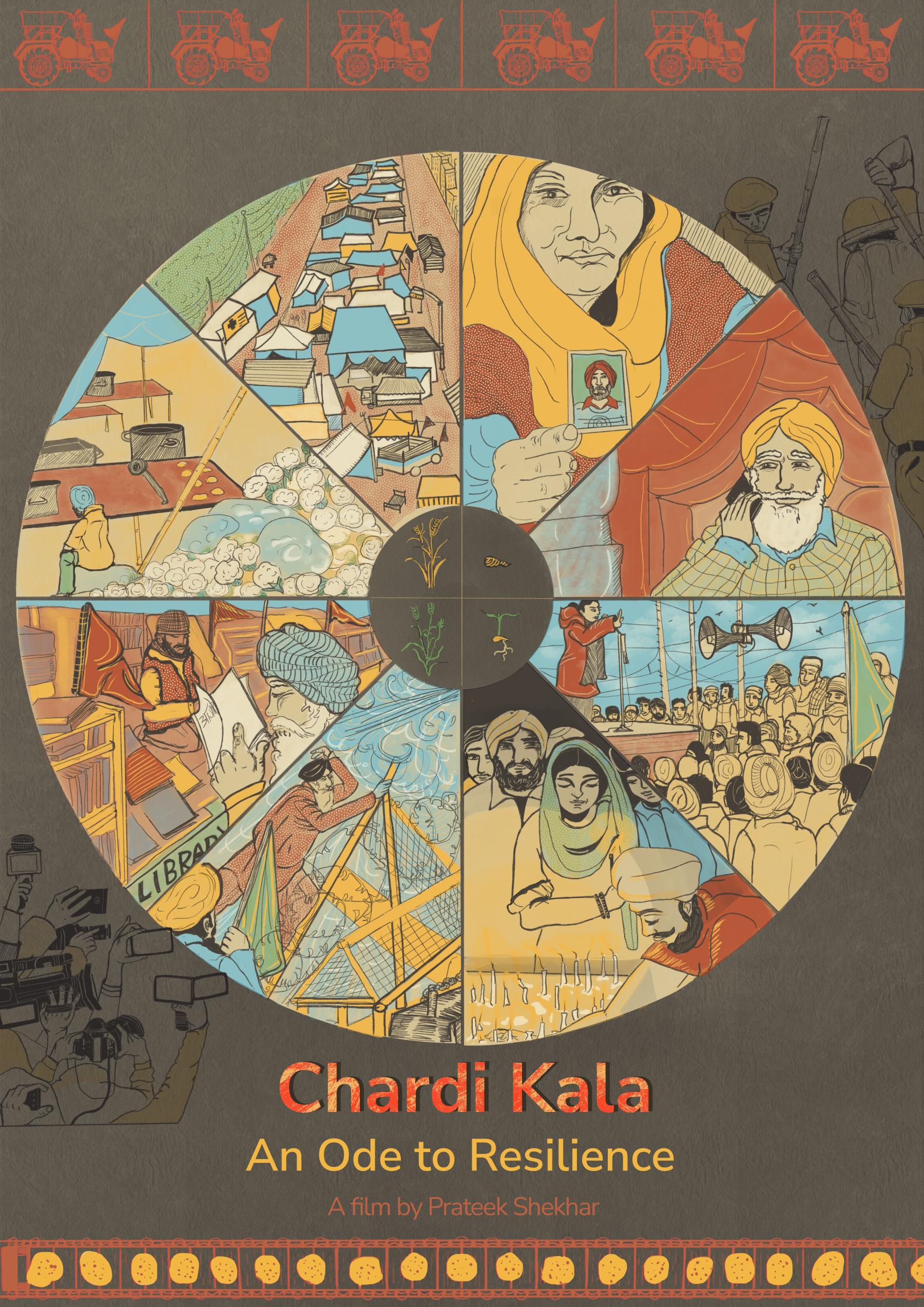
The poster for Chardi Kala (An Ode to Resilience).
The year 2021 will remain etched in collective memory as a year of profound disruption in the aftermath of the COVID-19 pandemic. However, it also stands out for another reason—the historic farmers’ protest. This mass mobilisation saw thousands of farmers from across India come together to protest the three contentious farm laws passed by the central government during the peak of the pandemic. Widely criticised for being unconstitutional and ‘anti-farmer’, these were the Farmers' Produce Trade and Commerce (Promotion and Facilitation) Act, the Farmers (Empowerment and Protection) Agreement on Price Assurance and Farm Services Act and the Essential Commodities (Amendment) Act. Collectively, these laws sought to allow farmers to trade their produce outside the Agriculture Produce Marketing Committee (APMC) acts, raising a fear of the weakening of the APMC mandis (marketplaces); enable a legal framework for contract farming, raising the fear of eventual corporatisation of agriculture and the removal of the Minimum Support Price guarantee; and finally also the removal of a few items from the essential commodities list. Against this turbulent backdrop, Prateek Shekhar’s documentary Chardi Kala (roughly translated as ‘eternal optimism’) unfolds as a quiet, resolute portrait of collective endurance. The film was recently screened at the second edition of Parda Faash, a festival of films from and about South Asia, organised by the Asia Society India Centre in collaboration with Film Southasia and the National Centre for Performing Arts on 26 and 27 April 2025.
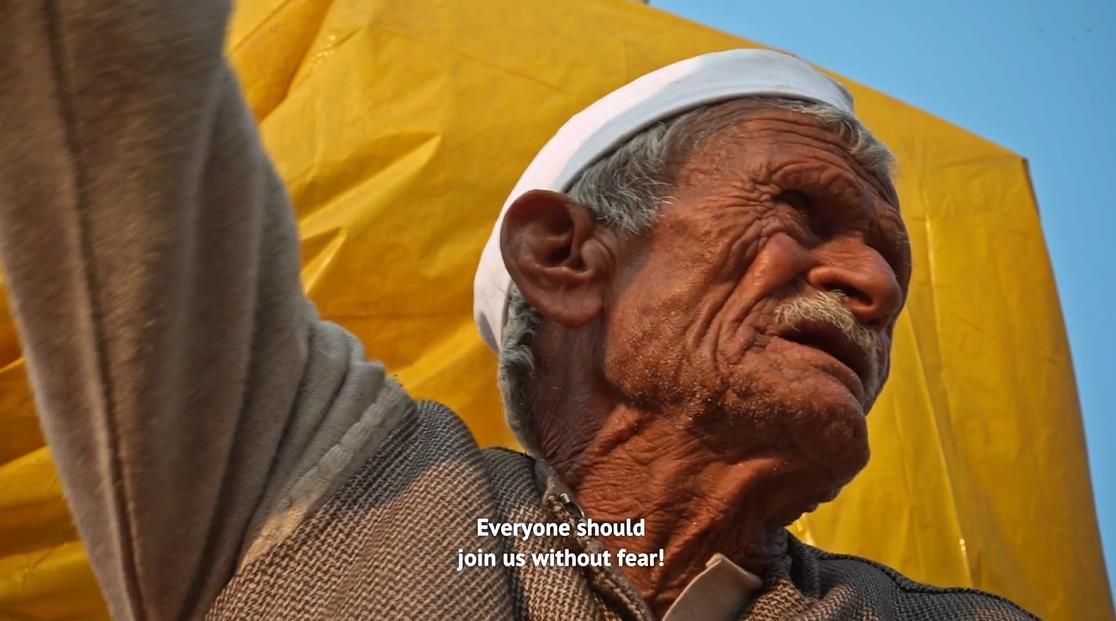
A senior farmer from UP highlighting how the movement attracted people from across states and religion.
Spanning over ten months, Chardi Kala (2023) traces the arc of the farmers protest, from early negotiations between farmer leaders and the government representatives at Vigyan Bhawan in January 2021 to the haunting aftermath of the Lakhimpur Kheri massacre in October that same year, where eight people, including four farmers, were brutally killed by a vehicle linked to a sitting Union Minister's family, and finally to the declaration by the Prime Minister repealing the three farm laws in November 2021. Along with the sequence of events covered, the film’s steadfast focus remains on documenting the incredible journey of the movement through the lens of the everyday acts of sewa (selfless service) that the protesting farmers—the majority of them hailing from Punjab, Haryana and UP, and ascribing to the principles of Sikhism—carried out. It emphasises the titular belief of chardi kala (eternal optimism/ enduring resilience) that kept the might of the movement strong through several months of the harsh Delhi winter and despite the repeated disappointing back-and-forth negotiations with the government. When asked what prompted him to pick up this theme of chardi kala, Shekhar confessed that during his initial daily visits to the protest site, he often came across the term in conversations. With no absolute literal definition out there, Shekhar soon realised that everybody at the protest had their own meaning or understanding of chardi kala that they were practising. It all culminated in the collective positive state of mind that was so palpable and powerful that it even transformed the filmmaker’s usual cynical outlook, leading him to document and deconstruct the everyday reality of the protest through what he describes as the “infectious spirit” of such selfless acts of chardi kala.
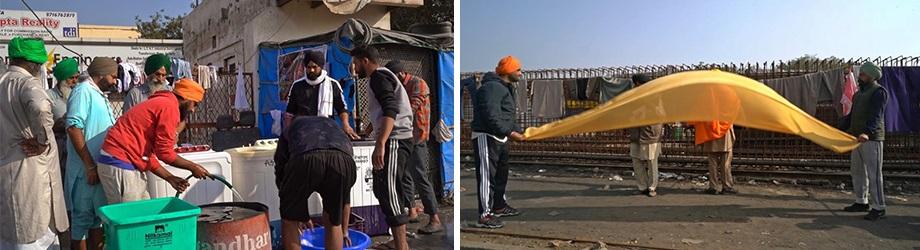
Farmers washing and drying clothes at the protest ground.
As one of the enduring themes of the documentary, Shekhar keeps an unflinching focus on the mundane acts of continuous, repeated labour that go on behind sustaining one of the largest non-violent protests of our times. The tasks range from arranging for stock ingredients to preparing breakfast, lunch and dinner; from building makeshift infrastructure for toilets to ensuring uninterrupted availability of essential services like medicines, salons and laundry; and from creating a temporary library-tent for people to read and borrow books for free to organising tattoo parlours, film screenings and graffiti art-making. Shekhar’s lens is adamant in lingering on the nitty-gritty of each of the building blocks of mass resistance. It is heartening to see the protesters break into a volleyball play-off or drop by the tattoo parlour in between days of sitting in patient protest, walking in marches, organising open lectures and arranging for food, even as they plan their movement, bit by bit, brick by brick, every day.
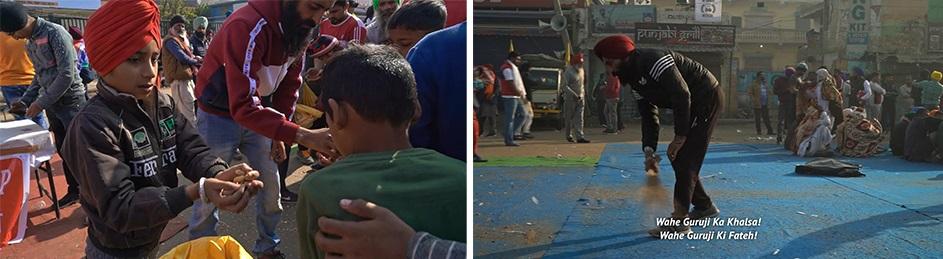
(Left) Kids and farmers distributing peanuts to people participating in the protest. (Right) Protesting farmers cleaning the grounds every morning.
Under Shekhar’s editing, the film mirrors the very pace and rhythm of the protesters and their unshakeable belief in the organised persistent insistence of a democratic resolution, reeling back the movement to its centred approach at every provocation, humiliation or resistance by the government. For every moment of anomalous tension captured on camera, be it the stampede and lathi (baton) charge during the Republic Day farmers’ parade—something that Shekhar marks as a defining moment in his shooting experience—or the reprehensible Lakhimpur Kheri violence, Shekhar’s gaze diligently shifts back to the regularity that sustained the movement for months without a ripple in the collective conscience. It was only after spending weeks at the protest site without shooting at all but simply hanging about, observing and having conversations that the filmmaker could gradually map out the everydayness of the protest site’s reality. This grounds the film too, as Shekhar’s lens keeps going back to this everyday reality of the protest after every such unprecedented or untoward incident that threatens to derail the steady, planned progress of the movement.
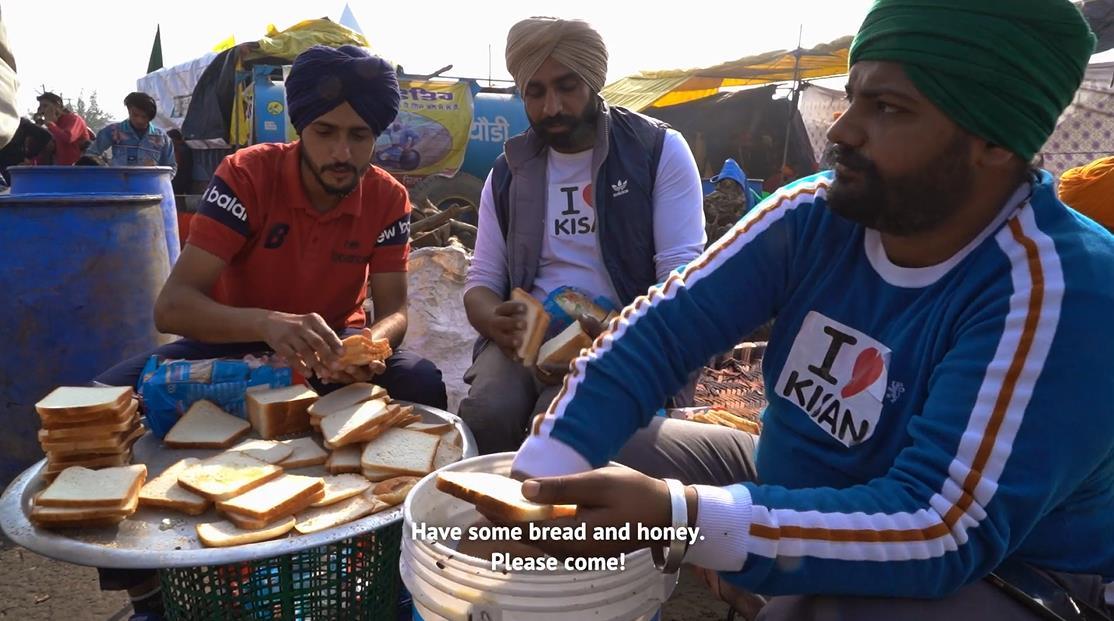
Protesting farmers distributing honey-lathered bread during breakfast.
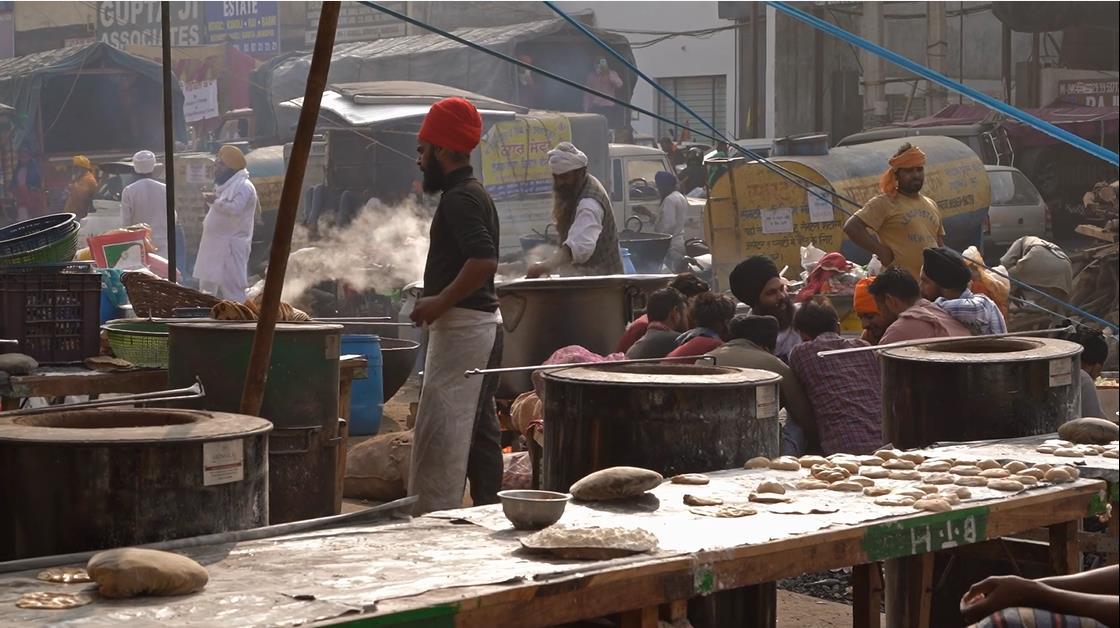
Glimpses from a makeshift kitchen on the road, as protesting farmers put all hands on deck to prepare the day’s food.
Shekhar was aware of the multitude of narratives that were doing the rounds at that time, from mainstream media’s armchair documentation to several photojournalists, vloggers, photographers and filmmakers like him shooting the protest as per their respective perspectives. To ensure a dispassionate response, he chose not to read up on all that was being said, written and commented upon in the media about the movement before going to the site himself to shoot. Apart from one article by economist Sudha Narayanan that critically analysed the bills against the contextual relevance of a changing agricultural market in the country, Shekhar only engaged with mainstream news media in terms of noting down the different narratives portrayed in the span of the few months leading up to the Republic Day. While referencing these narratives in the film, the director does not present them in an ironic or satirical manner but intersperses the mainstream media news footage and the shrill of TV news anchors spewing insensible accusations on screen with images of what really happened on the ground during such events. The juxtaposition is subtle and matter-of-fact, with the starkly different narratives not in contrast but, rather, in parallel for the viewers to absorb. These sequences recreate the flow of such events as they unfolded almost four years ago, but now with a sense of patient restraint for viewers to see the gap between lived reality and televised narrative for themselves.
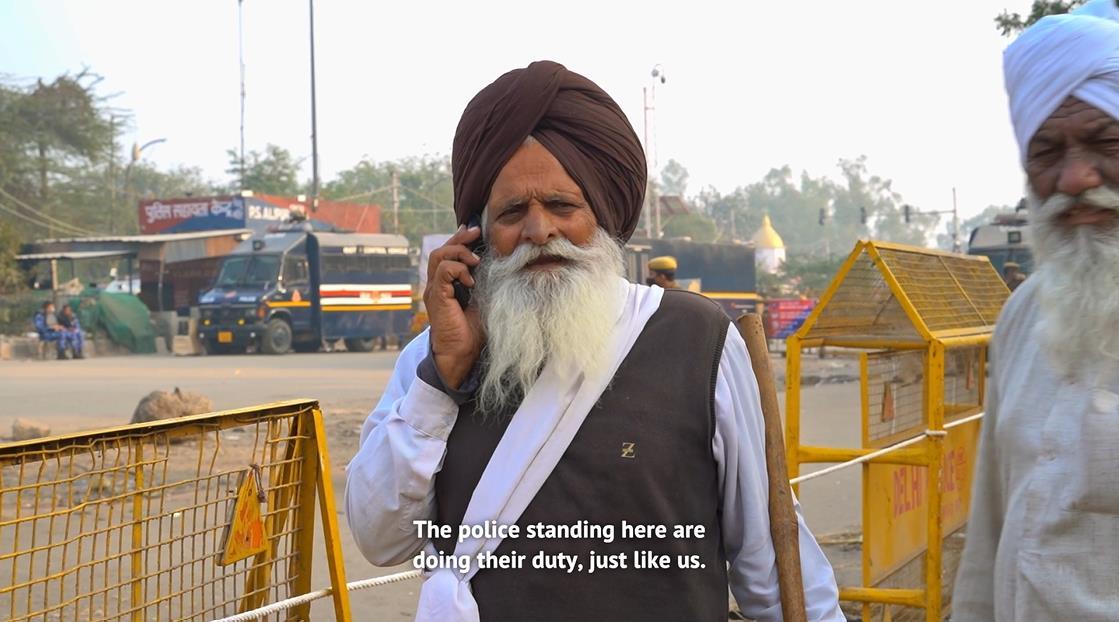
A senior farmer reassuring family members back home.
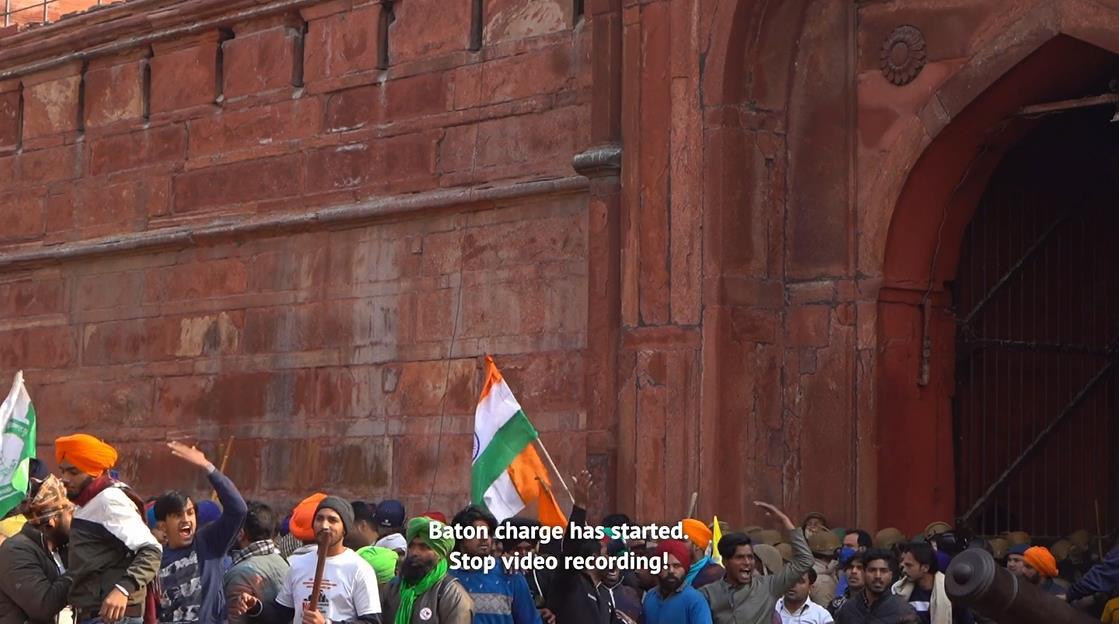
Minutes before the Republic Day parade that soon turned into an unprovoked lathi charge by the police, compelling Shekhar to stop recording and find a safe refuge.
Interestingly, the conversations that Shekhar manages to capture and chooses to include in the film range across an array of sociopolitical scenarios shaping up the country’s agricultural sector over the last decade. This covers issues from the Centre enacting farm laws that constitutionally fall under the State’s supervision to the farcical role of the WTO (World Trade Organization) in aiding pro-corporate agendas in the market, from analysing the nuanced difference between food grain and food stuff in an attempt to hit back at the government’s stance on misusing the Concurrent List provisions in implementing the farm laws to the fallout after the dismantling of the Mandi system in states like Bihar that has rendered thousands of farmers landless, helpless and under mountains of recurring debt. Given today’s rising instances of repeated attempts at the erasure of history and distortion of events, Chardi Kala anchors itself in its lasting potency as a future textbook that recorded, documented and upheld the multiple layers of one of the biggest grassroots movements of our times in the multi-faceted richness of the conversations and aspects of the current agricultural ecosystem that it tried to account for.
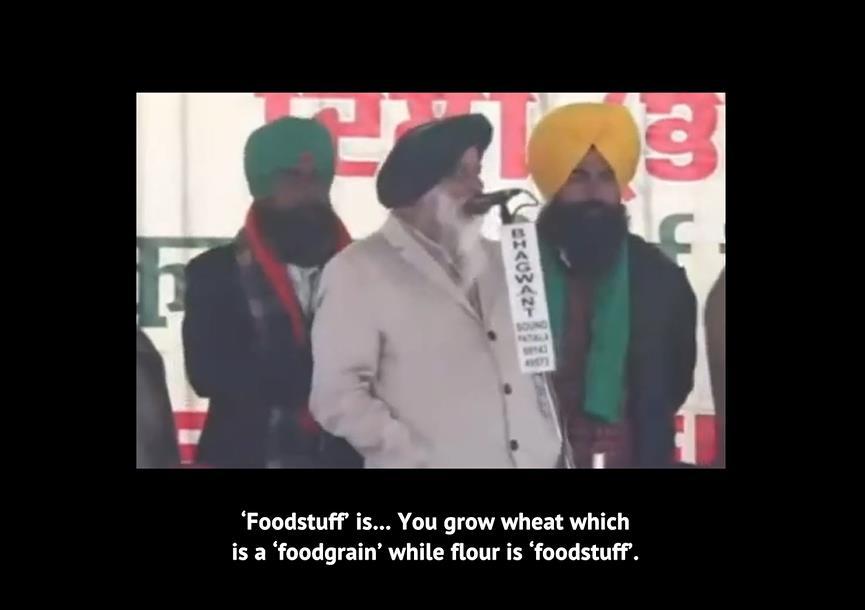
Explaining how the farm laws are unconstitutional and cannot be enacted by the Central government on food ‘grains’ as Entry 33 of the Concurrent List only deals with food ‘stuff’.
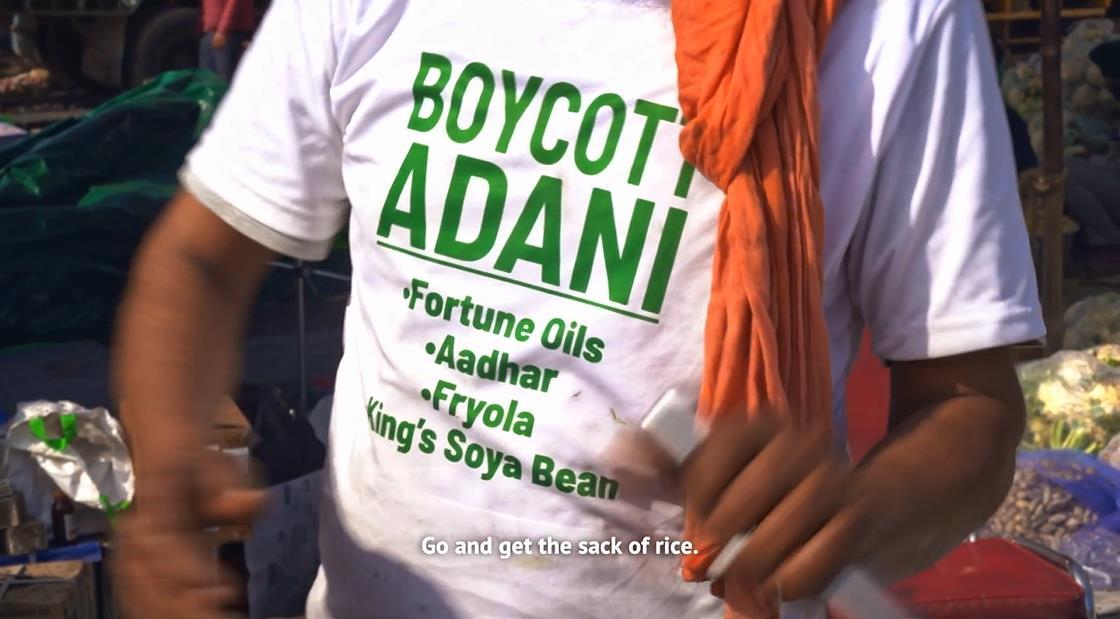
A farmer wearing a ‘Boycott Adani’ t-shirt while cooking food at the protest ground.
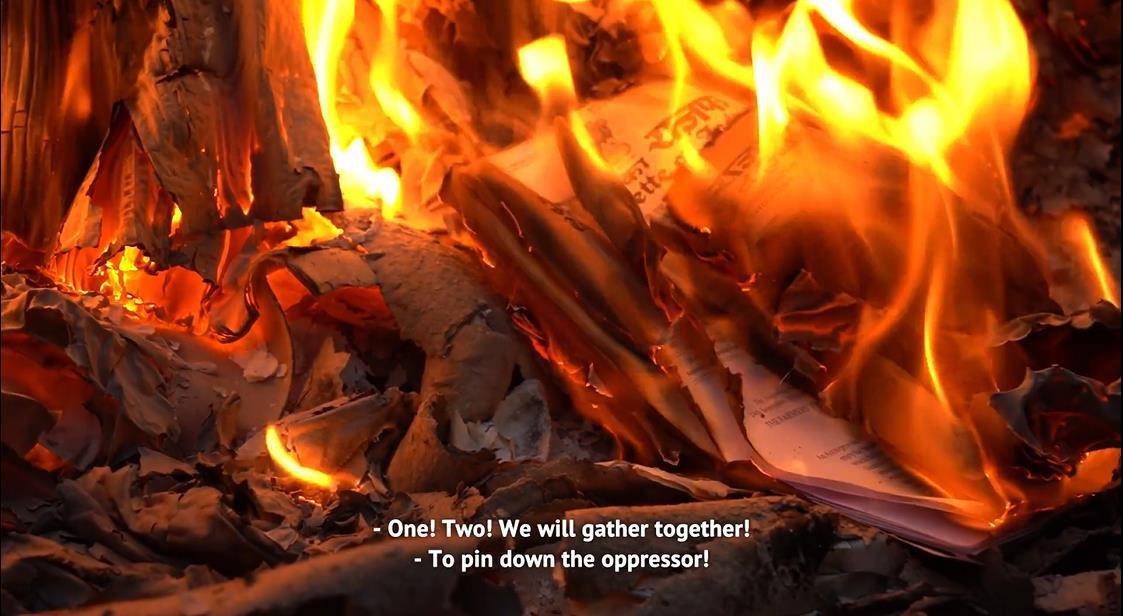
Burning copies of the unconstitutional farm laws during Lohri celebrations.
About a little more than halfway through the film, there is a disarmingly poignant scene of a few people trying to hold up a makeshift plastic sheet shelter cover above their heads as rain pours down heavily, with one of them breaking out into an impromptu rendition of FaridaTuriya Turiya Ja, the famous Punjabi couplet by Baba Farid, a twelfth-century Sufi saint and poet. The lyrics, despite their lost essence in translation, perhaps best encapsulate the spirit of the movement in a few words, if indeed that is possible. In its ability to archive the protest as a political episode and as a lived experience layered with emotion, labour and hope, Chardi Kala becomes less a film about protest and more a film about people—how they organise, how they serve, how they endure. It is a portrait of resistance built not on spectacle, but on solidarity; not on noise, but on nourishment. And in doing so, it becomes not only a record of what happened but a testament to what is possible when people come together, day after day, in pursuit of justice.
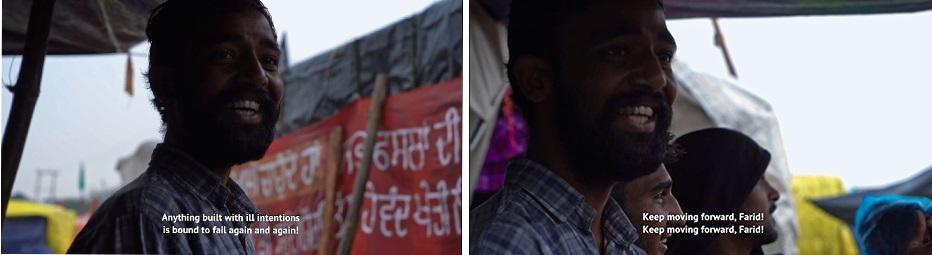
A young man sings FaridaTuriya Turiya Ja as the rain pours down on the protest site.
To learn more about films documenting the historic farmers’ protests, read Kamayani Sharma’s essay on Gurvinder Singh’s Trolley Times (2023) and Kshiraja’s reflections on Nishtha Jain’s Farming the Revolution (2024).
To learn more about the previous edition of Parda Faash, read Banhi Sarkar's essays on This Stained Dawn (2021) by Anam Abbas and Amid the Villus (2022) by Sumathy Sivamohan.
All images are stills from Chardi Kala (2023) by Prateek Shekhar. Images courtesy of the artist.