


“Strike Turns Violent”: Workers’ Protests in Noida
On 13 April 2026, workers across Noida’s (New Okhla Industrial Development Area) industrial belts took to the streets to demand higher wages, overtime pay and dignified working conditions, following a larger wave of labour mobilisation across the National Capital Region (NCR). Adjoining Delhi on one side and Uttar Pradesh on the other, Noida is one of the largest industrial townships in the country and houses thousands of corporations with their plants and factories. The uprising was triggered by the rising cost of living; gas shortages prompted by the US-Israel war on Iran; recent news of a minimum-wage hike in Haryana won through widespread protests in the neighbouring state; and the institutionalisation of informal labour by the new labour codes introduced in November 2025. As Anand Teltumbde notes in his essay, “Wages of Fury: Noida’s Wake-Up Call” (2026), the protestors asserted their right to “be treated as human beings rather than disposable units in the global supply chain.”
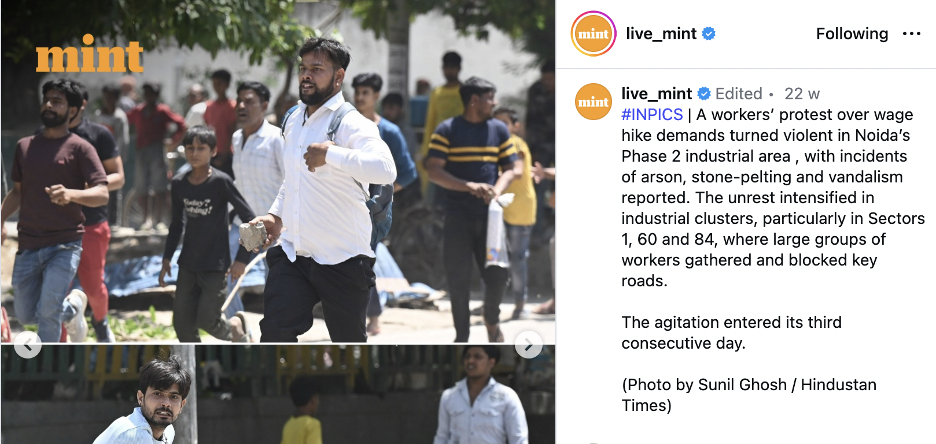
Unfolding over a few days, this protest came to be defined by a particular set of images that was being circulated by the media in their coverage. These included protestors hurling stones at the police who were dressed in riot gear; clouds of smoke billowing from torched vehicles; and workers spilling out onto wide-lined roads. It is this visual hegemony that depicted the protestors as disruptors and framed what was understood by the protest as having “turned violent.”
What, though, is the visual lexicon of violence and what is its threshold? These images that stabilise the meaning of these protests as violent seem to imply a break or disruption in an otherwise non-violent sphere. The protests reported no deaths and limited serious injuries. Most damage was to property and in clashes with the police. It is true that the protests were not violent; they were catalysed because of extreme dispossession and deprivation of workers who undergo routine structural violence and are victims of socio-political and economic injustice. And so, what forms of violence evade visual legibility? Given that the protests were promptly branded as a conspiracy, it is significant to read the visual forms that were ancillary to, or co-opted by, this narrative.

In “Reading an Archive: Photography Between Labour and Capital” (1983), Allan Sekula holds that there is a specific relationship between photographic culture and economic life—an observation resulting from his encounter with Leslie Shedden’s images made over a period of twenty years (1948-68) in the industrial and coal-mining regions of Cape Breton. The images of the protest in Noida emerge in an entirely different industrial-capital and media context, are produced by multiple people and do not have the historical character associated with an archive. Yet, they are similar to the images Sekula reads while thinking about how “photography works within everyday life in advanced industrial societies.” Thus, his framework remains useful for understanding the images of the protest from Noida and for situating them within larger contexts of labour and capital to allow for, as Sekula mentions, “an exemplary insight into the diverse and contradictory ways in which photography affects the lives of working people.”

Take for instance, a YouTube video titled Noida City | Emerging IT Hub In Delhi NCR | New Noida City | Noida City Drone View | City Impulse (2026), which positions Noida as a futuristic city in shaping; the highways here are lit up by a golden beam, the incandescence of which appears to be animating the infrastructure around it. It has the likeness of a technological charge that powers the landscape and enables its image as self-sustaining. Sekula argues that photography constructs an imaginary economy. The images produce Noida as a “world-class city”—a haven for corporate investment—while labour is represented in an excessively controlled manner, if not removed altogether. It is from this visual and spatial regime that the photographs of the protest emerge. It may, therefore, be useful to read the protest images alongside others which are embedded in its industrial rhythm.

Images are integral to how urban spaces such as Noida emerge from and are shaped by a nexus of private actors and the state. Formalised under the Special Economic Zones (SEZ) Act, 2005, they are designated as SEZs to promote economic and export-led activity by offering a range of incentives for domestic and international investment. However, the illusion of undeterred growth is necessary for the sustenance of such spaces. Thus, top shots showing technicolor-lit offices, cars sluicing along stretched highways, skyscrapers puncturing the skyline and billboards with smiling families against a verdant expanse are some commonplace elements that assemble a macro-image of Noida.

In these computer-generated promotional renderings, velocity, seamlessness and soaring economic prosperity is communicated in scale—what is already large becomes larger while the small, the hyperlocal and the contingent recedes. Many real estate developers depict in their visuals construction scenes in progress. For instance, a digital image by Supertech Limited visualises tower cranes jutting out from buildings as small silhouettes of building engineers look upwards. The composition directs our gaze vertically from bottom to top. The equidistant diagonal pattern on the cranes anticipates the uniform, tall buildings that will take its place. The embedded text reads, “An icon of India’s Urban Progress,” framing this image as a national ideal, inextricable from capital.
The industrial township thus circulates an aesthetic of cosmopolitanism tied to global capital and middle-class aspiration, which has become central to marketing India’s urban developments, to be “truly international.” This produces, as Christiane Brosius notes, an “enclaved gaze”—a mode of seeing that heightens pleasure in such aspiration and excludes disruptive elements from the frame. These images then, collectively, produce an affective register of the city that materialises its developmental imaginary.
.jpg)
The second part of this essay will trace why it is important to read images of the protest alongside this canonised visual regime that engenders them, even as the images themselves interrupt the narrative of seamless developmental progress that invisibilises the very workers who are subsumed into its machinery.
To learn more about workers’ protests, read Upasana Das’ two-part conversation with Debarun Dutta on his documentary The Delivery Guy (2025), which engages with South Asian migrants in Germany’s gig economy, Kshiraja’s reflections on Sara Saini’s film In the Wake of Remembering (2024) on the 1992 Burnsall Strike, and Sumaiya Mustafa’s two-part review of Samuvel Arputharaj’s Manjolai (2024) that looks at resistance struggles of tea-garden workers’ in Tamil Nadu’s Tirunelveli district.
To learn about artists exploring how landscapes are produced through the extractive gaze of the image and the image-maker’s own imagination, read Shweta Kishore’s conversation with Shaina Anand and Ashok Sukumaran on their project Bombay Tilts Down (2022) and A Photogenetic Line (2019), and other city cultures, Mehran Qureshi’s two-part reflection on two journeys to Kashmir—one by a seventeenth-century Mughal court poet and the other by a nineteenth-century British photographer, Ankan Kazi’s two-part essay on Peter Sutoris’ book Visions of Development: Films Division of India and the Imagination of Progress, 1948–75 (2016) and Nithya K’s documentation of the struggles of Puducherry’s fisherwomen against the Coastal Zone Management Plan that reassigns coastal commons for tourism development.