
Poetics of Fugitivity: Maha Haj’s Upshot
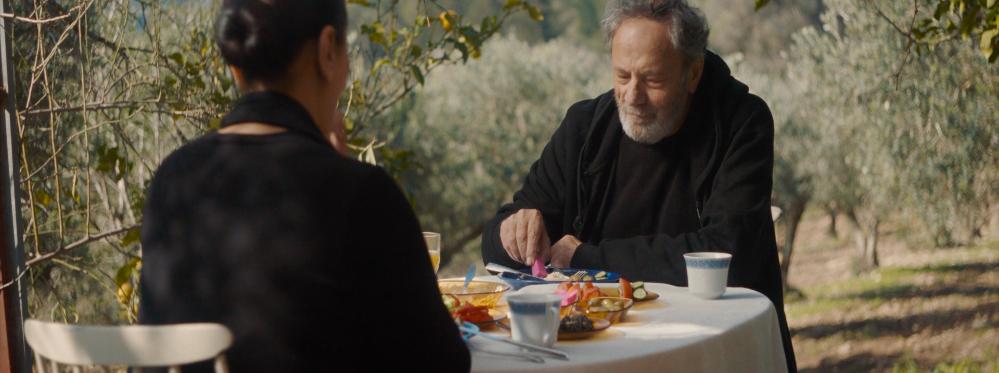
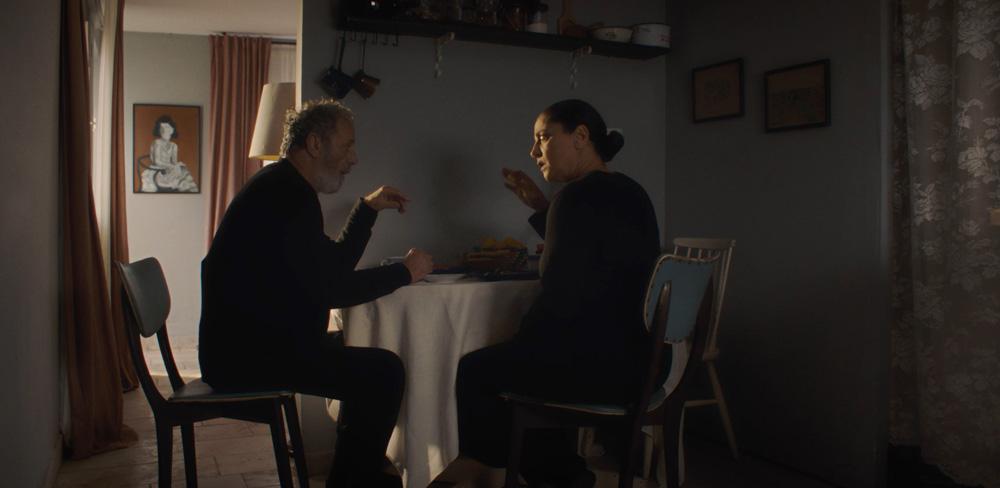
“In the future…somewhere,” Palestinian filmmaker Maha Haj’s recent film, Upshot (2024), opens amid a misty, hill-top terrain with a secluded hut surrounded by a grove of olive trees. Sheltered within this landscape is the solitary togetherness of the aging couple Suleiman (Mohammad Bakri) and Lubna (Areen Omari). Both spend their days tending the grove, maintaining a small chicken coop, gathering firewood and seeing to usual household chores. They work in silence and cohabit with a weary familiarity. And whenever they converse, they inform each other about the telephone conversations they have individually had with one or the other of their five children.
Haj has already proven her adeptness in navigating such taut, interpersonal dramatic scenarios over her last two features. Whether it be the curious bond between a suicidal writer and a petty criminal in Mediterranean Fever (2022) or the comically caustic relationship of an elderly Palestinian couple living in Nazareth in Personal Affairs (2016), sustained conversations—or even the abstention thereof—gradually untangle difficult revelations and repressed realities. In Upshot, screened as part of the curated programme ‘Sharjah Film Platform Montage’ at the Emami Art Experimental Film Festival (EAEFF) 2025 in Kolkata, Haj forges a somewhat similar narrative arc on a minimalist scale, albeit with a more grave emotional intensity than the ironic humour that characterises her previous work.
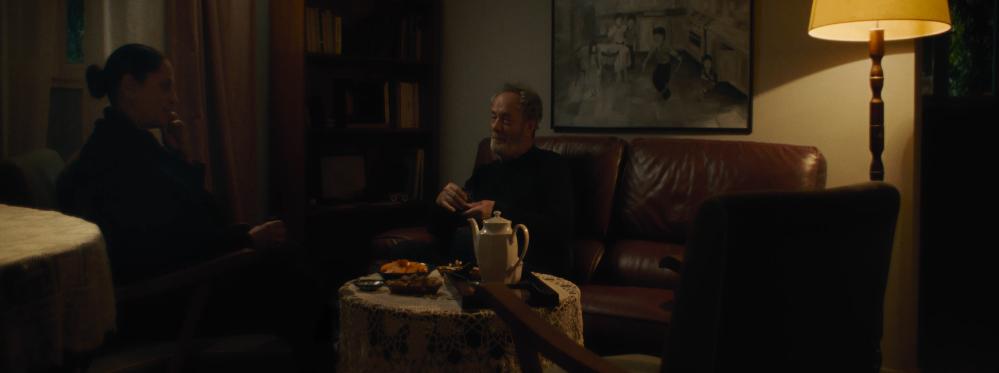
Suleiman and Lubna’s conversations are never without barbed edges. Past conflicts in the couple’s marital life resurface as they debate their children’s lifestyle and career decisions. Each of the children presents a peculiar concern that divides the parents. Suleiman, for instance, would go to any lengths to defend their thirty-four-year-old daughter Oumaya’s decision to obtain a PhD and travel the world instead of giving in to Lubna’s insistence on getting married. Lubna, on the other hand, remains quite defensive about their thirty-two-year-old son Hamza, whom Suleiman thoroughly disapproves of for being a Casanova. Through such exchanges, a bittersweet snapshot of the extended family materialises.
These familial contretemps, however, are not the reason that an air of quiet gloom and serene despondency hangs in the atmosphere. The gloominess is not overwhelming in its effect. It floats like dust, which, when the camera goes closer, settles in Suleiman’s ruffled hair, unkempt beard and weatherbeaten face, or in Lubna’s fatigued stare as she takes a stroll in the olive grove. Over recurring conversations, interspersed with extended periods of mute co-presence, the prevailing mood reaches a saturation point halfway through the film until a journalist, Khalil Haj (Amer Hlehel), visits them and interrupts their sequestered existence.
The third character’s entry in the film at once comes off as an intrusion in the couple’s world as much as it brings the narrative to a moment of devastating anagnorisis. Claiming to be a childhood friend of the couple’s eldest son, Khaled, the journalist declares how he has finally managed to find their remote farm after several years of scouting. He intends to write a story about the off-grid lives of Suleiman and Lubna, as they have been living “without mobile phones or internet” since tragedy befell them during an Israeli offensive in Gaza. What follows is a slow-burning disclosure of their unspeakable past, which dispels the fog of unbidden despair with the bluntness of recollected facts.
Though the drama takes place in a much yearned-for future, its excruciating impact stems from the ongoing occupation and genocide in Gaza. Haj started working on the script in June 2023, so to speak, before the onset of the current Israeli military onslaught. She was grappling with the cataclysmic psychological toll of living under heavily militarised zones, of families seeing their kin indiscriminately murdered, and of parents burying their children and of children grieving their dead parents. In a personal interview, Haj expressed how witnessing such harrowing incidents became ever more prevalent since 2008, when Israel intensified its military siege and imposed a total blockade on the movement of goods and people entering or exiting the Gaza Strip.
This blockade was a reaction to Hamas winning the Palestinian Legislative Council elections in 2006 and gaining a stronghold in Gaza the following year over the myrmidon, internationally backed Fatah government. After an armed face-off, a ceasefire deal between Hamas and Israel came into place in June 2008 to facilitate the reopening of Gaza’s border crossings. But the Israeli Defence Forces (IDF) violated it in November of that same year by raiding central Gaza under the pretext of a preemptive strike, followed by what it called Operation Cast Lead, which involved high-precision assaults on densely populated civilian regions for twenty-two days from 27 December 2008 to 18 January 2009. More than a thousand Palestinians lost their lives in this massacre, or, euphemistically, the First Gaza War, and its routine iterations by the IDF in 2012, 2014 and 2021.
In the film, the journalist refers to this historical continuity when he gingerly persuades the couple to recapitulate the brutal details of their traumatic past from the “years of Israeli invasions.” Haj started the film’s production in January 2024 after a few hitherto hesitant producers realised the renewed urgency of the story in the present and were keen on backing the project. The filmmaking process itself, as Haj recounted, was “cathartic” at a time when even showing solidarity with Palestinians in Gaza or mentioning the G-word, i.e., genocide, became a crime in the apartheid state of Israel.
For all their fact-checked analyses and expert opinions, journalistic upshots can hardly ever account for the intimate life-worlds of the people they strive to report about. In the glaring light of the intruder’s questions in the film, the couple’s reclusive haven turns out to be a mutually constructed ecology of mourning. The past is laid bare, and clarity kills the enigma. Yet Upshot is eventually a story about the poetics of fugitivity, about fiction as a constructive site for forgotten lives. Several questions linger by the time the narrative climbs out of its climactic passage: Can fiction be a bulwark against deeply traumatic yet irrefutable truths? If so, does it offer a restorative potential for healing?
In the writings of Fred Moten, Tina Campt and Saidiya Hartman, among others, ‘fugitivity’ has evolved as a contemporary analytic in Black liberation praxis. It is rooted in the historical context of marronage and other forms of resistance against transatlantic chattel slavery. But, besides referring to acts of physical escape, the framework of fugitivity also encompasses quotidian creative practices of refusal, denial and lithe disengagement from structures of racialised oppression. In other words, it entails the committed work of nurturing alternative spaces that upset processes of capture and control.
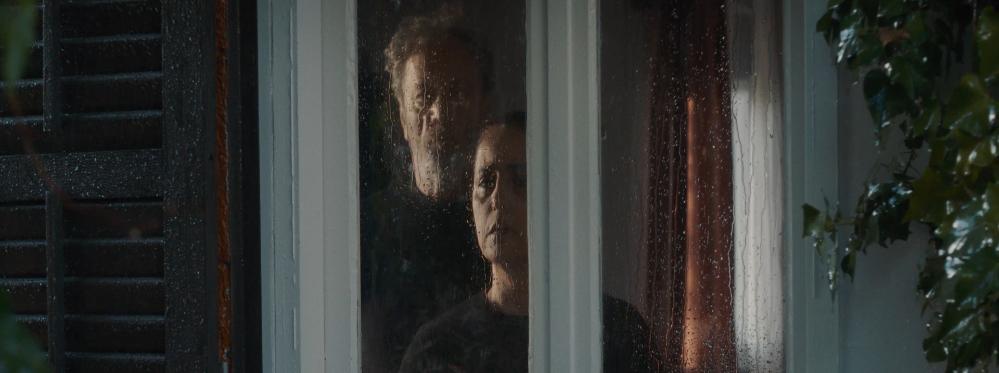
While Suleiman and Lubna spend their days as fugitives, away from superhighways of informational disregard, their internal, imaginative lives are where fugitivity as a mode of coping, noncompliance and refusal takes root. The space of fiction, as Upshot seems to suggest, can also be a reparative refuge for lost life-worlds that slip through the dehumanising streams of news headlines and death tolls. It is where fugitivity dons the task of world-making.
Haj is particularly attentive to the “sharpness of the Palestinian mind” that nurtures, hones and sustains restitutive fictions to rebuild lives in the face of the unbearable. Indeed, it is central to ṣumūd (صمود), a uniquely Palestinian ethic of “perseverance” and “steadfastness” through everyday acts, which emerged in the wake of the 1967 Six-Day War. In the closing minutes of the film, Suleiman, Lubna and the journalist, Khalil, wordlessly congregate over dinner at the dining table. An overhead lamp above them strains hard to dilute the darkness around them. “I forgot to tell you,” Suleiman suddenly begins, as if picking up a lost conversation with Lubna, “Khaled called, a little while ago…”
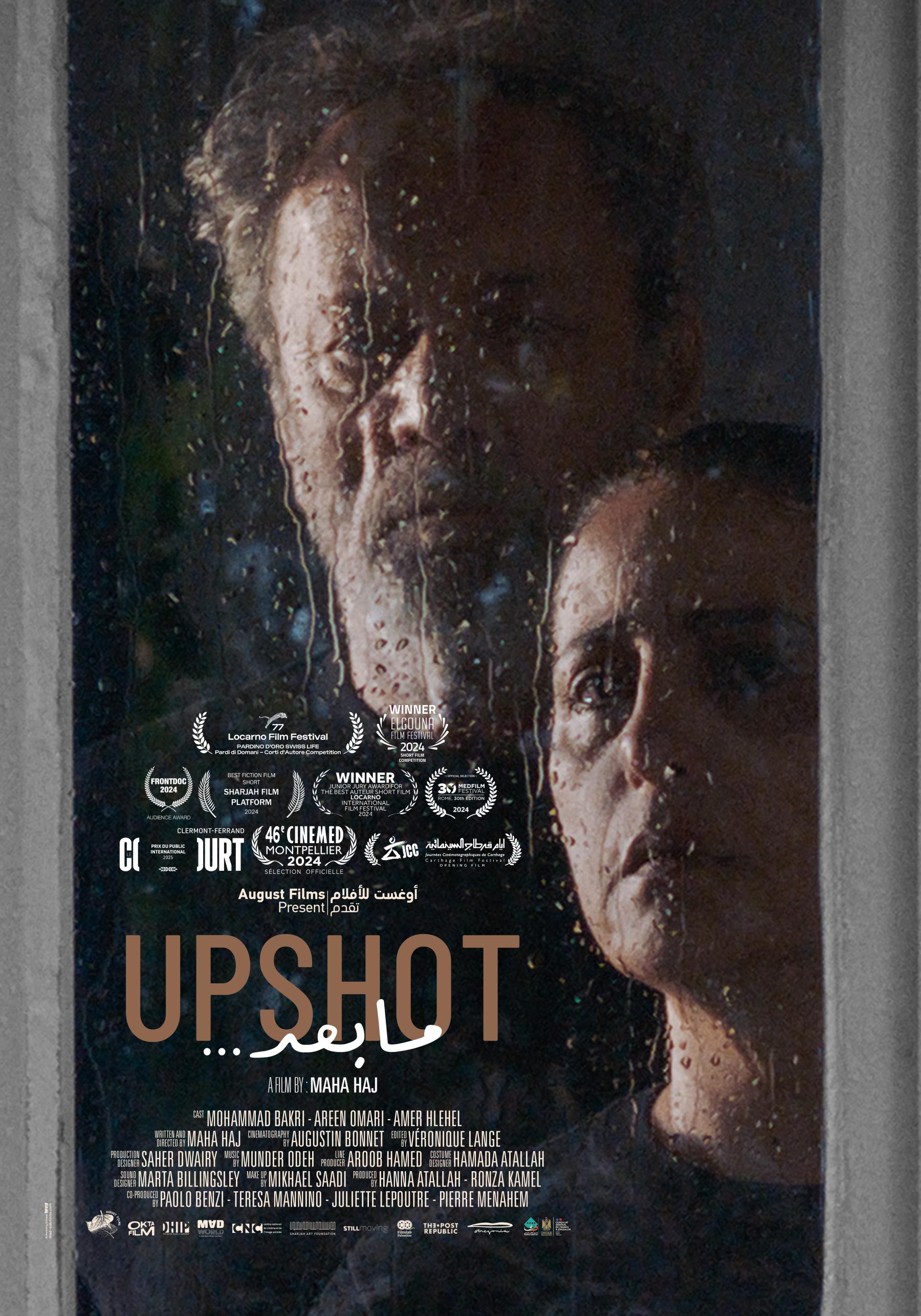
Upshot is being screened at the Emami Art Experimental Film Festival currently held in Kolkata from 11 to 14 September 2025.
To learn more about films screened at EAEFF 2025, read Vishal George’s reflections on Mohammed Jassim’s Bar Saar (2023) and Ishtayaq Rasool’s observations on Fileona Dkhar’s Ancestral Echoes (2022).
To learn more about films engaging with the genocide in Palestine, read Najrin Islam’s three-part essay on photography and filmmaking practices of Palestinian filmmakers, Ankan Kazi’s reflections on Abdallah Al-Khatib’s Little Palestine: Diary of a Siege (2021),
All images are stills from Upshot (2024) by Maha Haj. Images courtesy of the director and EAEFF.