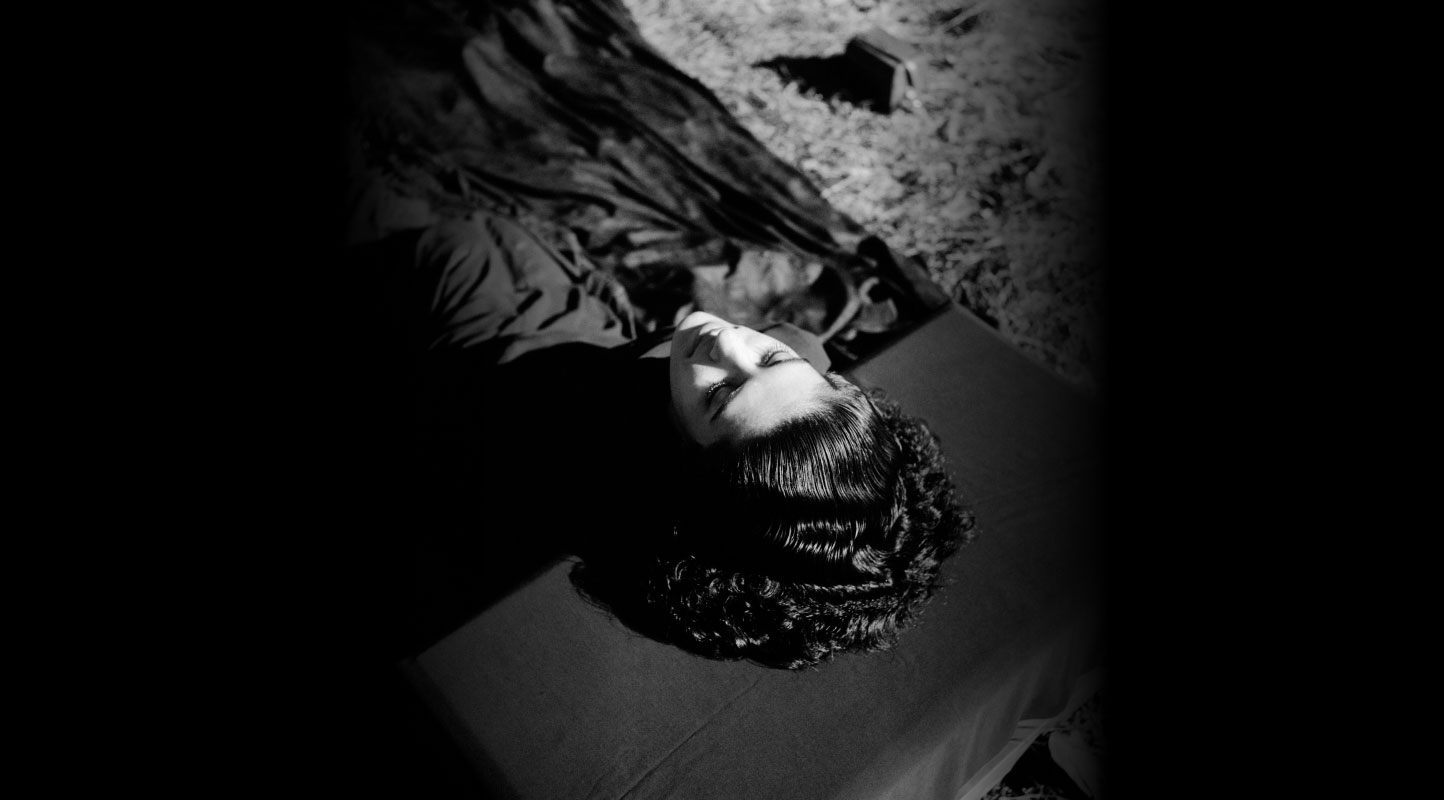


On Indigenous Sporting Cultures: Mohammed Jassim’s Bar Saar
Screened as a part of the Sharjah Film Platform (SFP) Montage and featured at the Emami Art Experimental Film Festival (EAEFF) 2025 in collaboration with the Sharjah Art Foundation, Mohammed Jassim’s Bar Saar (2023) is a short documentary on the Bahraini tradition of donkey cart racing in the Saar region. The father-son duo of Abu Ahmed and Ahmed mediate our access to this indigenous sporting culture. Their strained relationship provides insight into how difference is understood and expressed, across intergenerational participation in local traditions, to articulate the self.
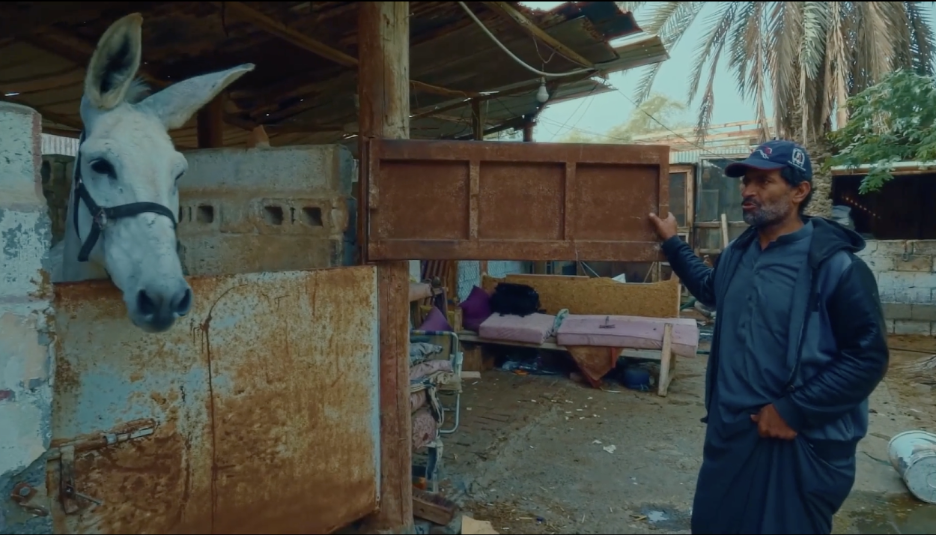
Abu’s charming personality is at its most effusive in the presence of donkeys.
The film’s subject—donkey cart racing in the Saar region—is framed by aerial shots of skyscraper-adorned Manama and footage of international sporting events such as Formula One and horse racing hosted in Bahrain. The opening sequence establishes the place of the local tradition in a small Bahraini community, alongside the very Western hegemonic sporting culture that signals the modernity of a nation on the global stage. Marianne Vaczi and Alan Bairner (2024) posit that looking at indigenous sporting cultures helps examine subaltern histories at the margins of hegemonical modernities, and are able to reflect and expound local narratives of the self. Such cultures provide a site within the fissures of the local, the national and the global, wherein identities can be explored and articulated as heritage in the face of subsuming forces.
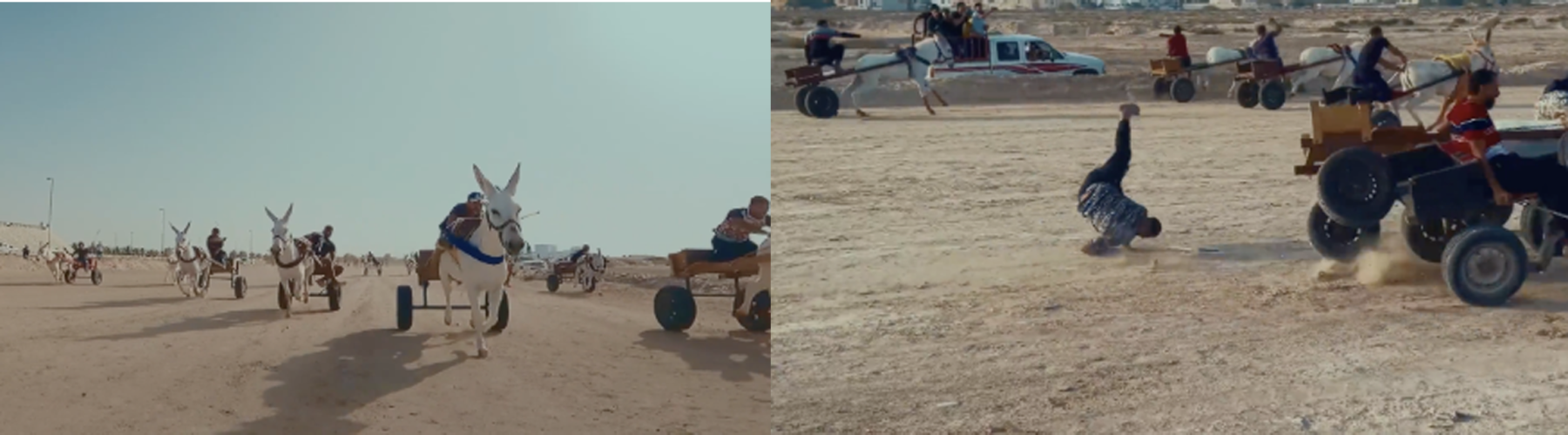
Action from the donkey cart races featuring multiple participants on a seven hundred metre long track.
Despite the film’s multiple references to donkey racing as only a hobby, it is raised to the level of sport by the passion of everyone involved, from fans to organisers and participants. A makeshift track by the side of the highway forms the venue for the sporting event. Abu Ahmed now acts as the main referee for the races in which his son often participates. Fans travel not only from nearby villages but also neighbouring nations such as Kuwait and Saudi Arabia to witness the free event every Friday.
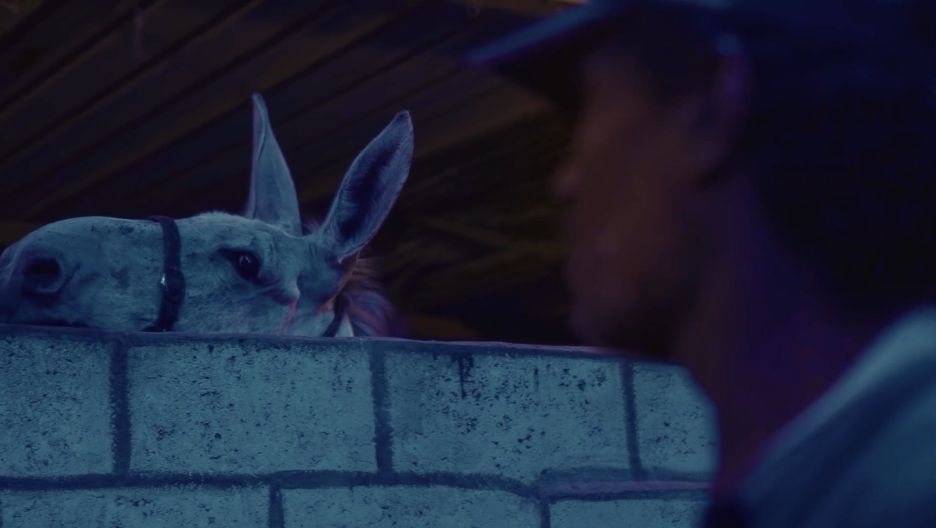
In one of the many striking visuals in the movie, a donkey stares at Abu and us.
The galloping donkeys, muzzled and harnessed to pull wooden carts by drivers armed with soft pipes to hit and direct them, leads one to wonder what they would have to say about their ordeal. Their unhappiness can be surmised in their return of kisses with bites. It is not hard to see why animal rights activist groups proclaim these races—amidst the justification of being a long-standing tradition—unacceptable. However, this conundrum is somewhat reconciled by the immense love that the film’s protagonists have for the animals. The charismatic Abu Ahmed is obsessed with donkeys and conveys it with abandon when discussing them, which is in stark contrast with how he talks about his son.
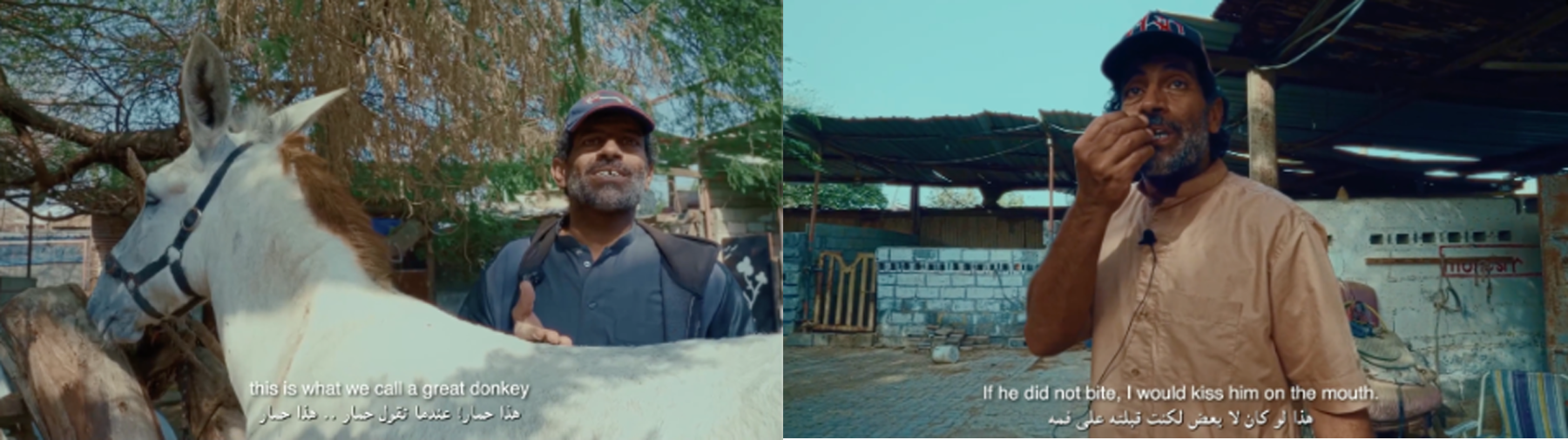
Abu Ahmed admires and gloats about his donkey.
Ahmed inherited the passion from Abu at a young age. The hobby offers an incessant source of conversation as well as friction between them. They spend their days surrounded by these animals, taking care of them and talking to them. Both father and son renounced meat because of their deep love for animals. Bickering over racing and donkeys forms the crux of their relationship, as is the case for many a father and son bonded through sports. Abu Ahmed insists that a cherished carriage will be his legacy, willed down through the generations in his remembrance, exemplifying how indigenous sporting cultures build roots within communities, thus encouraging the consideration of identity as heritage. Abu Ahmed’s love for the sport affixes his place in the community, as the race winners await his arrival to begin their wild celebrations. His son Ahmed would rather spend time on his phone reading, and training in the gym as he seeks an identity of his own.
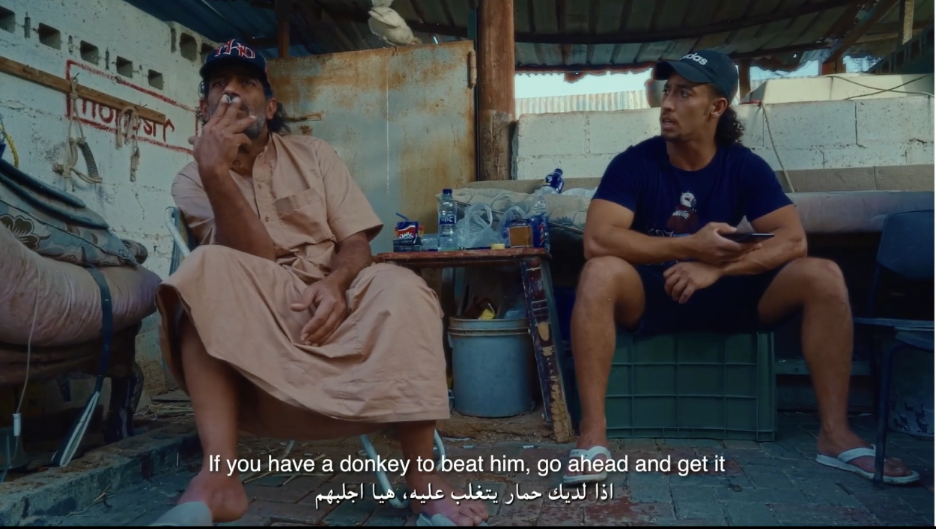
The tension between Abu and Ahmed in this squabble on donkeys and racing reached a boiling point.
The film contains elements common to the generic sports movie narrative: owners’ love and care for the animals, training and preparation before the day, father-son tensions boiling over, and adrenaline-inducing coverage of the races. However, the film refrains from plunging into genre cliches, refusing to construct a monolithic narrative that seeks to resolve the protagonists’ interpersonal strife. The racing is showcased around the halfway mark as opposed to the end of the film, directing our attention to the dynamics within the community built around this sporting culture of donkey racing. Jassim’s raw visual style exhibits no pretension—one sustained through mostly handheld camera work and unabashed zooming into the ‘action’—and helps support his claim of conveying reality.
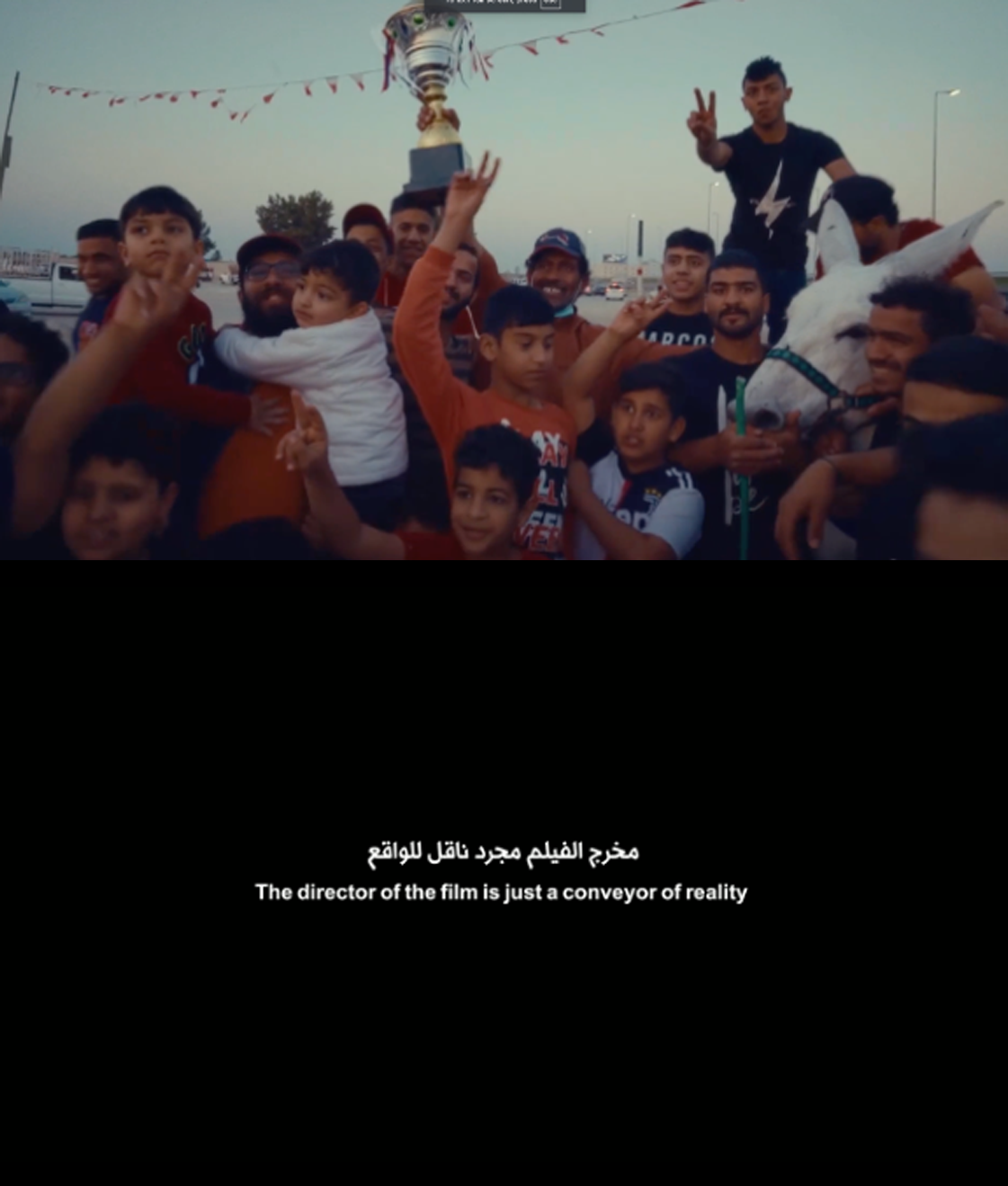
(Above) Abu celebrating with his winning donkey. (Below) A bold disclaimer by the director
In its short runtime, the documentary does not compromise on the culture’s multidimensionality, providing no easy answers to the various questions it hints at. Instead, the film invites us to rethink and decolonise the hegemonic knowledge claims of Western sports. As the film progresses, Ahmed refuses to ride a donkey and participate any more in the races. Between his love for donkeys possibly weighing on his conscience and his desire to grow beyond his father’s shadow, he never explicitly provides a reason why. Ahmed’s bright smile and vague deflections mask his true feelings from the camera and the people around him but imply a profound uncertainty bubbling beneath the surface that he reckons with. While he denounces his interest in participating in the tradition any further, he still finds himself unable to withdraw from his culture and community. Local traditions need not always be a vehicle to contest modernity, but nevertheless play an important role in the consolidation of identity of the self with respect to one’s community.
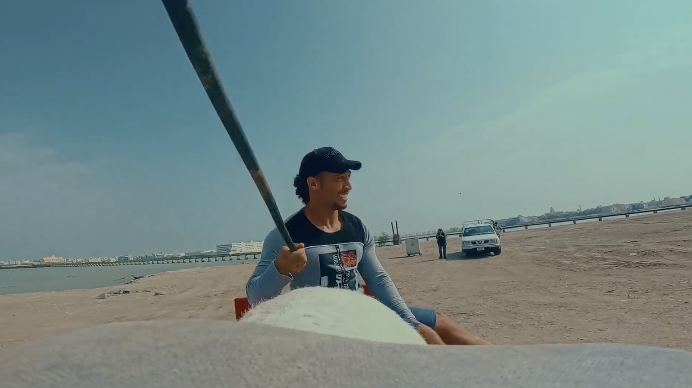
Ahmed demonstrates his skills in racing, using the stick in his hand to guide the donkey.
Bar Saar (2023) is being screened at the Emami Art Experimental Film Festival currently held in Kolkata from 11 to 14 September 2025.
To learn more about the films being screened at EAEFF 2025, read Ishtayaq Rasool’s reflections on Fileona Dkhar’s Ancestral Echoes (2022).
To learn more about sports and sporting cultures, read Sujaan Mukherjee’s essay on Bani Singh’s Taangh (2021) and his examination of a visual history of body building through the book Muscle Control and Barbell Exercise (1930) by Ghosh and Sengupta.
All images are stills from Bar Saar (2022) by Mohammad Jassim. Images courtesy of the director and EAEFF.