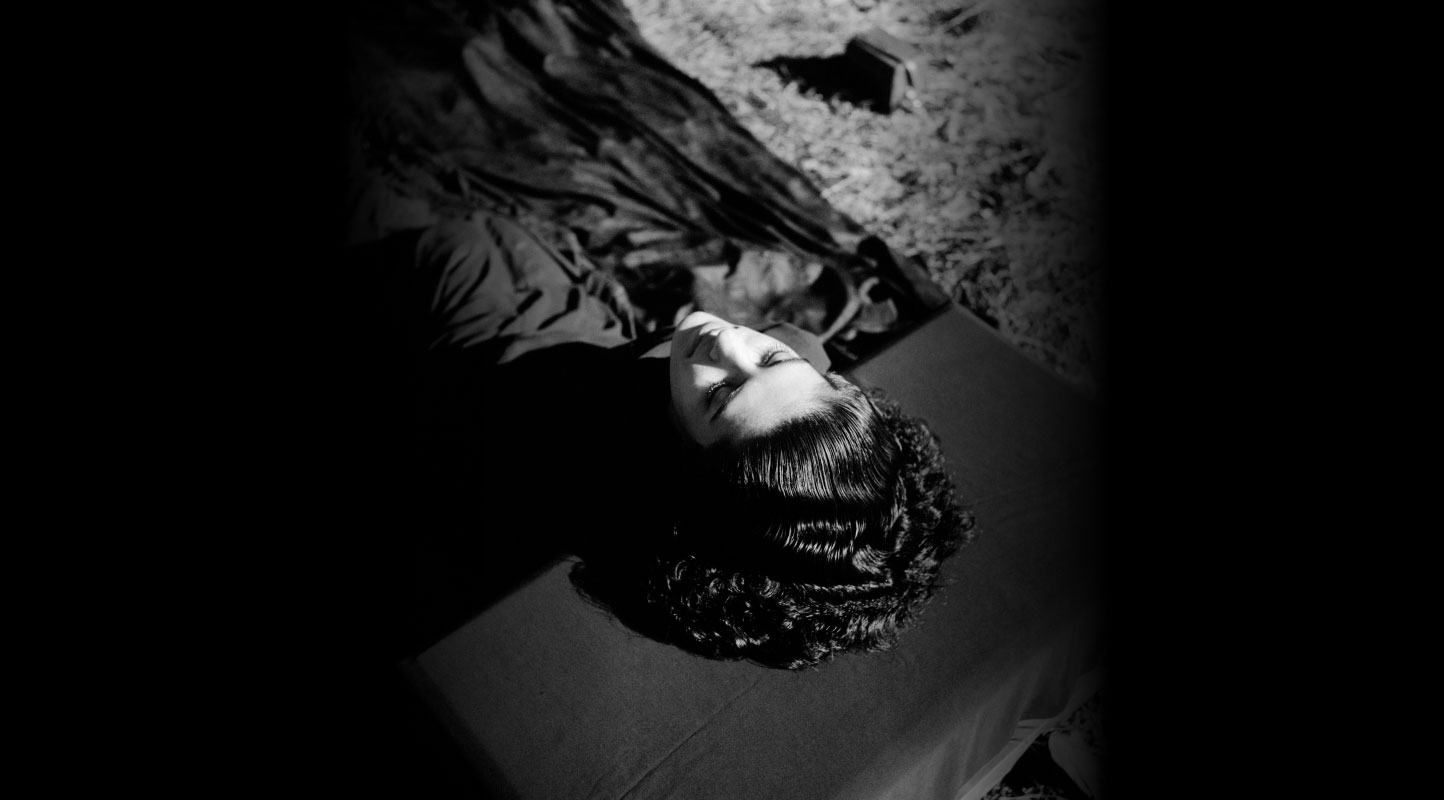


What would Zahir Raihan have done? Finding Raihan in Naeem Mohaiemen’s A Missing Can of Film
The first part of this essay delved into how Naeem Mohaiemen’s single-channel video A Missing Can of Film (2025) explores the mythical creation of the existence of Bangladeshi filmmaker Zahir Raihan’s missing can of 16mm film, and why a rumour—that the Pakistan army or Biharis harmed Raihan—became necessary to explain Raihan’s disappearance, given that many new Bengali political forces, fighting for dominance in newly independent and unstable Bangladesh, might have done the deed. Mohaiemen does not recall if the historian-journalist and left activist Afsan Chowdhury—who first mentioned to him about the rumour of a missing film which Raihan was thought to have produced while he was in Kolkata sometime during Bangladesh’s Liberation War of 1971—spoke about it with a great deal of conviction; “But for a while,” Mohaimen remarks, "It made me imagine I would find it and I did try.”
In Mohaiemen’s short film Rankin Street 1953 (2013), he finds a box of his father’s negatives behind a set of books. The negatives were packed tightly against each other like a bunch of sardines in such a way that at least one photograph was getting twisted. It was a strange way of storage, as Mohaiemen observes in the film, and one can imagine Raihan’s rumored missing film almost similarly shaped and stuffed in some tin of flour, lying somewhere as inconspicuous.
1.jpeg)
Mohaiemen ended his search upon realising that if Raihan's film was indeed politically charged, the many anxious forces inside this new country would have probably found it already, if it existed. Therefore, the title of Mohaiemen’s film and its cause to exist are deceptively self-fulfilling—not for him but for those who believed in the post-1971 nationalist image and collectively created a MacGuffin (an irrelevant plot device that drives the narrative), to make sense of a death forty-five days after the 1971 Liberation War ended. The first post-liberation Bangladesh government was sworn in on 12 January 1972, and twenty days later Raihan would leave for Mirpur, after a phone call informing him that his missing brother, Shahidullah Kaiser, was there.
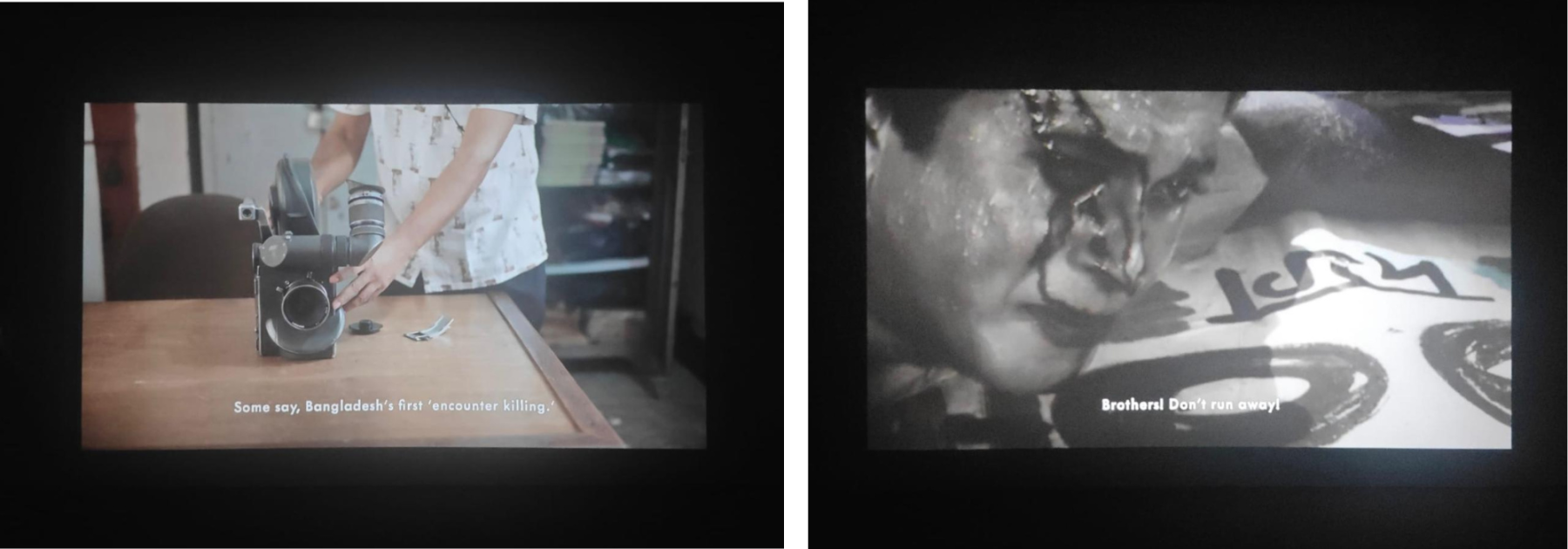
Many who watched the film in Bangladesh asked Mohaiemen about a certain closure to Raihan’s disappearance from Mirpur—of which other narratives seem to conjure up different versions. In his biography of Raihan, film writer Chandi Mukhopadhyay notes how the police informed Raihan about the presence of the Pakistani army in the area where he was going. Another scenario is emphatically voiced by then army officer Moinul Hossain Chowdhury in his book, Ak Generaler Nirob Shakkho: Shadhinotar Prothom Doshok (The Silent Witness by a General: The First Decade of Independence, 2000), about how a group of Biharis attacked the platoon as they attempted to search for missing people in Mirpur the very same day—as reiterated in a now archived article by the Bangladeshi newspaper The Daily Sun.
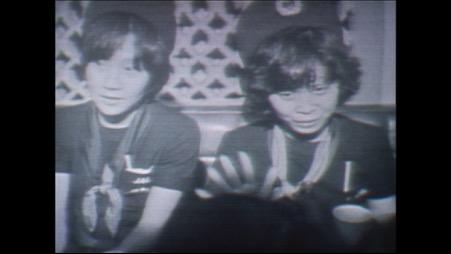
In Afsan's Long Day (2014), Mohaiemen notes how it is easy to mythologise historical figures as they remain distant and shrouded in mystery, carrying the hopes of young leftists, who retell fables riddled with the problem of invisible witnesses and conflicting accounts. These male icons shapeshift into towering mammoths bearing the burden of singlehandedly creating communist governments and fragile solidarities while they themselves collapse “dragging down entire communities in their flailing masculinity.” One such figure is Osamu Maruoka, who was a member of the New Left militant group the Japanese Red Army (JRA), and desired to overthrow the Japanese government. Banking on hopes of leftist solidarity from the “populist” government of Bangladesh to achieve his demands seamlessly, he hijacked a plane en route from India to Japan. However, Maruoka, thinking that the ruling regime in Bangladesh was popularly elected, did not realise that Bangladesh was now governed by a military government that had arrested the very leftists who had hoped for collaboration in governance—solidarity was seemingly a mirage.
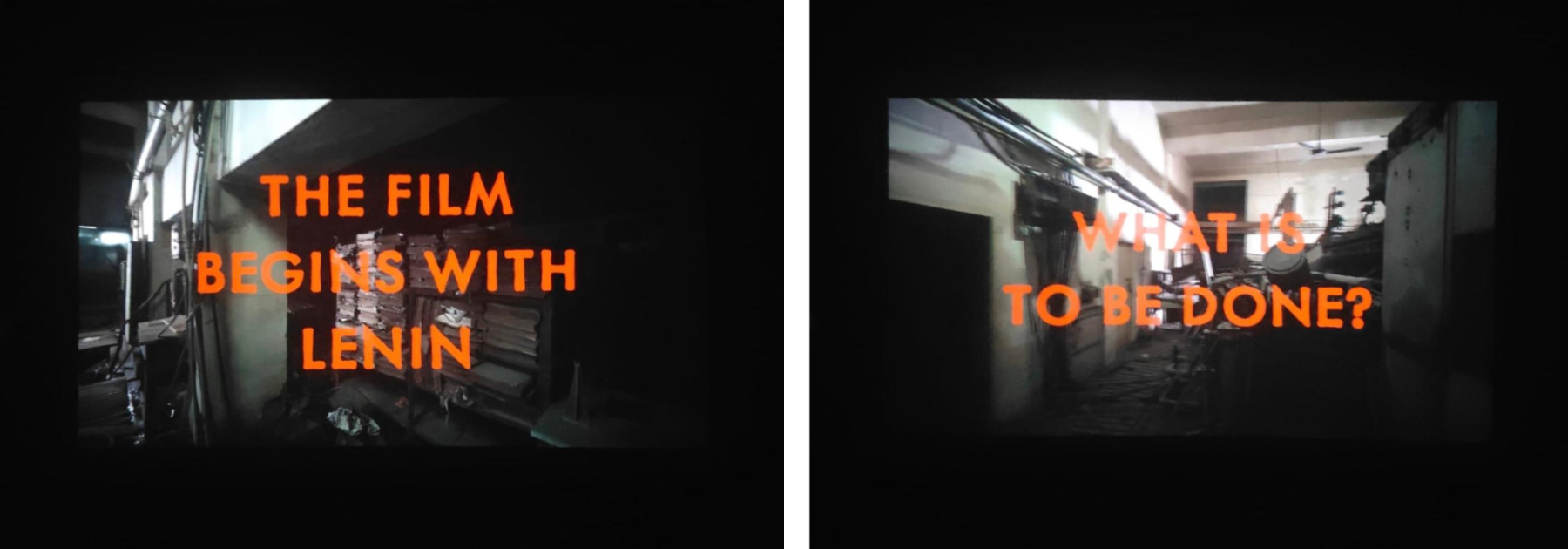
Therefore, Mohaiemen focuses on the contradictions inherent within such vaulted pictures painted by both sides; for Raihan, it comes in the form of state’s non-reconciliation with his Urdu films that lie without restoration in the State Film Archives, with poor copies circulating online. The government institutions in Bangladesh followed the state’s prioritisation of Bangla over Urdu, decades after the Bhasha Andolon (Language Movement) which demanded Bangla to be considered the official language in East Pakistan. After the 2024 student uprising in Bangladesh, Mohaiemen films the empty staff-less grounds of the Bangladesh Film Development Corporation (BFDC), whose walls are whitewashed in attempts to remove its red graffiti, which nevertheless still comes through. Silence reigned in a building enshrined to the spirit of Raihan—whose image is located alongside a portrait of Satyajit Ray, placing the two stalwarts of Bengali cinema across borders in a creative continuum, with no thought towards the fact that the leftist positionalities that form the core of Raihan’s work would align him more with Ritwik Ghatak than Ray.
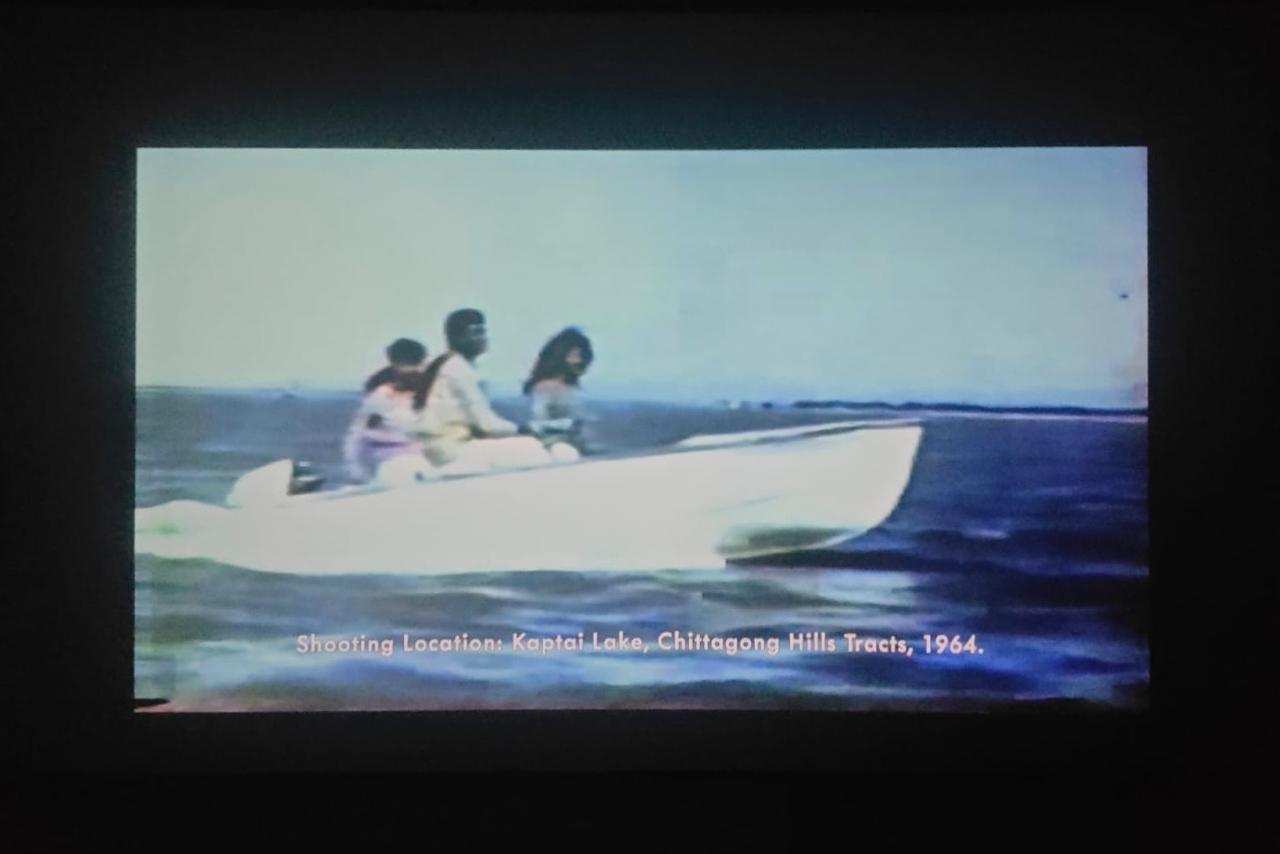
A gaze of criticality is also turned towards Raihan for filming Sangam (1964) on the Karnaphuli River that had just seen the completion of the Kaptai Dam project by the Pakistani government—financed by the United States (US)—which displaced thousands of Jumma Peoples from the Chittagong Hill Tracts. In the scene, a few figures move forward in a speedboat on the river, following the visuality of Raihan’s highly commercial Urdu films. How does one reconcile the contradictions within Raihan’s practice itself? Mohaiemen wonders what Raihan would think of the fresh hopes from the student uprising today—the situation already having changed swiftly with women activists being pushed out of the national movement, around the same time that Mohaiemen first showcased A Missing Can of Film at the Kochi-Muziris Biennale 2025-26.
Some catalogues of books are also laid out in the gallery—two of them real, coming from the wishlist of terminal cancer diagnosed-Maine resident Karen Wentworth, who accessed the state’s Death with Dignity Act (2019) and another imagined one that speculates how a Bangladeshi doctor might have sought refuge amidst an intense loneliness in Libya, even in the face of Muammar Gaddafi’s pan-Islamist Ummah (global religious community) dreams. The act of reading—sometimes shared—and long lists of books with well-worn pages or rendered in line drawings return in Mohaiemen’s work, almost as footnotes of historical phenomena, blown up in his characteristic method.
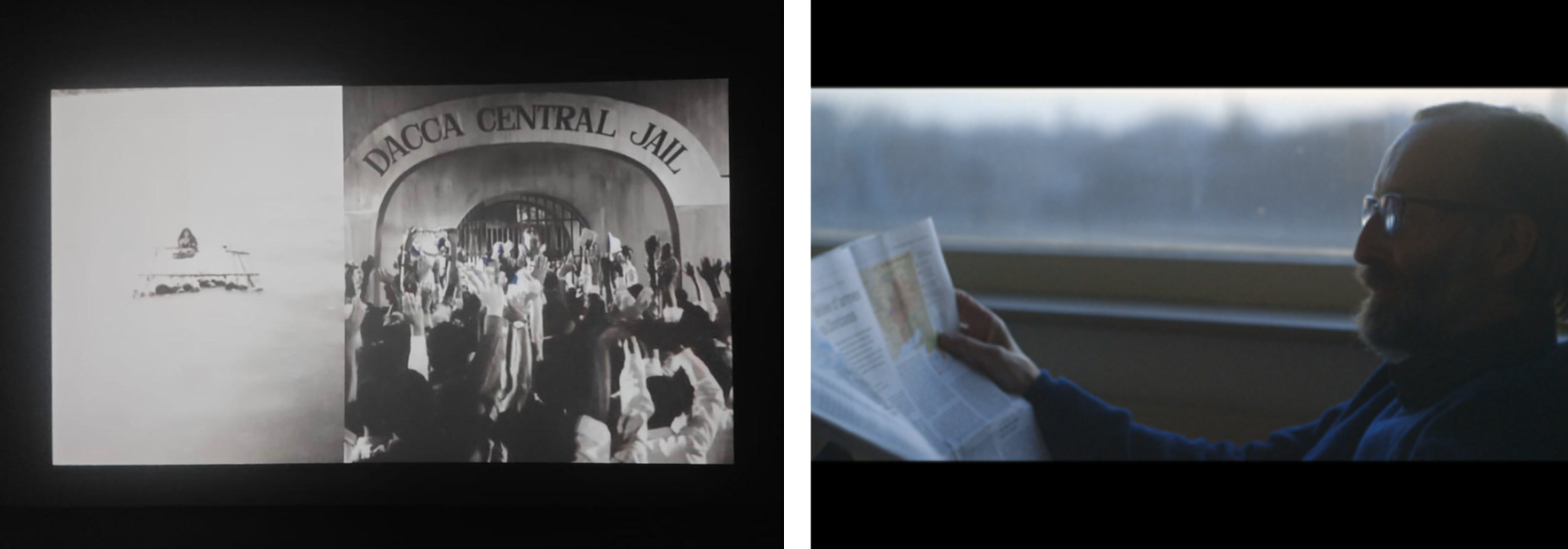
Left: Still from Naeem Mohaiemen’s A Missing Can of Film (2025) screened at Kochi-Muziris Biennale, curated by Nikhil Chopra and HH Art Spaces. (Kochi, 2025-26. Image courtesy of the artist and the Biennale. Photograph of the installation by Radhika Saraf.)
Right: Still from Naeem Mohaiemen’s Last Man in Dhaka Central (The Young Man Was, Part III, 2015). Image courtesy of the artist and Shobak Studios.
In Mohaiemen’s film Last Man in Dhaka Central (2015), well-read pages of the Bangladeshi writer and political historiographer Mohiuddin Ahmad’s book, The Rise and Fall of JASAD: Politics of a Turbulent Time (2014), are turned by Peter Custers, the latter being part of an underground Maoist group that was ousted before they could take action. Perhaps by juxtaposing these reading acts alongside the film, Mohaiemen asks the same question of how Raihan, had he remained alive, would situate himself within the various nationalist projects—which arrived one after the other—and how he might have lived amidst those who had survived, such as Chowdhury or Custers, “spend[ing] their waning days in solitary apartments, writing down memories” and reading. However, Mohaiemen would rather veer on readings of hope, and by engaging in an act of imagination, perhaps a different language of writing and working from the remnants of Third World internationalism could emerge.
In case you missed the first part, read it here.
To learn more about artists exploring the contemporary socio-political landscape of Bangladesh, read Adil Manzoor’s review of Jafar Muhammad’s Pankauri (2025), an online discussion by ASAP | art with Munem Wasif, Sarker Protick, Tanvi Mishra and Vincent Hasselbach on Chobi Mela International Festival of Photography 2026, Shahidul Alam’s mapping of recent youth-led resistance against undemocratic systems in Bangladesh and Ankan Kazi’s essay on Wakilur Rahman’s photo-series Censored Image (2015–) and Dilara Begum Jolly’s Amorar Akhyan (2015).
For more insight into artistic practices tracing Partition and the historical relationship between India and Bangladesh, read Rahaab Allana’s conversation with Sarker Protick on his exhibition Nirobodhi/Till Time Stands Still (2022), Silpa Mukherjee’s observations on disco music, diaspora and the presence of a new Islamicate in Bombay cinema in 1970s-80s, Ankan Kazi’s essays on Kasturi Basu and Dwaipayan Banerjee’s documentary A Bid for Bengal (2021) and an online conversation by ASAP | art on films addressing The Partition and communal violence in Eastern India, Niyati Bhat’s review of Samarth Mahajan’s Borderlands (2021), and Senjuti Mukherjee’s conversation with Suchitra Vijayan on her book Midnight’s Borders (2021).