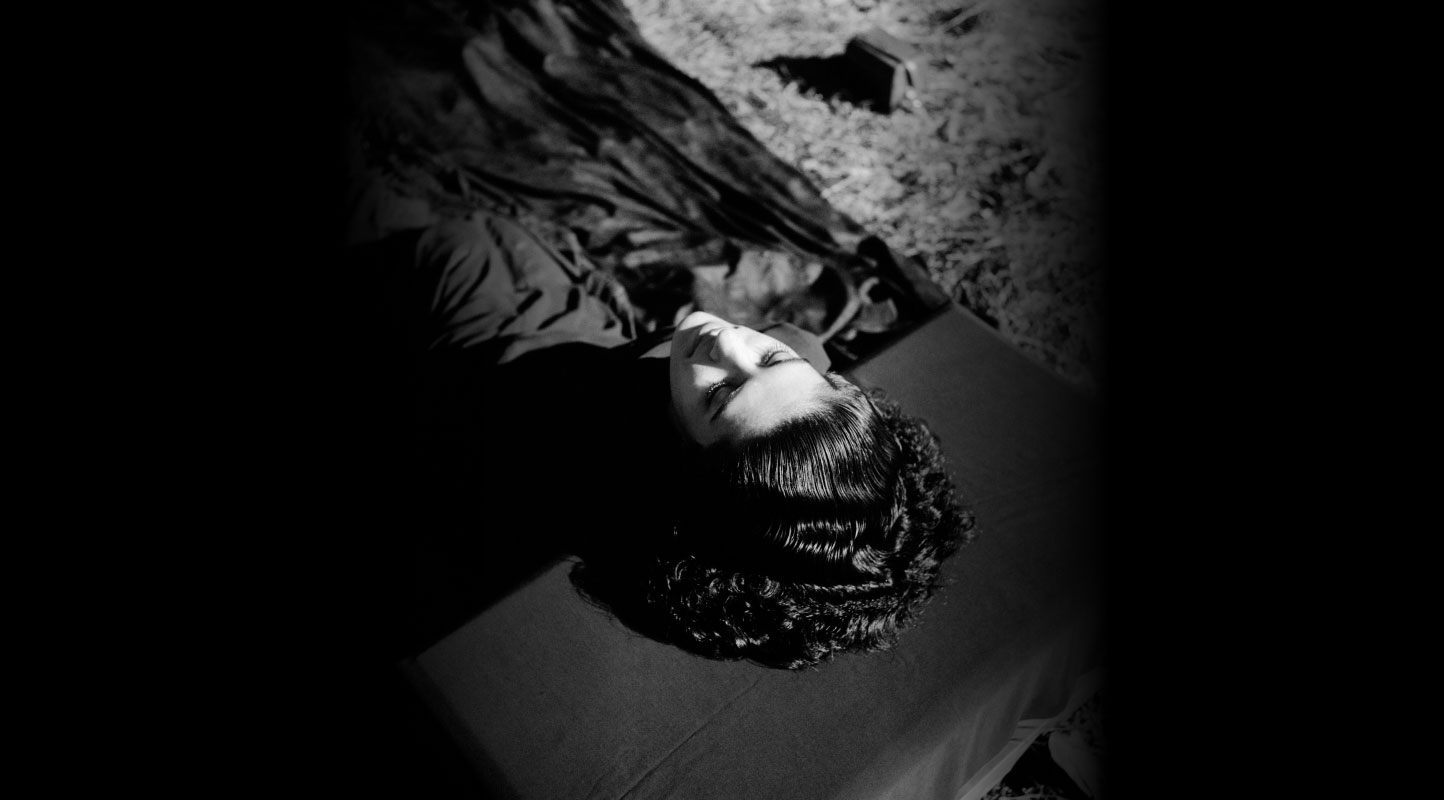


Zahara Batool’s Invisible Threads: Weaving, Belonging and Women’s Labour in Kargil

Pashkum (Kargil)-based artist Zahara Batool speaks about her textile project Invisible Threads (2026), asking who is invisible and what binds them together? To explore these inquiries further, I visited her site-specific installation in Hunderman, Kargil, where twenty-one women artisans, who are members of local self-help groups, intently work their afternoons away with red, black and white threads. They weave complex traditional patterns, motifs resembling everyday objects, traditional jewellery, apparel on jute tapestries and woollen carpets, knitting extensions of their fast disappearing intangible heritage. As they sit in a circle under an apricot tree, cups of gur-gur cha (salted butter tea) are passed around, lunch is a daily shared ritual, and the hours spent weaving strengthen the bonds between the women—bonds that may be invisible but have stood the test of time.

As an “Above 3000 metres” Royal Enfield fellow, Batool exhibited this installation as part of a larger constellation of artworks at the sā Ladakh Biennale, held from 01 to 10 August, 2026 at various locations in Ladakh. In this expansive display across 230 kilometres and eight sites, nineteen international and Ladakhi artists worked under the theme, “Signals from Another Star,” guided by the curatorial vision of Vishal K Dar and Associate Curator Tsering Motup Siddho. Here, Batool’s Invisible Threads takes the form of a field of signals, foregrounding attentive practices that engage with the land—its memory, weather, trade routes, communities and histories. The project aims to speak about the invisible labour of women in conserving and continuing a cultural practice that faces the threat of extinction due to increasing technological advances in textile production, with a focus on quantity instead of diligence or artistry. In doing so, it attempts to reverse this hierarchy, foregrounding the makers, their knowledge and their relationships with the craft.

For Batool, one of many sources of inspiration is the Japanese artist Chiharu Shiota, who weaves kilometres of black, red and white yarn into immersive installations that negotiate with memory. In Japanese culture, red threads symbolise blood and the continuity of fate; Shiota defines her black thread as signifying the cosmic dark and the white as symbolising life. In Batool’s hands, the same threads take on different meanings—of the women’s grit, labour and artistry in their work, itself produced through their everyday lives. At the core of her artwork then, Batool claims, lies an accountability to render this invisible effort visible. During harsh winters in the region, this art, which existed as a collective tradition in communities, possessed the power to bring the community together through knowledge production and skill exchange; however, it was mostly considered part of the inner sanctum of the household, rendering it unseen. With Batool’s project, the craft evolves into a strong statement of these women as independent, thriving entities who have strong voices in their households even as they maintain their inherent kinship with a practice that runs through their blood, veins and swiftly moving fingers.

An artisan from Batool’s team, Zehnab Khatoon, provides a more historical perspective on knitting traditions; speaking about learning to weave and knit from her api (grandmother) and mother, she mentions that “weaving has come as easily as breathing” since they were children. It is a community activity that begins soon after the Ladakhi New Year, Losar, and continues during the long intense winters spanning over six months, during which all the women in the community gather to weave pherans, suits, blankets, carpets and other woollen garments. Khatoon recalls exchanging weaving knowledge with her playmates, learning specific techniques from those who were skilled at a certain pattern, testifying to the shared spirit of Milaak—a traditional system of collective labour—where every possession and speck of knowledge is owned not by a person but by the community. Perhaps this is the invisible thread that ties the generations together and has taken the physical form of knitted pieces and woven patterns in Batool’s installation. Throughout its expanse, Batool’s work then feels like a piece of contemporary history that excavates deeply rooted practices of the past and immortalises them in the form of art.

What sets apart the “responsive” element in this biennale, in contrast with the general definition of site-specificity, is that each artwork forms an ongoing dialogue with Ladakh’s ecological or cultural history by incorporating community memory in the methods of both Ladakhi and international artists alike. They treat these sites not as passive backdrops but as evolving environments, which are made visible in the making of the works themselves.
Besides Batool, Stanzin Tsepel reflects on a retreating glacier through the art of balancing rocks and local weaving techniques in Traces of Flow; Stanzin Samphael remembers lost and interrupted grazing routes using waste material from a marble carving factory; Tashi Namgyal retells local myths of a rainbow bursting open; and Stanzin Wangail reimagines the enchantress like female spiritual entity, Manmo, through Ladakhi headgear encrusted with turquoises, locally called perak, which works as an exclusive female banking system passed on from mother to daughter. Alongside these Ladakhi artists, projects by international artists operating in the same register of cultural and ecological memory include Shupiwe Chongwe’s earthen vessels in Likir honoring the local pottery traditions; Studio Eidola’s Ground Control, a speculative protest against lithium mapping on grazing grounds and Tom Mùller’s Thriin/Karsi, which honours the yearly lime-washing practices at Basgo.
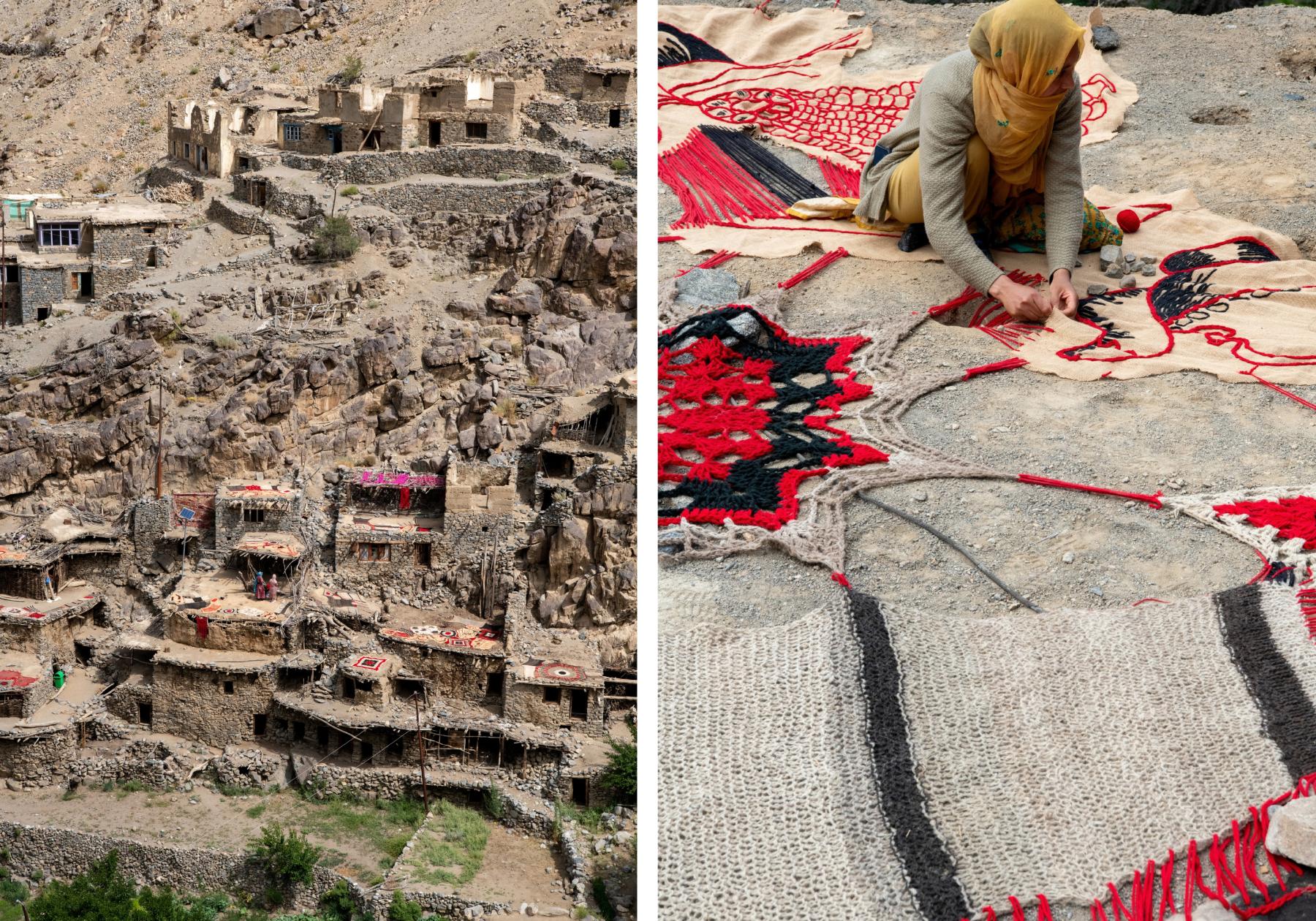
Right: Different patterns of traditional Ladakhi weaving, including Challi. Photograph by Saurabh Suryan.
In conversation with works by other artists, Batool’s Invisible Threads feels part of a synchronised vocabulary through which Ladakh can be remembered. Following sā Ladakh’s spirit of meditative dialogue with and deep remembering of place, her installation incorporates the traditional Challi pattern of white and black sheep wool, sometimes even taking on a more experimental direction through the portrayal of jewellery, apparel and utensil pieces—including tomar (a traditional headpiece worn by women), brangshil and gurga (women's jewellery), sulma (traditional women's dress), phailoo (woollen blanket), mugur (vessel for drinking), phaphor (container for storing barley), samvar (kettle for chai or pink tea), chukar (vessel for carrying water from the river) and thavou (two-handed kettle made of brass or copper)—on the textile. Batool initially imagined Invisible Threads as an installation where interwoven threads emerge from kitchen windows and take over the entire structure of a house—the kitchen being the most important room of any Ladakhi household, it signifies a space for shared warmth and is a site for women’s labour. However, her artwork evolved to sit on the roofs of abandoned houses of Hunderman village. The choice of rooftop as a site pays homage to their local functionality as they are commonly used for the traditional practice of drying golden Halman apricot, a famous cash crop of the region that empowers many households through its harvesting, conservation and processing.

As a frontier, Hunderman is a complex landscape and has to negotiate its identity against the popular online definition of a “ghost village” since its residents, being displaced, had to abandon the village and migrate to Pakistan during the 1971 revision of the LoC (Line of Control). And so Batool’s tapestries cover the roofs of a living museum of memories called Unlock Hunderman—curated by brothers Mohammad Ilyas and Baqir Ali, and started in collaboration with Roots Ladakh, a sustainable travel initiative by Muzammel Hussain in 2015—where objects of daily use, utensils, blankets and clothes left by the earlier residents are conserved to remember the forgotten past. Batool’s work then is an enduring connection and a poignant encounter between the objects on the tapestry and those in their tangible form in the museum right beneath it. A synchronicity emerges between motif and object as the textile does not merely depict the material culture of Hunderman but creates a second life for it.
Rather than spotlighting only the artist, Batool’s project puts the community of labour at the forefront. As an amusing coincidence, Batool’s team has three other women artisans, all of whom share the name Zahara Batool. The artist’s process has no hierarchies except that she came up with the initial designs; the collective contribution on-site is completely decentralised, where every artisan works with a shared ownership over the artwork.
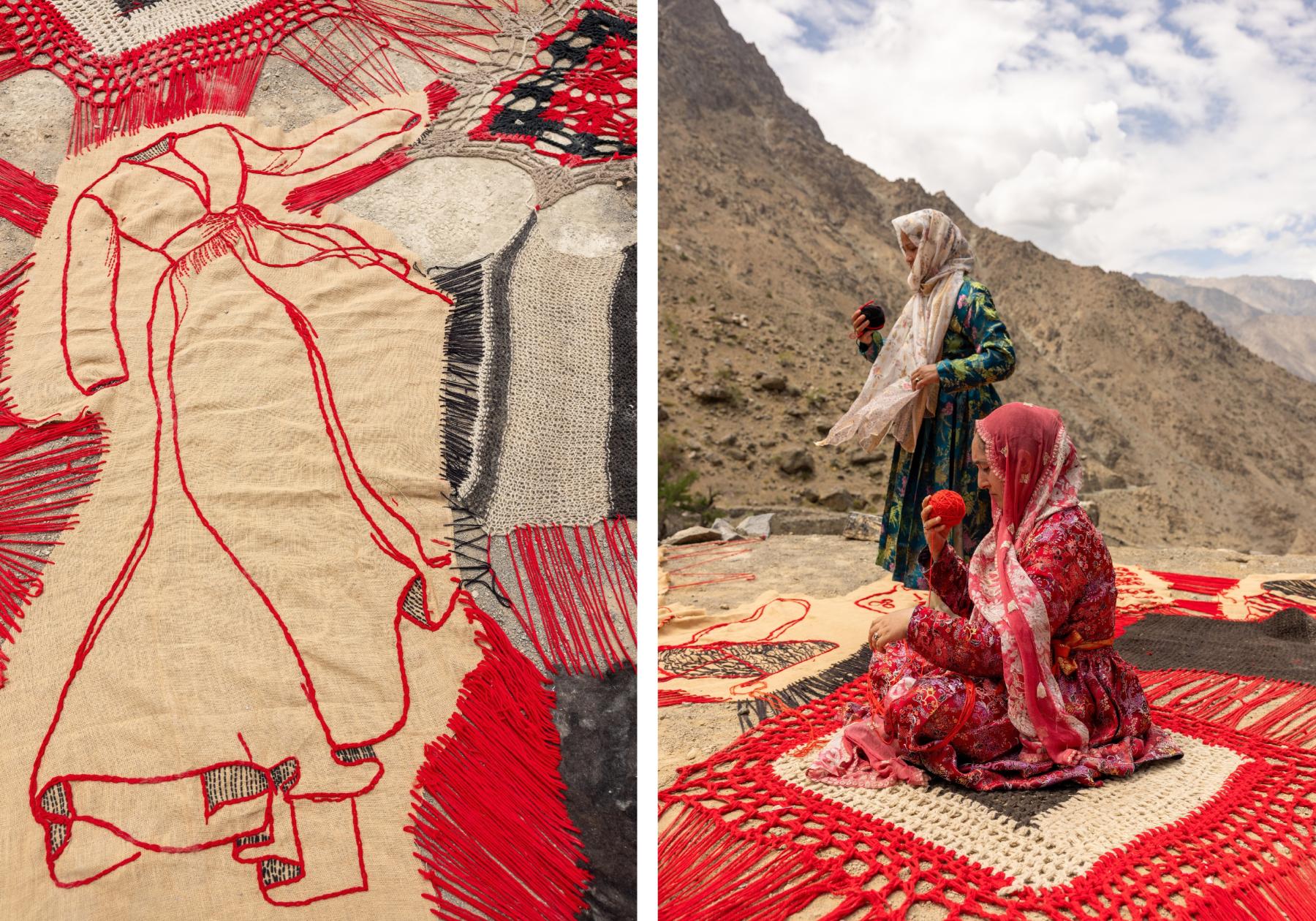
Right: Local artisans with the installation. Photograph by Manan Sheth.
This sense of ownership extends beyond the artwork into a visible sense of responsibility that the women have towards sustaining their skills by uplifting others. Namza Bano from Batool’s team follows in her footsteps and is working towards facilitating more than 200 women locally with knitting, weaving and crocheting skills. Alongside craft knowledge, she also guides women in developing digital proficiency to sell their products. This transmission used to take place in the domestic interiors but has now transformed into a sustainable mode of economic independence for the local women.
Batool’s own statement defines her artwork as “the coming together of local women artisans weaving, knitting and assembling embroidered textile pieces into an act of repair”—which may begin with the textile itself but extends beyond the material. Their work of sustaining a cultural legacy through collective labour brings a collaborative practice alive in a landscape often shaped by narratives of displacement and conflict, reestablishing it within the lives of artists and the larger community as well as the history of Ladakh. In Invisible Threads, repair lies in women reclaiming the authority to carry Kargil’s textile traditions forward as artists, educators and custodians of their own heritage.

To learn more about women artists working with textiles, read Samira Bose’s conversation with Noopur Desai and Pallavi Arora on Mrinalini Mukherjee’s archive, Najrin Islam’s interview with Sumakshi Singh on creating immersive environments through stitching and embroidery, Aparna Chivukula’s interview with Jayeeta Chatterjee on her use of Kantha embroidery in her printmaking practice, Sukanya Baskar’s reflections on Habiba Nowrose’s series of portraits covered in a cotton fabric from Bangladesh called Chitkato, which look at everyday realities of gendered expectations.
To learn more about artists exploring the intersection of women’s labour, community traditions and gendered experience, read Barsha Bhandari’s review of the exhibition Urlado Nadisari (Like a Rising River, 2026), Alfa M. Shakya’s reflections on Nistha Thapa Shrestha’s Subdued Song of Chaā (2024) on sparse representation of women in Thimi’s pottery tradition and the struggles of the region’s community to preserve the ancient craft, Shranup Tandukar’s review of Sikuma Rai’s Come Over For A Drink, Kanchhi (2020) that looks at the women in the Rai community and their relationship with alcohol-making tradition and Vishal George’s essay on Aditi Maddali’s Songs of Our Soil (Pani Paata Poratam, 2019) that traces the agricultural tradition of Uyyala songs passed down through generations of women in Telangana, which express their resilience and resistance.
All images are installation views of Invisible Threads by Zahara Batool, exhibited at sā Ladakh Biennale. (Hunderman, Kargil, 2026. Photographs by Manan Sheth and Saurabh Suryan. Images courtesy of the artist, photographers and sā Ladakh Biennale.) Translation of local and regional terms by Zarina Malik.