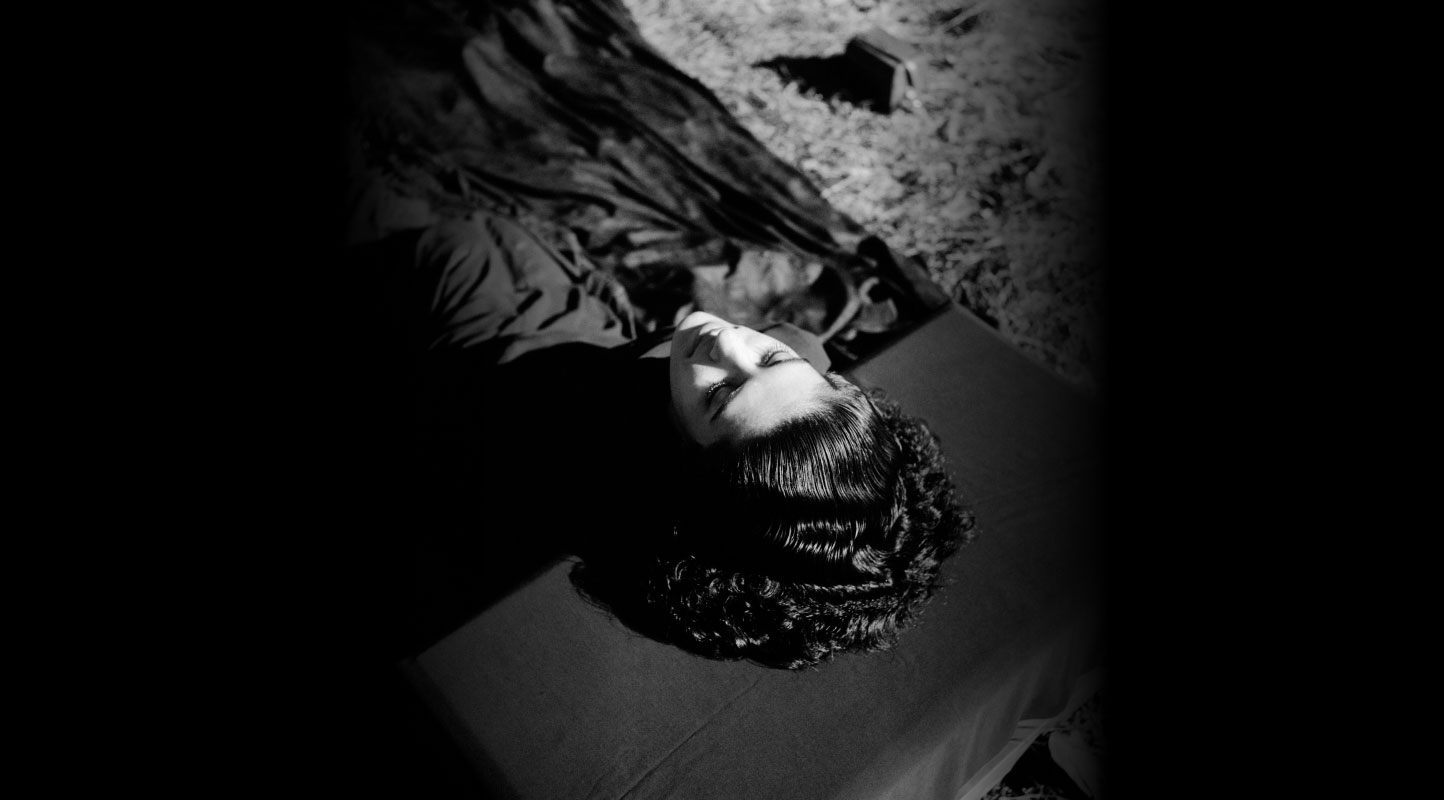


Abhishek Khedekar’s Tamasha: Migratory Lives and Marathi Folk Theatre
Over six months in 2015-16 and during subsequent trips in 2022 and 2023, photographer Abhishek Khedekar travelled through Maharashtra with two Tamasha groups—the Tukaram Khedkar and Pandurang Mule Tamasha Company, and the Dattoba Tambe Shirolikar Lokanatya Tamasha Mandal. Observing, documenting and probing the migratory lives and everyday realities of people attached to this popular form of Marathi folk theatre, he made a series of photographs, which was recently featured in the artist’s solo exhibition, Tamasha – Photos by Abhishek Khedekar, curated by Bharat Sikka at Dilip Piramal Art Gallery of the National Centre for the Performing Arts (NCPA) in Mumbai from 08 May to 14 June 2026.
In her essay, “Mangala Bansode and the Social Life of Tamasha: Caste, Sexuality, and Discrimination in Modern Maharashtra” (2017), the renowned academic Shailaja Paik notes that historically, Tamasha has been practised by nomadic, Dalit and Bahujan artisan castes from amongst the bara balutedars—a system in Maharashtra wherein twelve hereditary "village servants" or service castes performed various obligatory services for the villages in which they resided. Viewed through a brahmanical, patriarchal lens of morality, Tamasha, as a form of performance, has been typically seen as lowly and vulgar. Paik writes about how during the twentieth century, Tamasha became a tool for political mobilisation by Dalits but was later appropriated by a newly-independent Maharashtrian state to represent Marathi identity. It is thus that despite stigmatisation directed particularly at Dalit women, it remained popular and flourished throughout the period.
While many Tamasha artists continue to have generational ties to the form, Khedekar has produced his photographs at a time when Tamasha troupes are beset by financial struggles, competition from modern mass media and dwindling, indifferent audiences, who, as he says, “request popular Hindi and Marathi songs.” However, the photographer adds that young boys who are interested in hip-hop dance are now invited by traditional Tamasha groups to perform with them as “they are keen on evolving their Tamasha performance according to public taste.”
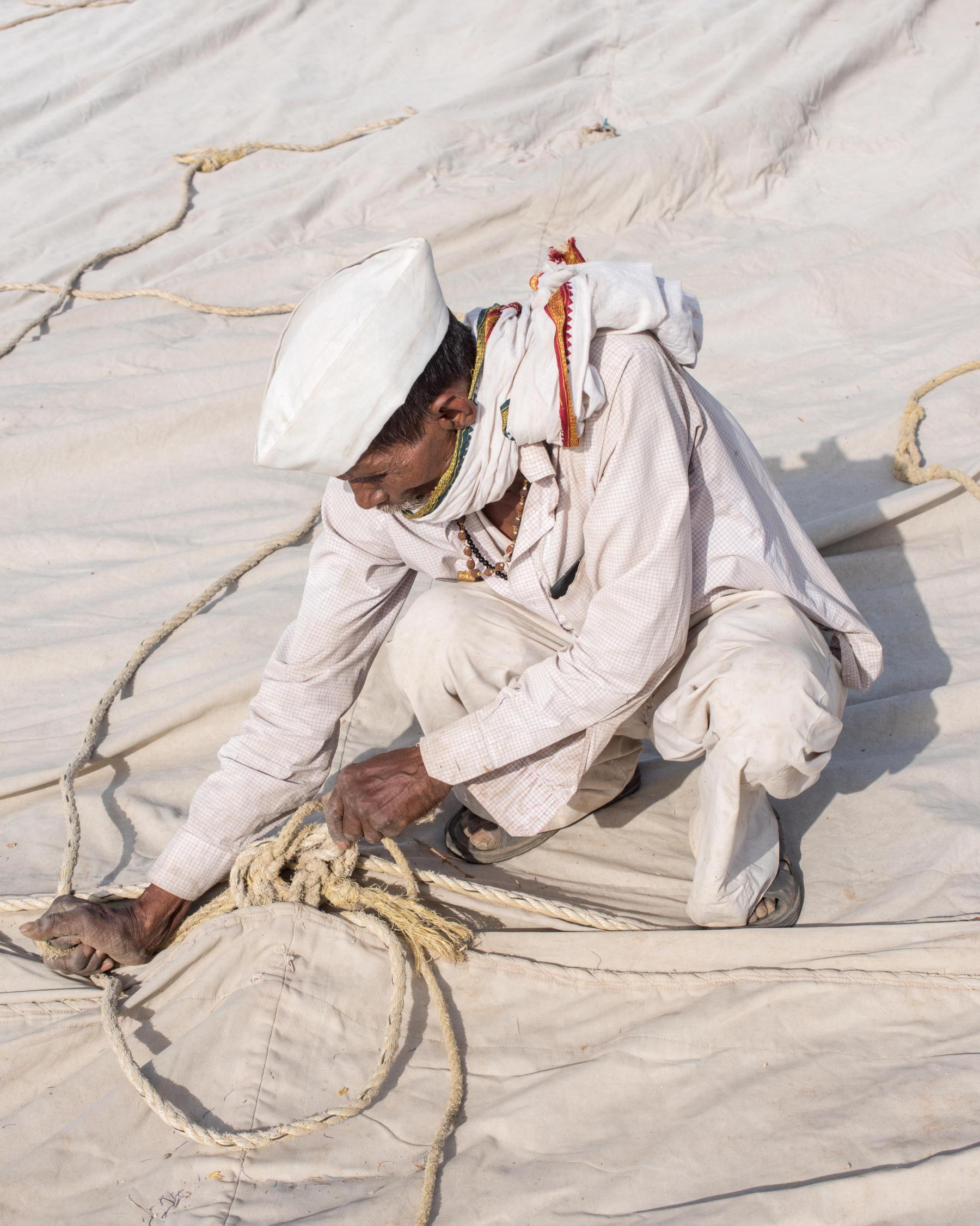
Certain objects and material such as trunks, poles, tapes, fairy lights, ropes as well as trucks and tents find their documentation in Khedekar’s photographs, evoking the migratory life of the Tamasha artists. Thus, one encounters otherwise unnoticed details such as the colourful fabric drying on a truck’s radiator grille; labourers pitching tents; and the bare landscape with a sliver of tent cloth on the edge of the photograph’s frame. Integral to the everyday life of these artists, such objects indicate the ephemerality of the theatrical experience that they help to conjure, where empty fields are transformed momentarily into theatres with romp, colour, music and ribaldry, before the troupes pack up and disappear again.
One photograph from Khedekar’s photobook, also titled Tamasha and published by Loose Joints in 2023—of a dholki player standing against a shimmering star-lit sky—is also printed on a cloth that hangs from the ceiling of the exhibition space to evoke the Tamasha backdrop. Calling it an “accidental photograph,” Khedekar states: “The Tamasha performance starts with the dholki player, but he chooses to stand at the back. The image too, like him, is underexposed—seen and unseen.”
Exemplifying the hardships of this itinerant life, Khedekar relates a story, where, as a member of his roving Tamasha ‘family,’ he was not allowed by certain village residents to use the water from a village tap and was asked instead, to wait for “their”—i.e. their caste’s—own water tanker to arrive. This incident drove home for the photographer, the inherent and persistent caste bias and discrimination faced by practitioners of this rural, folk performance tradition.
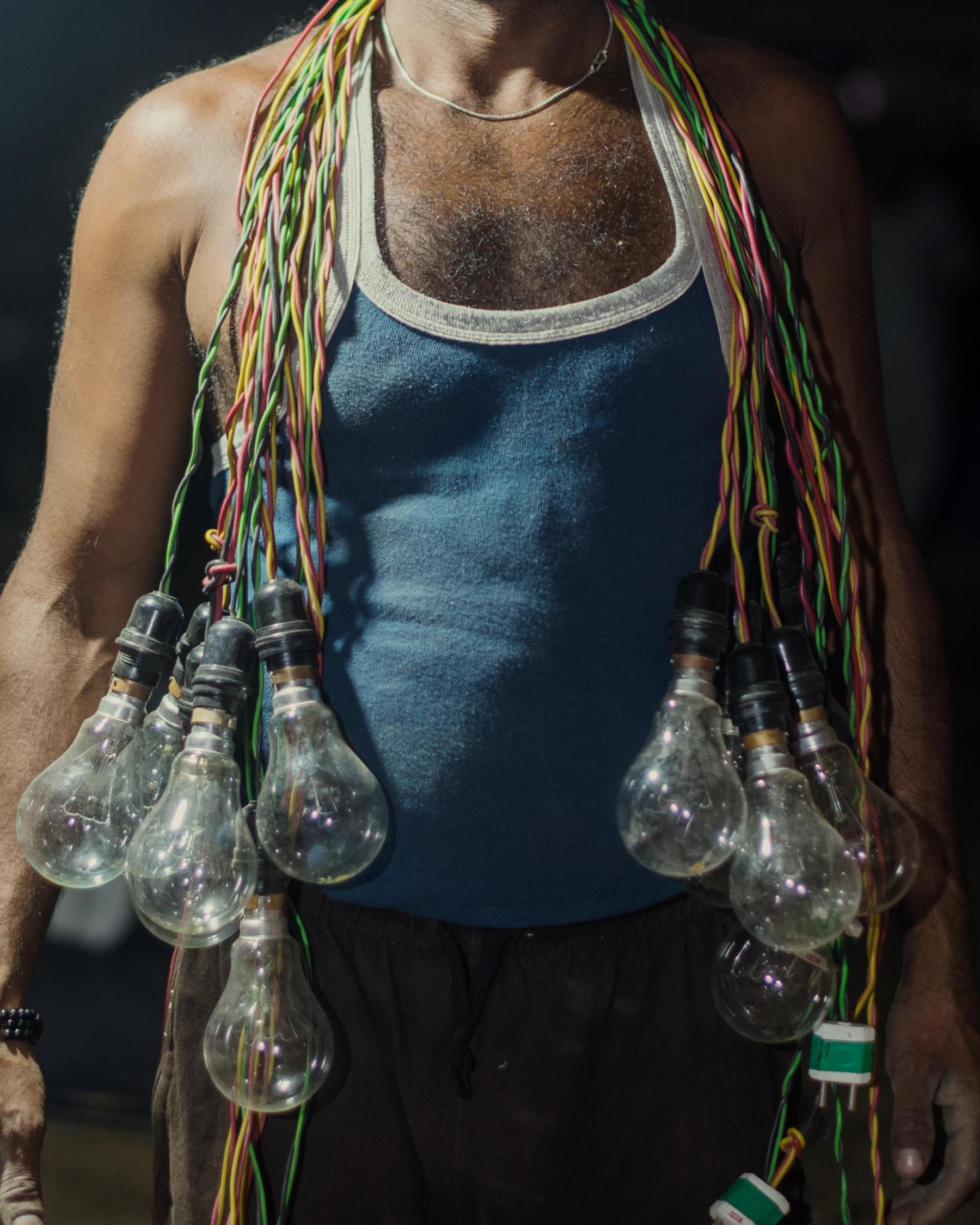
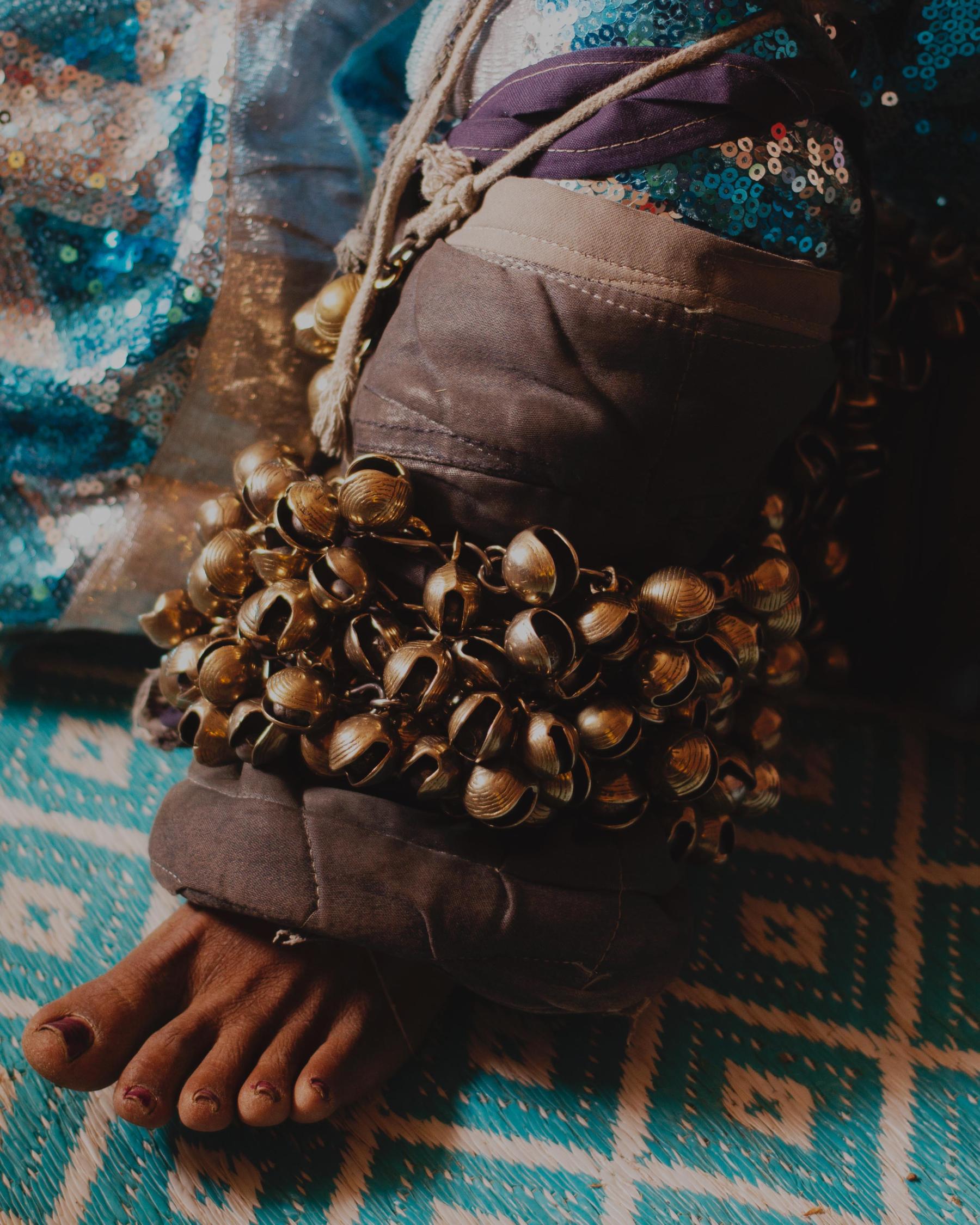
Central to Khedekar’s approach is the practice of constant zooming in—letting an object or a detail fill up the frame and loading it with meaning so it turns into a symbol. The lens mimics the act of looking closely at the individual lives and experiences of Tamasha performers. In this dissection by the camera, parts are repeatedly chosen over the whole—as can be seen in extreme close-ups of the bodies of Tamasha performers as well as those of the workers who travel with the phads (travelling troupes). In these incisive frames, more than the human form, we see fragments of physical bodies bearing traces of a performance while often being wrapped up by its paraphernalia—such as the heavily made-up face of a Tamasha dancer, a foot covered with rows of ankle bells or a torso carrying bulbs attached to wires dangling down from the back of the neck. These images signify the physical labour underlying Tamasha’s informal structure and recall Paik’s seminal work, The Vulgarity of Caste (2022), which examines Tamasha as part of veth-begar (bonded labour) that was historically expected from Dalit communities and which served to further reinforce exploitative caste relations of socio-economic and cultural servitude.
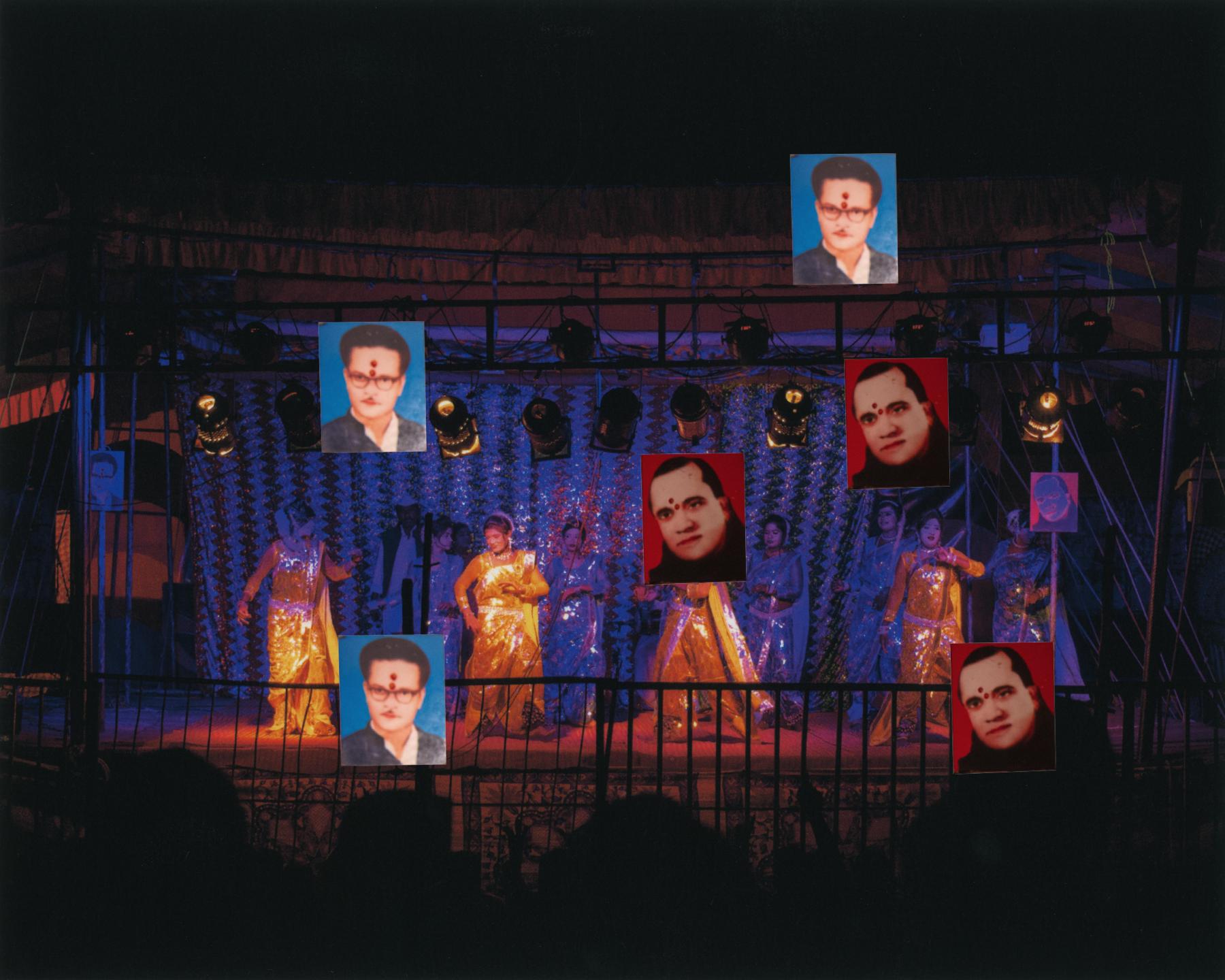
However, it is not through the act itself that Khedekar chooses to depict the Tamasha performers; his focus is on what goes into putting together a Tamasha performance—the people, the equipment and the work—so that in a rare instance when he chooses to step back to shoot a performance, there still remains a fragmentary element. Thus, in a photograph in the photobook, dancers and musicians on a stage are under a panel of overhead lights and rigs but even here, small cut outs of faces are added on the original image to disrupt its integrity. Rather than being a purely documentary record however, Khedekar emphasises this series as a docu-fiction project, as is visible in the palimpsestic, layered quality to many of the photographs.
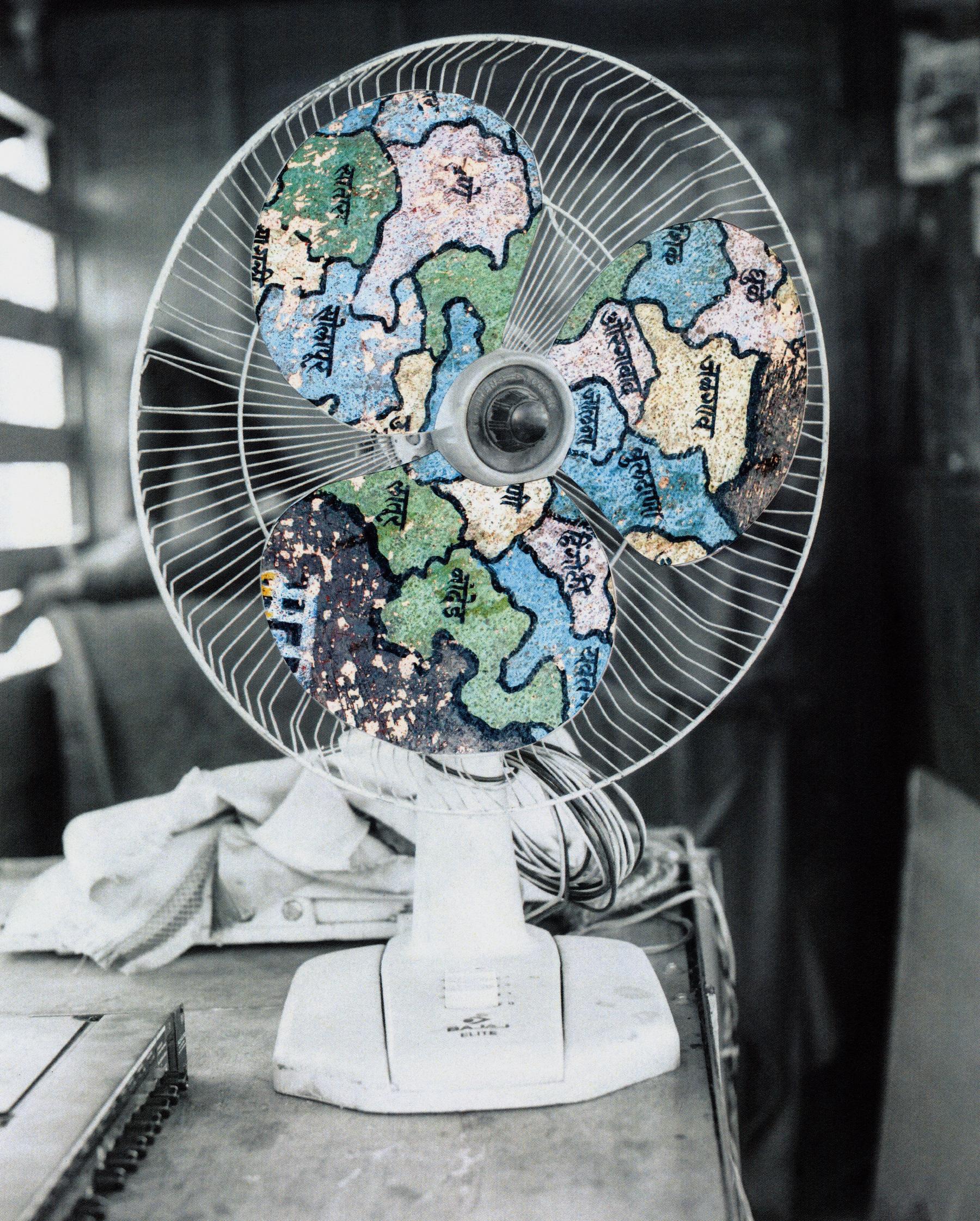
For instance, the black-and-white image of a table fan whose blades are covered with colourful scraps of maps bears names of places like Solapur, Latur, Aurangabad and Hingoli, indicative of the routes traversed by Tamasha’s nomadic performing troupes. At other times, the photographic image is layered with various materials to produce textures on a visual surface. Thus, on the print of a man’s face, taken while he was swimming in a river, the photographer placed thorns and scanned the two surfaces to create the final work—a scanograph. And in another, dirt is scattered on the printed image of a blue trunk and the composition is then photographed. In both cases, the materials i.e., thorns and soil, overlaid on the original images, have a familiar tactility that is introduced to the visual plane through the processes of scanning and photographing, which transfers their distinct haptic experiences of prickliness and graininess to the viewers.

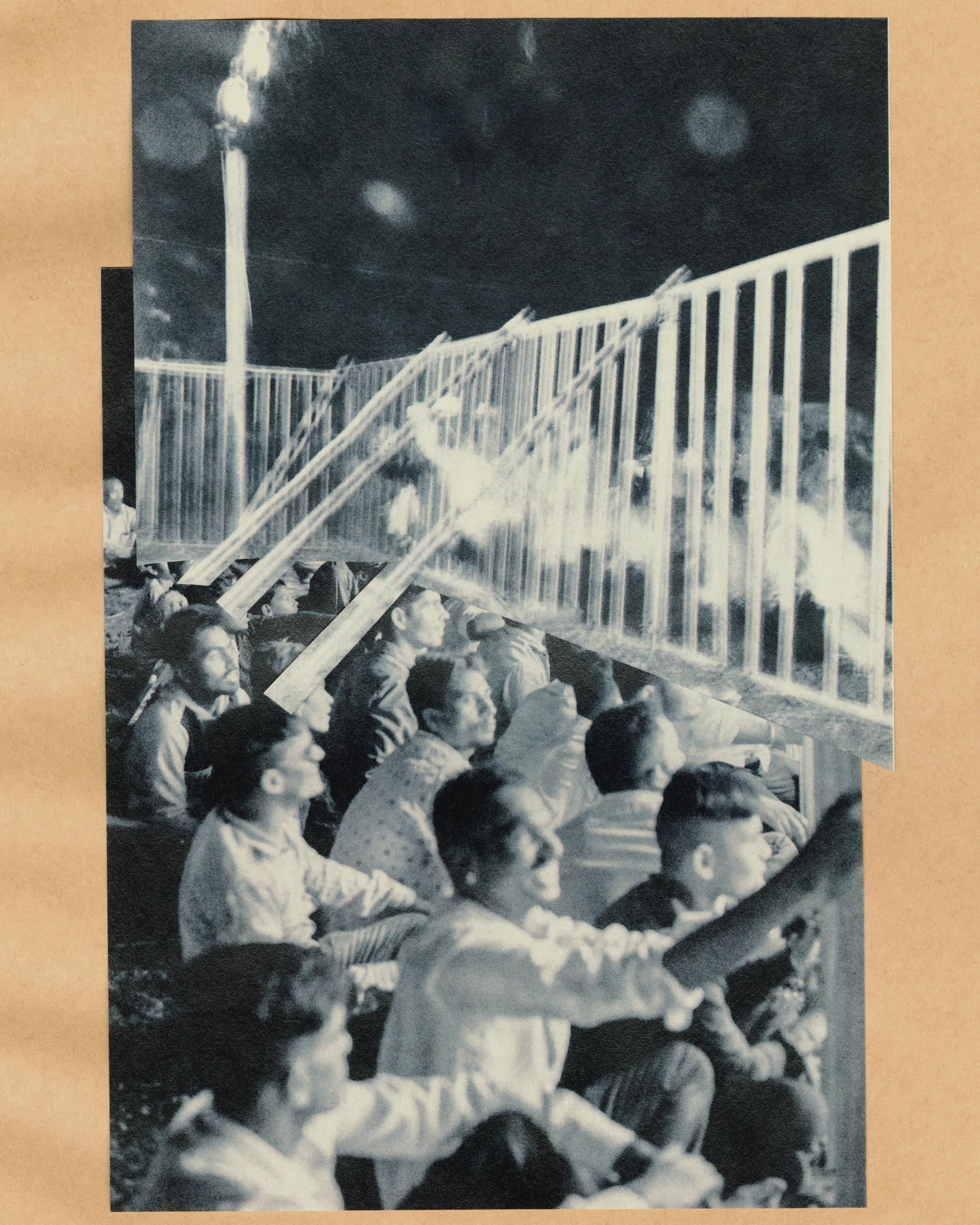
Through cut-outs of dancers and a black-and-white collage of raucous male spectators mounted on cardboard—one of the very few photographs in the show depicting audiences—the artist also points to Tamasha’s primarily male viewership and the distinctly male gaze that is directed at the performance stage. Moreover, the use of archival photographs from the 1950s—for instance, an enlarged black-and-white group portrait of a large Tamasha troupe gathered on an open ground with trucks, tents, posters and loudspeakers around them, which is the show’s centrepiece—allows for a contextual fluidity. An image is taken out of its original setting to be placed in another, becoming a collage, not of materials, but of assorted times and spaces. This juxtaposition introduces comparisons not only between historical, ethnographic, zoomed out images and Khedekar’s own contemporary, collagic, zoomed in ones, but also between the two periods they come from—the mid-twentieth century and the present—signalling how the fortunes of the Tamasha tradition have been altered during this time.
To learn more about caste dynamics and power relations around performance traditions in India, read Arindam Sen’s reflections on Mani Kaul’s film Desert of a Thousand Lines (1981) that sketches the complex lives of folk communities in Rajasthan marked by migration, caste and the precarious arid landscape, Vishal George’s essay exploring films such as Ashok Maridas’ Casting Music (2016) that looks at caste discrimination faced by the nadaswaram players of Savita Samaj in Karnataka and Steevez’s review of MKP Gridaran’s Dalit Subbaiah: Voice of the Rebels (2025) that traces the reclamation of Carnatic music from Brahmanical dominance by the Tamil working-class and Dalit communities.
To learn more about ritualistic folk performance as well as theatrical, musical and oral traditions, read Sakhi Subramaniam Chowla’s essay on Madai Mela, a travelling ritual in which Bastar’s Adivasi communities carry processions of village deities, Vishal George’s observations on Aditi Maddali’s Songs of Our Soil (Pani Paata Poratam, 2019) which explores the agricultural tradition of Uyyala songs by women in Telangana, Ankita Ghosh’s article on Naveen Kishore’s Performing the Goddess: The Chapal Bhaduri Story (1999) which traces the life of Chapal Bhaduri through jatra theatre and Ankan Kazi’s review of Prantik Basu’s Bela (2021) that focuses on the performances of a troupe of Chhau dancers.
All images are photographs from the series Tamasha (2016-22) by Abhishek Khedekar, displayed at his solo exhibition, Tamasha – Photos by Abhishek Khedekar, curated by Bharat Sikka at Dilip Piramal Art Gallery of the National Centre for the Performing Arts. (Mumbai, 2026. Images courtesy of the artist.)