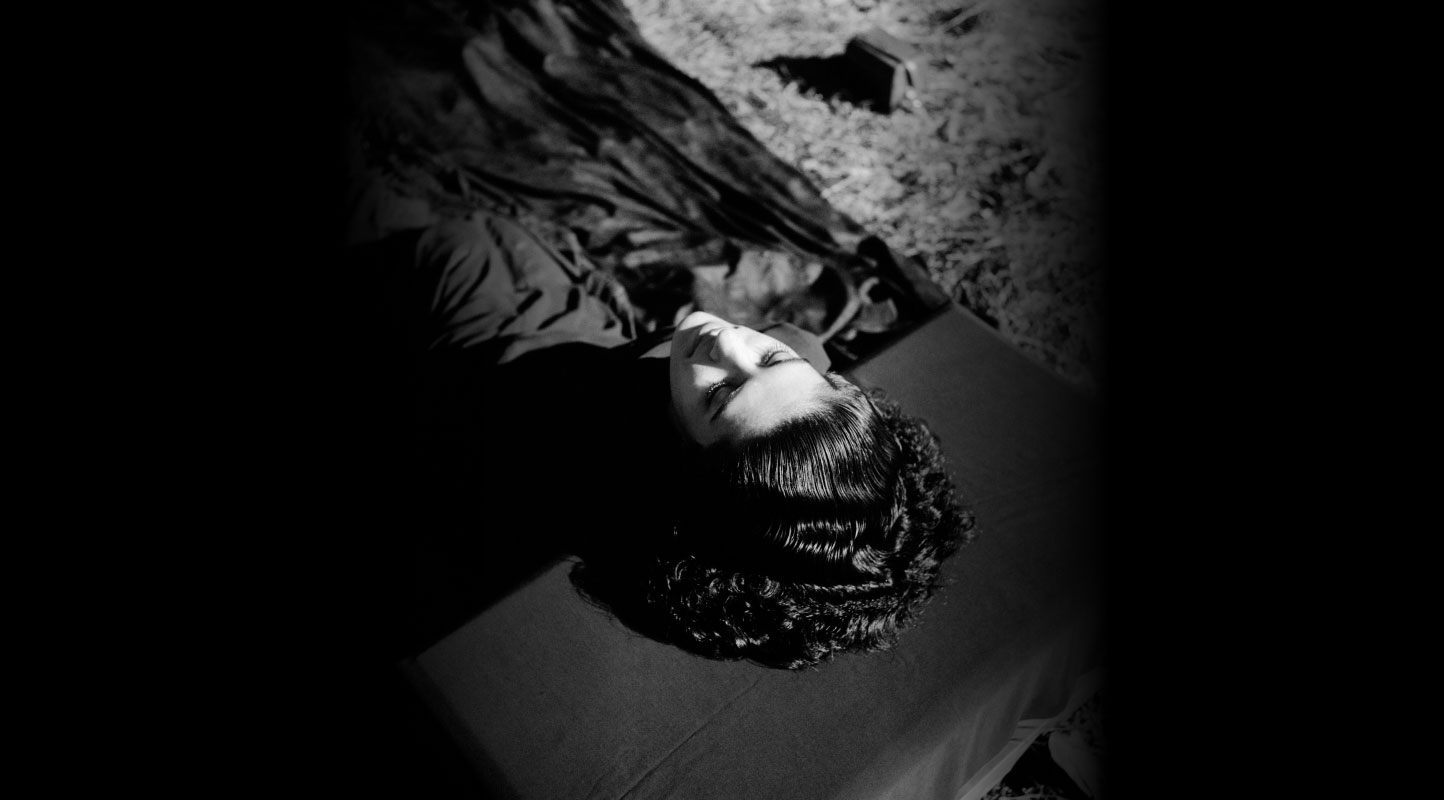


Rhythm of the Land: Mani Kaul's Desert of a Thousand Lines
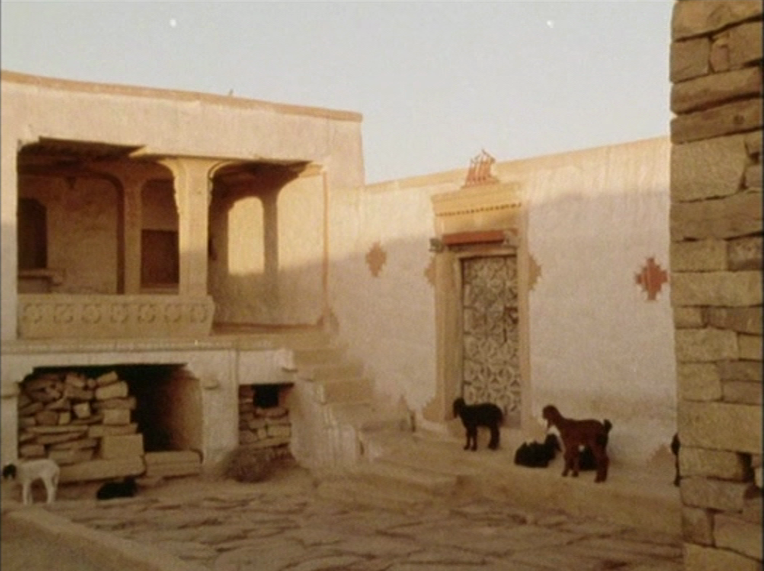
Born to a Kashmiri family in Jodhpur, Rajasthan, filmmaker Mani Kaul would frequently return to the land of his birth. In his third feature-length film Duvidha (1973), Kaul, inspired by Pahari painting traditions, delivered a singularly stylised Rajasthani folk tale based on a love story of a bride and a ghost. In his crowning film from the following decade, Dhrupad (1982), his ode to the eponymous North Indian classical music form, Kaul leisurely filmed musical performances in the Amber Fort in Jaipur. He made two other short films in the desert terrains: one, an archive of two Manganiyar folklore songs in Borunda, and another, a portrait of the nomadic puppeteers of Rajasthan, traditionally belonging to the Bhat community of the state.
These films, with the exception of Dhrupad, enunciate Kaul’s regard for folk narratives that self-admittedly was an outgrowth of his acquaintance with Vijaydan Detha and Komal Kothari—the founders of Rupayan Sansthan in the 1960s, an institution dedicated to researching and archiving folk traditions of Rajasthan. In fact, if there was one lingering curiosity that underpinned his filmmaking in the 1970s and the 1980s, it was about the contrasting sustenance of folk and classical variants of Indian art forms through their entwined histories and how their mutation maps to social and structural transformation within society.
Another Kaul film that squarely places life in the forlorn, arid landscape of Rajasthan at its epicentre, is Desert of a Thousand Lines (1981). It finds scant mention among his longer films, in both critical literature about his work as well as his own formidable corpus of writings. Stacked between his fictionalised portrait of Marxist Hindi poet Gajanan Madhav Muktibodh, Satah se Uthta Aadmi (Arising from the Surface, 1980), and Dhrupad (1982), in many ways, it marks Kaul’s lasting turn towards non-fiction filmmaking in that decade.
Produced by the German public television broadcaster ZDF, the film is an episodic study of the rhythms, hardships and cultural peculiarities of desert customs, delivered neither with a romantic affectation, nor with critical intervention, but in a matter-of-fact style objectivity aided by Kaul’s own deadpan voiceover in direct or oblique relationship to the unfolding images. A couple of years ago, almost by accident, I attended a showing of Desert at the Silent Green in Berlin and took down some notes. These serve as a departure point for the following passages.
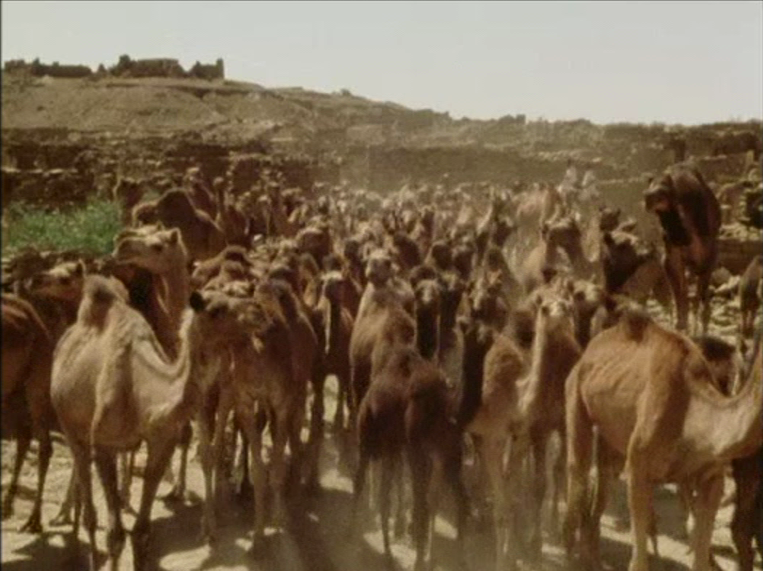
Desert resembles a fabric of interwoven laces. The topography’s sand-strewn vastness is flocked by cattle and camels. These indispensable livestock in the shimmering heat and little rainfall are corralled—by migrant herdsmen—to move efficiently between groundwater and desert grasslands. Near the beginning of the film, Kaul tried orchestrating a scenario where the cowherds were attacked by local villagers, who were then attacked by the cows. Kaul failed, since the cows, in confusion, ended up attacking the film crew, leading to a shot where the absconding cameraman films a charging cow on the run—as Kothari recalled to Rustom Bharucha in a conversation.
Elsewhere in the desert, the camels’ flanks are stamped to mark their ownership and cameleers assist them in mating—details that lodge, albeit slowly, as one is transfixed by the languid movements of these quadrupeds and the captivating scenery in the backdrop. Kaul, never content with tedious naturalism, limits his commentary to the functional and the anthropological. He frames the limbs of the desert transporters in close up, focusing on, for example, their rhythmic chewing motion, as Nancy Graves had done in her remarkable Sahara film, Isy Boukir (1971), momentarily freeing up the camels from an anthropocentric utilitarianism and ascribing them their graceful autonomy as indigenous wanderers of the desertland. In Desert, their return to the functional realm is soon enough. In one of the most memorable shots, Kaul filmed two camels drawing water from an ancient deep well in a long take lasting nearly three minutes. After two short pans back and forth, first towards and then away from the well, the camera holds still for about two minutes, during which the animals pull the well line away into the distance. As their figures diminish in size, the movements in the frame are minimised, limited mostly to its right, except for the cable gently wavering centrally in the frame.
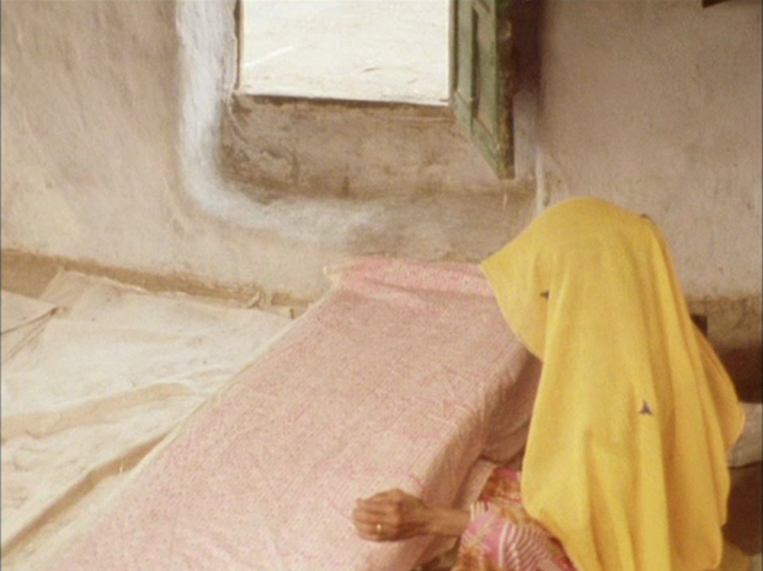
Encountering folk material in their original form was instrumental for Kaul’s Rajasthan films—it allowed him to eschew the touristic imagery of the place, vestiges of Rajput royalty and hagiography borne by palaces and forts, much of which steers a film like M.F. Husain’s differently charming Through the Eyes of a Painter (1967)—in favour of marginal communities and lifestyles. Kothari, who is acknowledged in the end credits for his ethnographic research in the film, provided formidable guidance during its making. Kaul himself, far from being Rajasthan’s son-of-the-soil, had to rely on the much-revered folklorist, musicologist, researcher, reluctant historian and as Bharucha once described him, “the vernacular cosmopolitan” Kothari. Taking his cue from the multivalent Kothari, Kaul dispersed within Desert, several skeletals of narrative—the migration of the Paliwal Brahmins out of Jaisalmer; a Muslim Manganiyar’s lyrical recitation of Bhati Rajput’s genealogy; the relationship of the prints and stitches of garments to caste; and the reliance of upper-caste patrons on lower music castes like Langas during familial ceremonies of birth, marriage and death—thus painting a picture of the motley cultural life in Rajasthan.
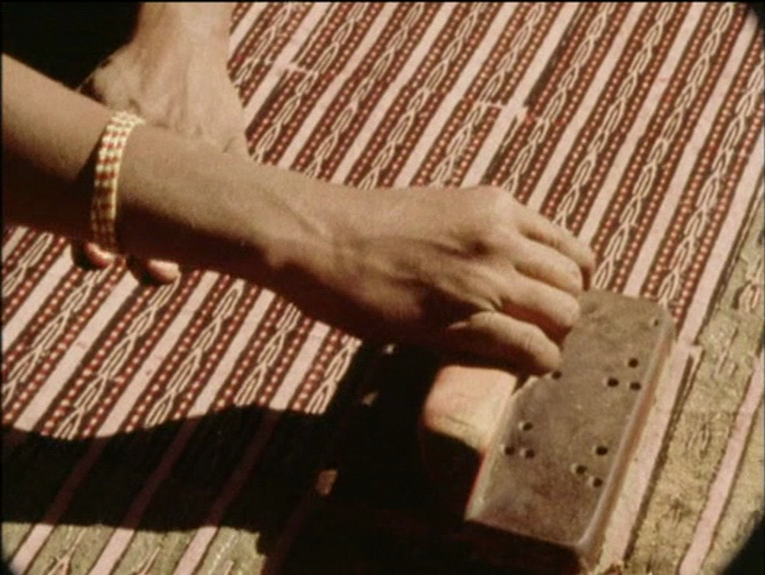
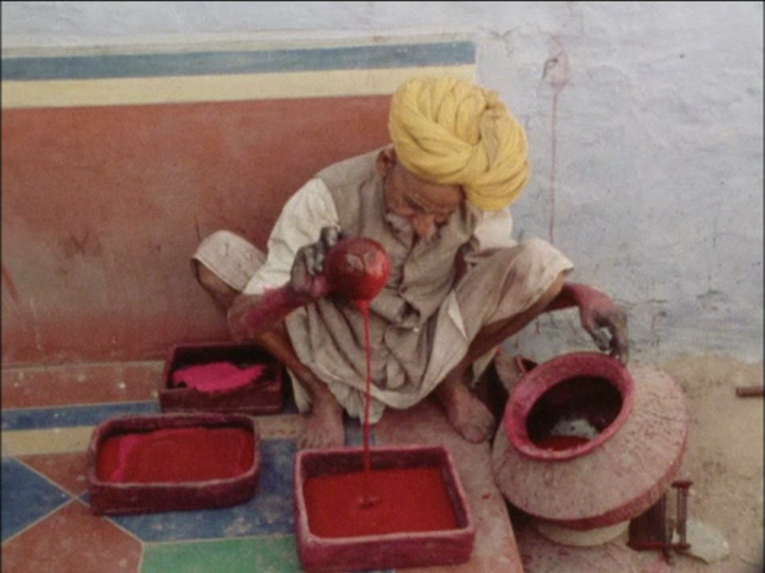
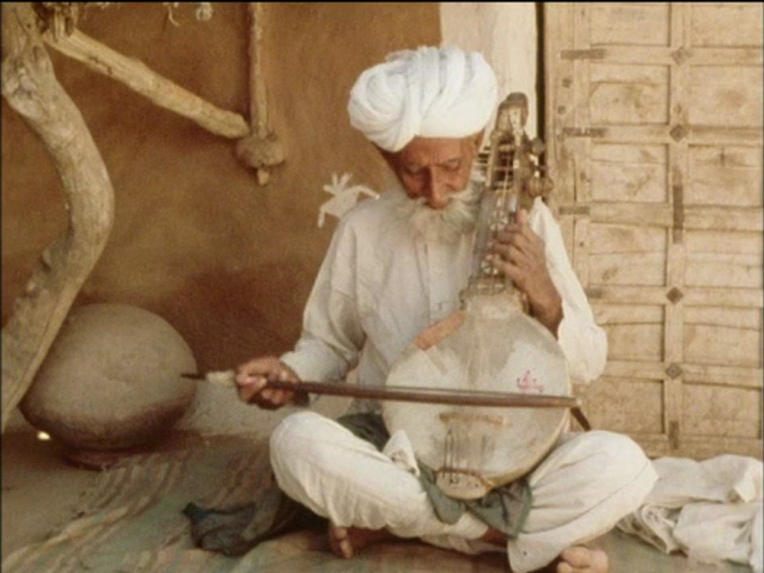
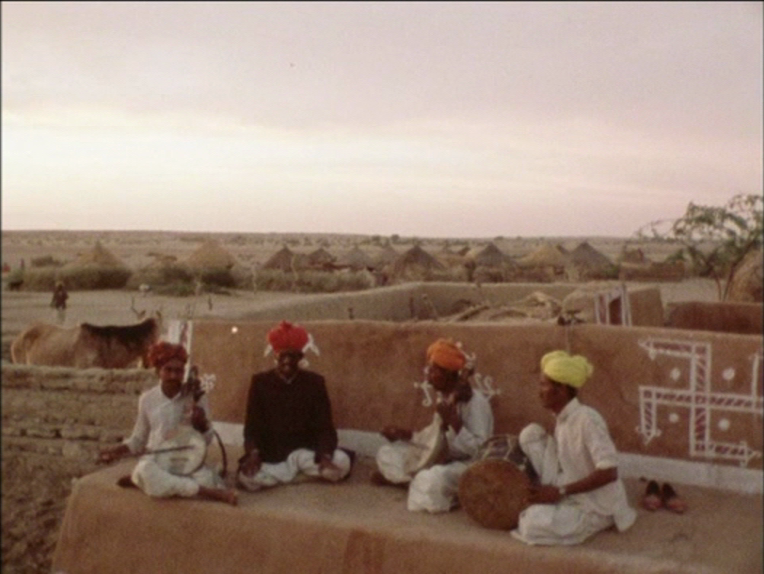
Kaul’s documentary prowess comes to the fore in two lengthier episodes of the film, one devoted to the hand-block printing and dyeing of intricately detailed fabrics by the Muslim Chhipa community on the banks of the Luni River, and another, when folk musicians are filmed tuning and practising their instruments—the wind ones, Murli and Algoza, and the rare, yet exquisite bowed string Sarinda and Kamaicha. In both these segments, Kaul cuts between tightly framed shots, allowing for the particulars of the textiles and the musical apparatus as well as the hand movements of the artisans to sovereignly impress. Kaul films the landscapes in stark contrast: then, the camera remains distant and beautifully still, while he employs pans to vacillate between a figure and their surroundings. Zoom is sporadically used, but on rare occasions when it is, its presence registers unmistakably.
If there is one critique of Kaul that can be made, it is his nonchalance towards questions of caste and gender as vectors of social asymmetries. Given that Desert commendably dwells on communities resident on the fringes of dominant cultures in Rajasthan, caste and gender dynamics are integral to the film. Yet Kaul’s presentation of caste-based discrimination and patriarchy that are rife within the social fabric of the depicted communities is too rationalised—he makes it seem as if they are a perfectly logical form of social organisation and a convenient division of labour.
The demand from Kaul here is not one of didacticism, particularly given his position vis-à-vis the tribes as an ethnographic observer; any sweeping generalisation could easily amount to paternalism. For Kaul to pursue that line of criticism might even have been somewhat redundant had the film not been primarily intended for a German television audience. Kaul’s filmmaking is marked by an inherent capacity to show or hint at, without the tediousness of having to tell—a quality he barely mobilises in this regard.
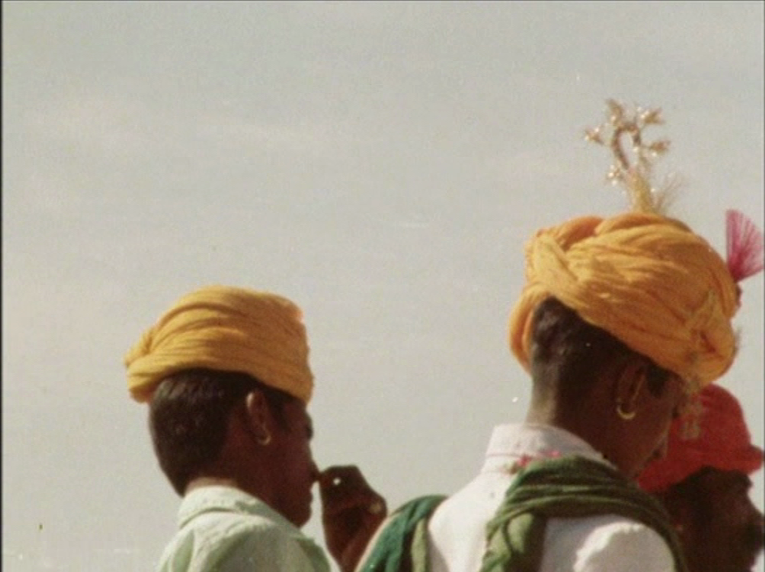
If Kaul’s reticence on matters of social division is a partial folly, the refusal of his formally-alert poetics to aggrandise the quotidian hardships of life is a substantial upside in Desert. Contrast that to Raghubir Singh’s photographs in Rajasthan: India's Enchanted Land (1981), published the same year as Desert, which, at least outwardly, shares a few affinities with the film such as the mud and straw houses and the village wells. But while Singh, true to the title of the book and in spite of his innate ability to compose with brightly-coloured foregrounds against muted backgrounds, hovers dangerously close to (some would say, drifts towards) internalising and reproducing the exotic stereotypes of his homeland, Kaul remains an inquisitive artist whose modest motivation in Desert was to figure out for himself why people in the desert do not give up on the inhospitable terrain and move elsewhere.
To learn more about Mani Kaul, read Arindam Sen’s two-part essay on Kaul’s Dhrupad (1982).
To learn more about films exploring the intersections of music, caste and gender with reference to marginalised communities in India, read Steevez’s observations on MKP Gridaran’s Dalit Subbaiah: Voice of the Rebels (2025), Ayushi Koul’s reflections on Danish Renzu’s Songs of Paradise (2025), Vishal George’s essay on Ashok Maridas’ Casting Music (2016) and his reflections on Aditi Maddali’s Songs of Our Soil (2019). Also watch an episode of In Person featuring Surabhi Sharma as she discusses her film Music in a Village Named 1PB (2025).
All images are stills from Desert of a Thousand Lines (1981) by Mani Kaul. Images copyright with the filmmaker.