
Networks in Circulation: Emily Jacir's Where We Come From
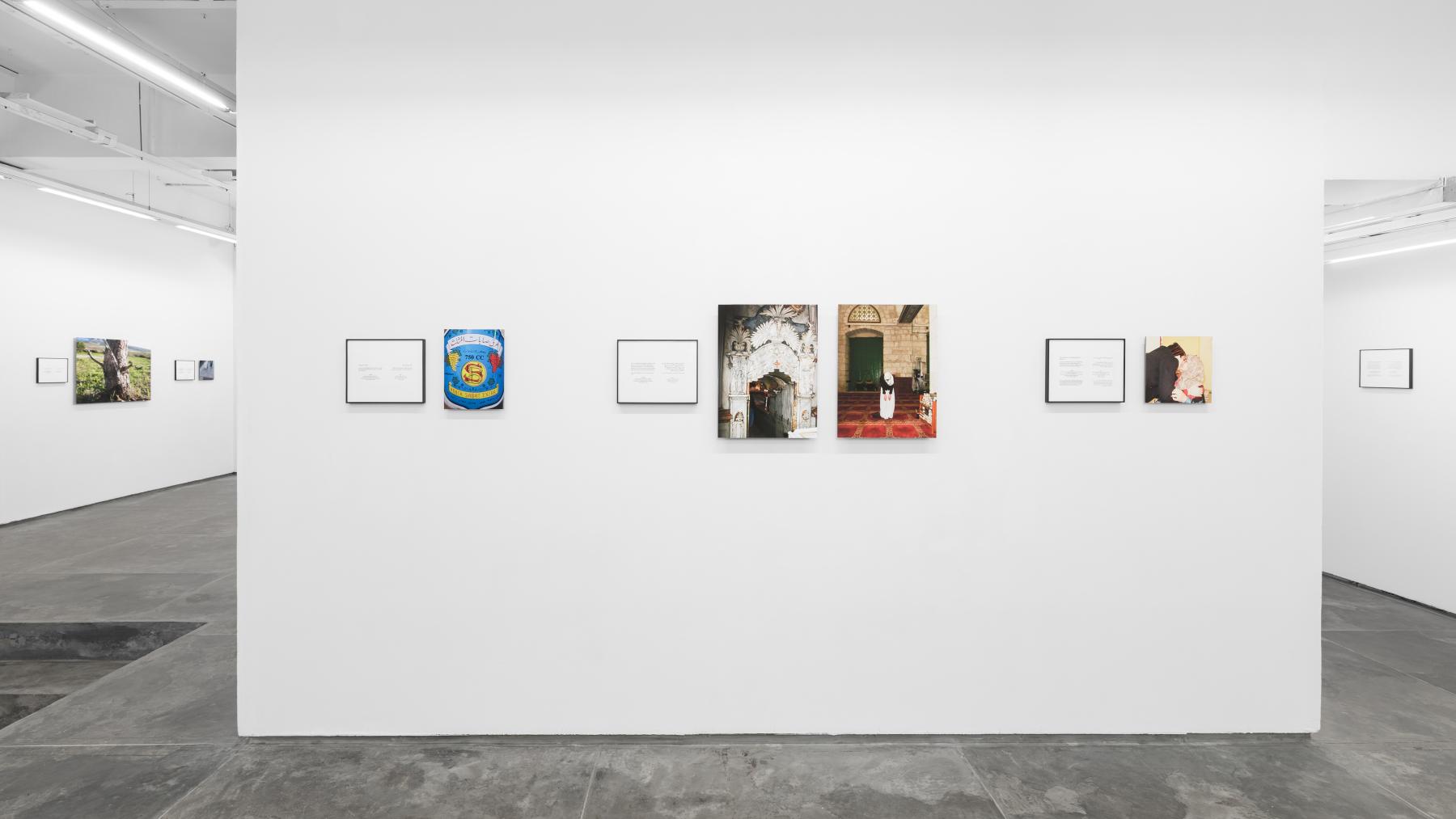
Emily Jacir’s Where We Come From (2001–03)—recently displayed at her eponymous solo exhibition held at Experimenter, Kolkata from 27 March to 27 June 2026—was conceived after the Oslo Accords went into effect in 1993 and 1995, and was made during a residency in Jerusalem at Al Ma’mal in 2001. The American cartoonist and journalist Joe Sacco would write about this precarious condition in his graphic novel Palestine (1993):
“Weeks later in the Jabalia refugee camp I met an old Palestinian who told me about the home he fled in 1948 after Israel declared independence and the Arab armies invaded . . . He returned, as it were, a few years ago. He got a permit from the Israeli authorities. For a few hours he could leave the Gaza strip. He could cross into what is now Israel to visit his home village.”
When Jacir was travelling back and forth from Palestine during the project, the Israeli government was building an eighty-kilometre long wall—part of the barrier that now runs 700-kilometres in length—along the 1967 Green Line dividing Israel and the West Bank. Constructed with sensors, fences, ditches and barriers, Jacir recalls how it was being erected to monitor any movement of Palestinians across borders, which Israel had termed “illegal”:
“Before the Oslo Accords were signed, we could move freely within all of the territories of the West Bank and Gaza and the 1948 areas. We were living through and witnessing the West Bank and Gaza de-evolve into a collection of confined ghettos within one de-facto Israeli sovereign space from the Mediterranean Sea to the Jordan river.”
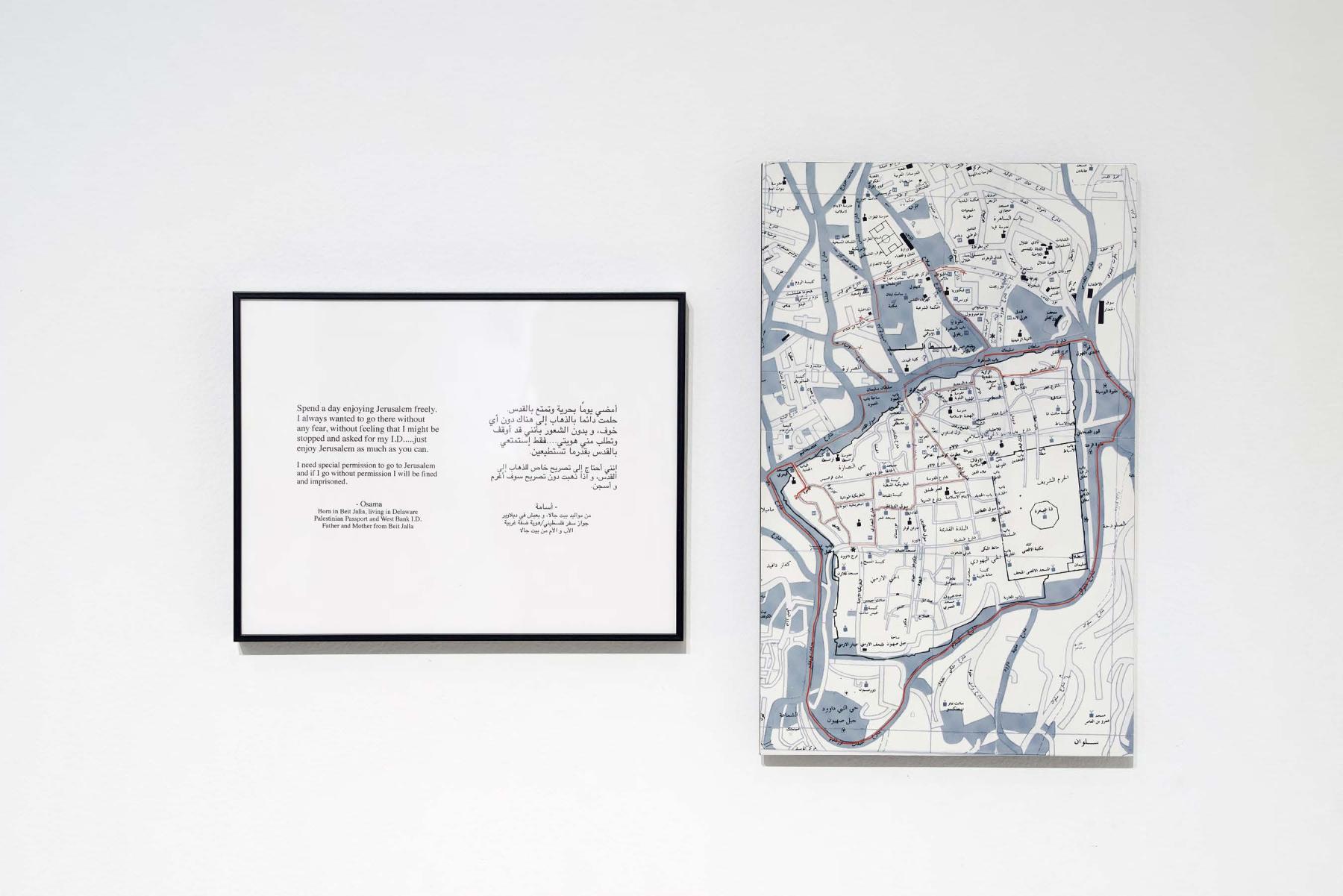
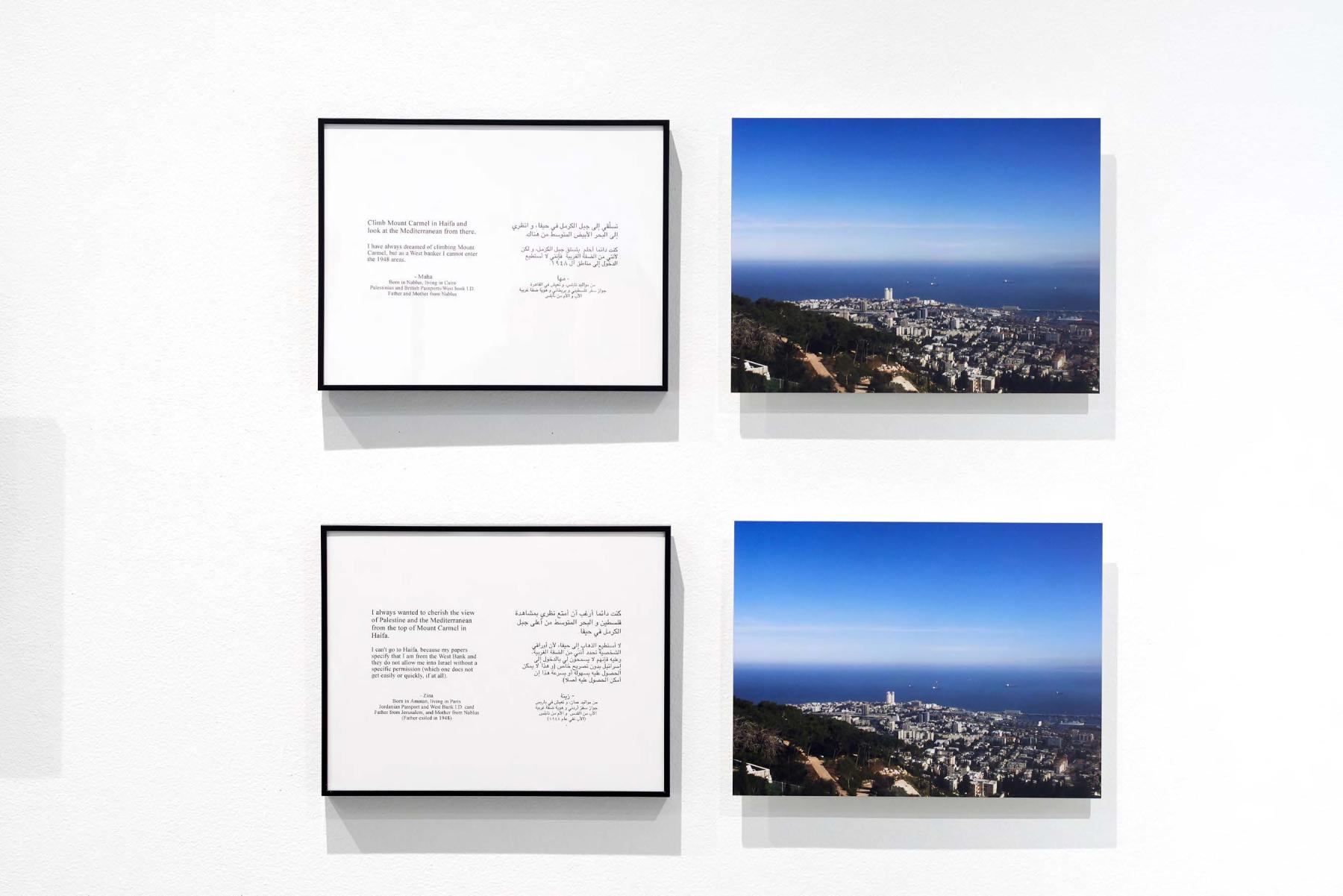
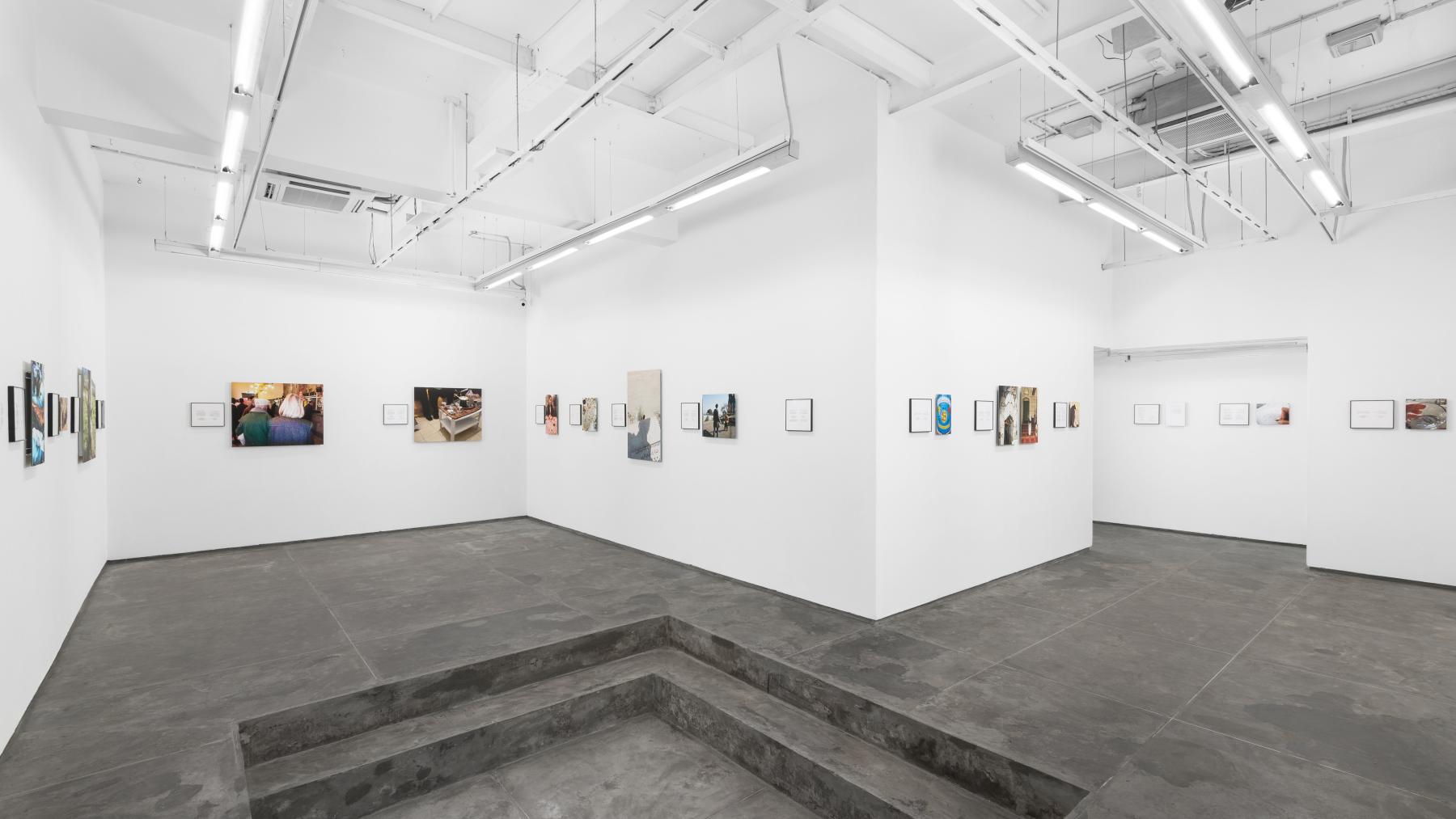
Therefore, it was important for Jacir that these requests remained unhindered by borders while also underlining the impossibility of such movements for Palestinians, who asked her to move in ways they themselves could not. A single map of Jerusalem hangs in the show with red lines trailing along main roads and narrow alleys, tracing the route that Jacir took while following Osama’s request, who wanted her to spend a day enjoying Jerusalem “freely.” “I always wanted to go there without any fear,” reads his message, replicated in grounding direct speech, “I need special permission to go to Jerusalem and if I go without permission, I will be fined and imprisoned.”
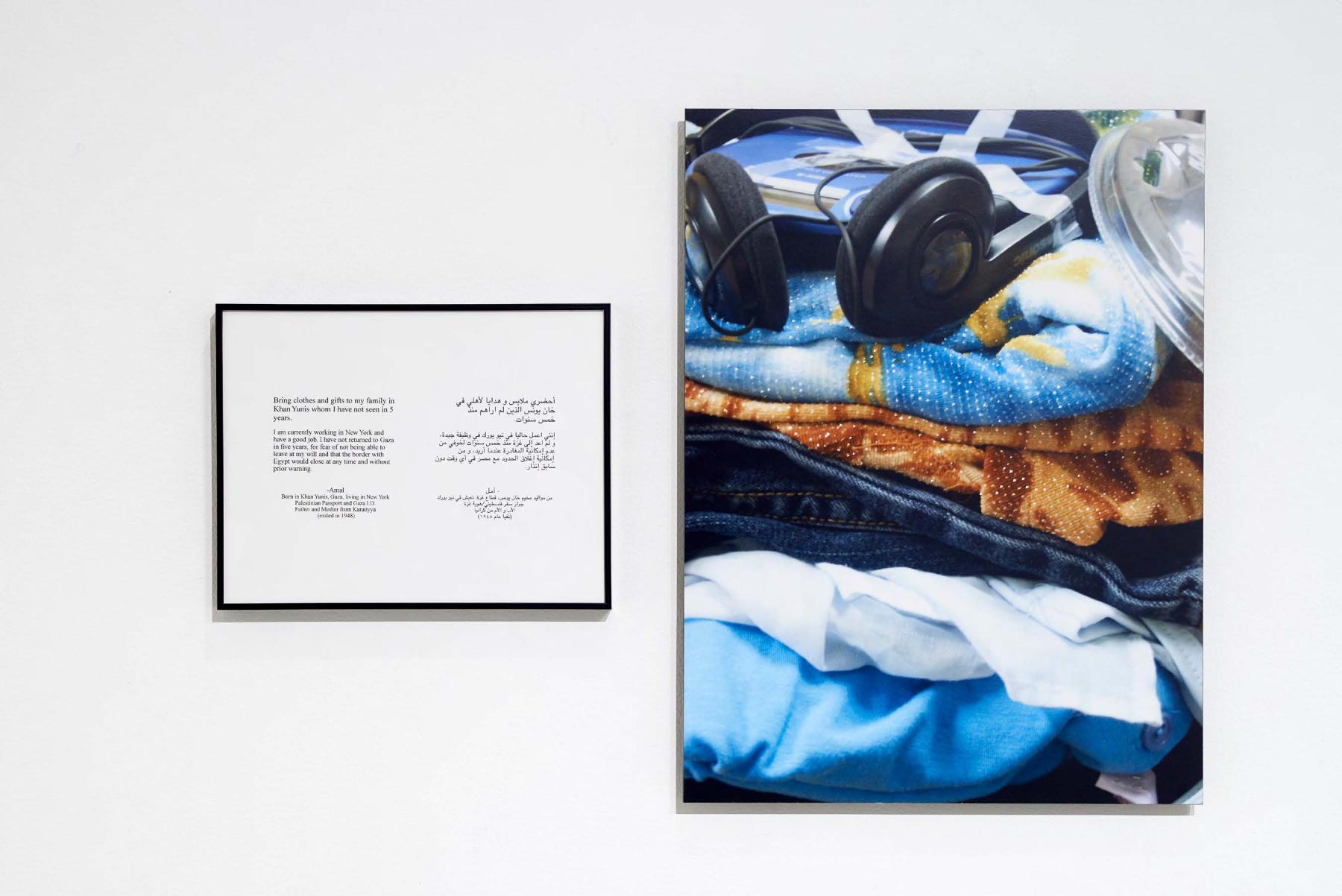
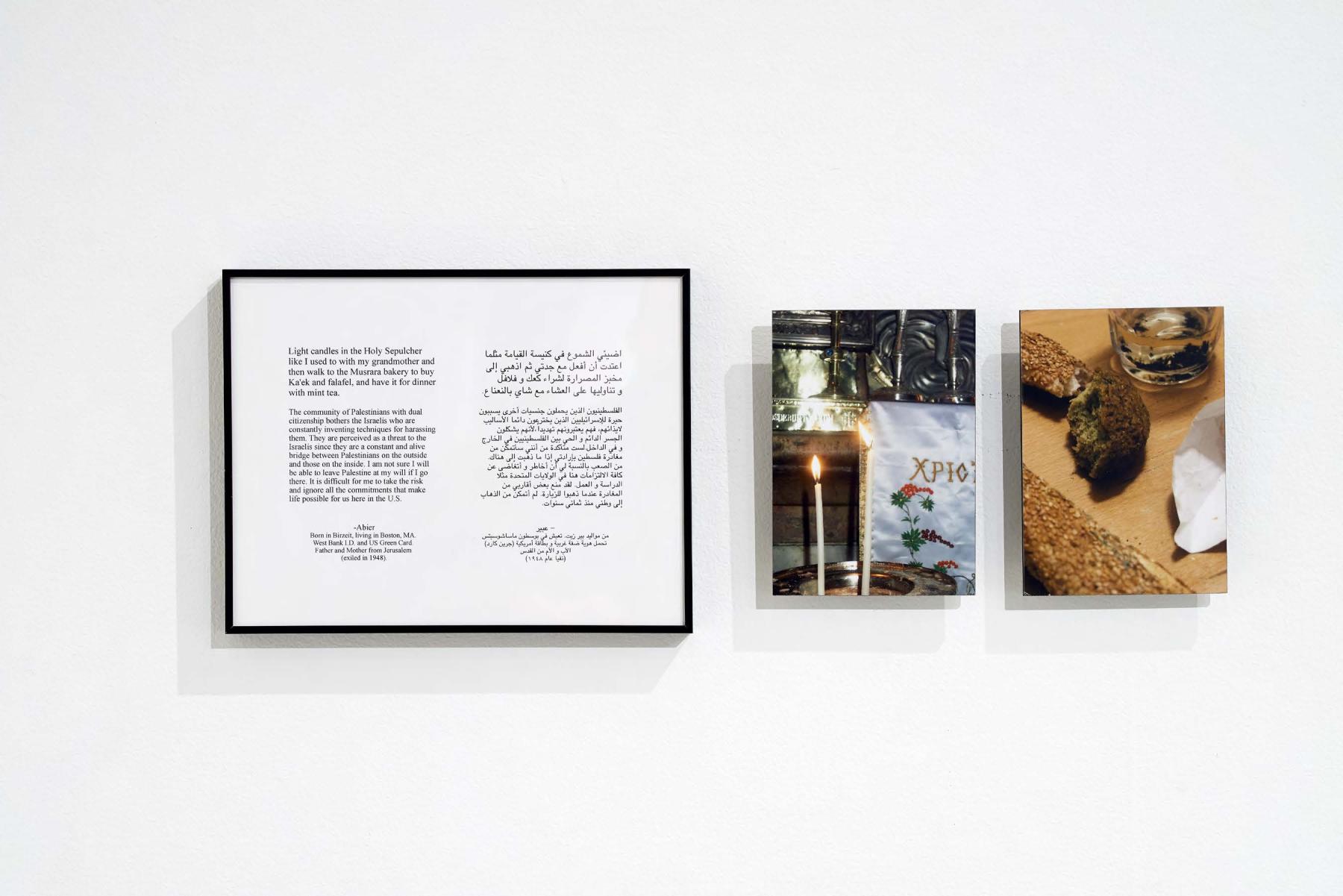
Below Osama’s message in the text beside the map, Jacir mentions his name and that he lives in Delaware with a Palestinian passport and West Bank ID. This identification appears in Jacir’s every other set, below the specified person’s message—such as that of Amal (born in Khan Yunis, Gaza; lives in New York City with a Palestinian passport and Gaza ID; parents were from Karatiyya and were exiled in 1948) or Abier (born in Birzeit; living in Boston, Massachusetts with a West Bank ID and US Green Card; parents were from Jerusalem and were exiled in 1948)—creating another map of divided-up identities, classified and surveilled for their existence by Occupying forces.
A closer look at the exhibited map reveals tiny crosses marked out in hand—over the seamless roads, proudly proclaimed by the Israeli Occupying forces in this official document while completely disregarding the reconfigured landscape. The map highlights the dead ends that have emerged from the building of divisive walls that abruptly cut through neighbourhoods, making Jacir’s journey to fulfill Osama’s request marked by the presence of Israeli checkpoints. Nevertheless, freedom was still afforded to Jacir—albeit a very different kind from when she drove into Texas for an hour, unhindered. The audio-visual work, from Texas, with love (2002) was evidently made during her trips to and from Palestine for this then ongoing project for which she creates a sonic bundle of the frustrations of checkpoints she shares with her Palestinian community. As T.J. Demos mentions in his 2003 essay "Desire in Diaspora: Emily Jacir," to her Palestinian friends, Jacir asked: “If you had the freedom to get in a car and drive for one hour without being stopped (imagine no Israeli military Occupation, no Israeli soldiers, no Israeli checkpoints and roadblocks, no ‘bypass’ roads), what song would you listen to?”
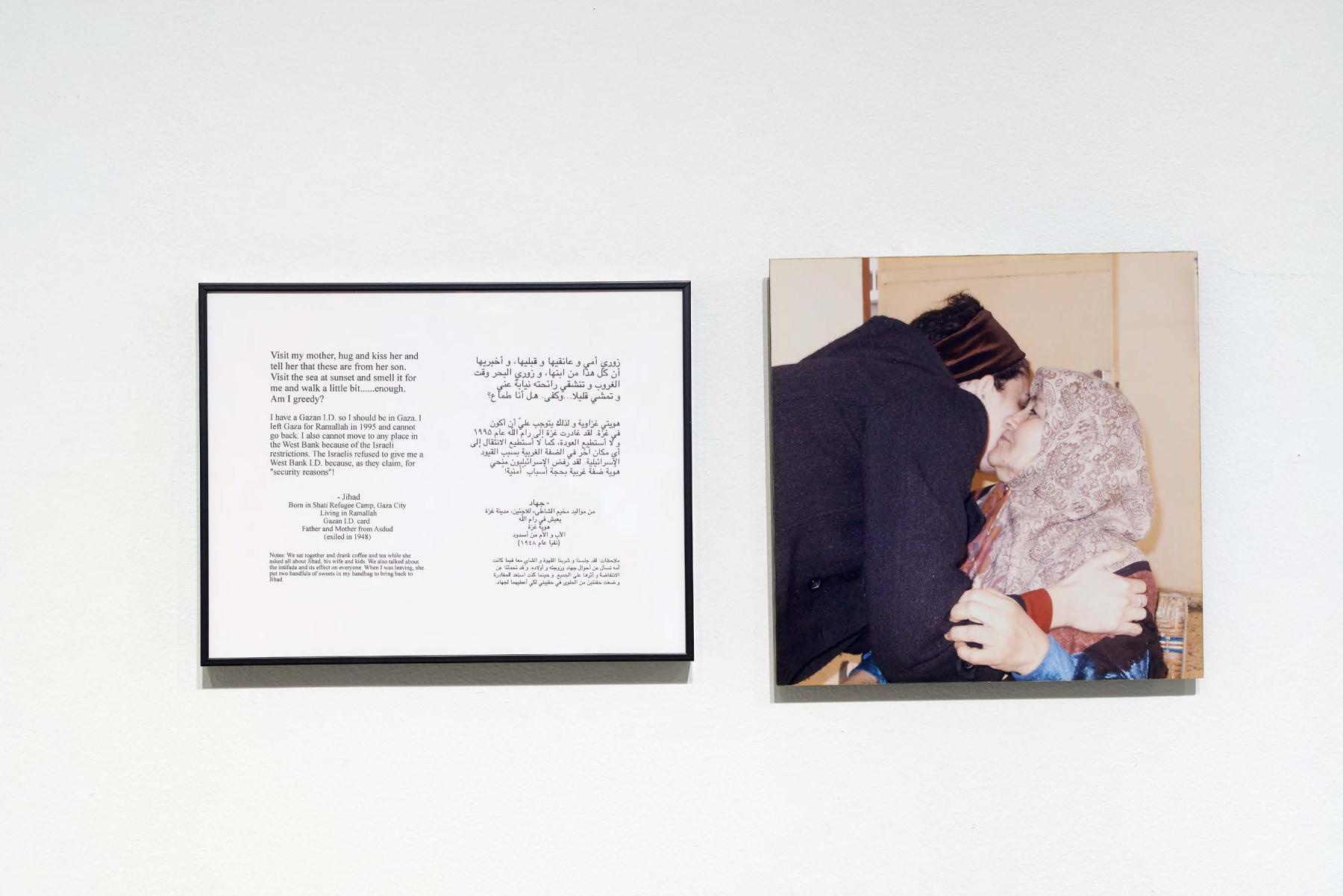
Jacir’s work arises from this community, whose needs and desires around a place they are not allowed to return to or move through become the ground on which she anchors her practice. Their voices documented as diptychs around the white cube space or as desires experienced through simulation—where the viewer can play a song from the playlist of all the songs her community far and wide sent her in response to her prompt, as the Texas road stretches ahead—is a practice towards imagining a free Palestine.
The second part of this essay will contextualise Jacir’s practice as an act of reclaiming mobility amidst the ongoing genocide of Palestinians and the prolonged restrictions on their movement under Israeli Occupation that denies them the right to exist in their homeland.
To learn more about artists exploring Palestinian community’s history and narratives, read Shefali Khan’s essay on Nemahsis’ (Nema Hasan) artistic practice, Anoushka Antonette Matthew’s review of Abdel Salam Shehada’s Ila Aby (To My Father, 2008), Kamayani Sharma’s reflections on three short documentaries that traces long colonisation of Palestinian childhoods, Santasil Mallik’s engagement with the photo book Against Erasure (2024), Asim Rafiqui’s two-part essay on his time in Gaza as a journalist amidst Operation Cast Lead in 2009 and Ankan Kazi’s review of Abdallah Al-Khatib’s Little Palestine: Diary of a Siege (2021).
All images are installation views of archival pigment prints mounted on alu-dibond and framed inkjet prints on paper of variable dimensions from Emily Jacir’s Where We Come From (2001-03), displayed at the exhibition, Emily Jacir | Where We Come From at Experimenter. (Kolkata, 2026. Images courtesy of the artist and Experimenter. Photography by Vivienne Sarky.)