

The Fate and Future of the Fakirani Jat: Sonum Sumaria’s Under the Open Sky
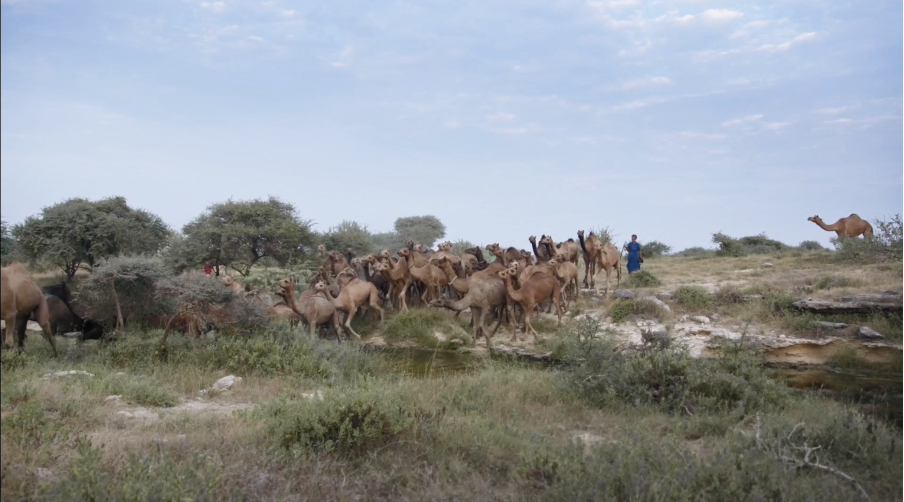
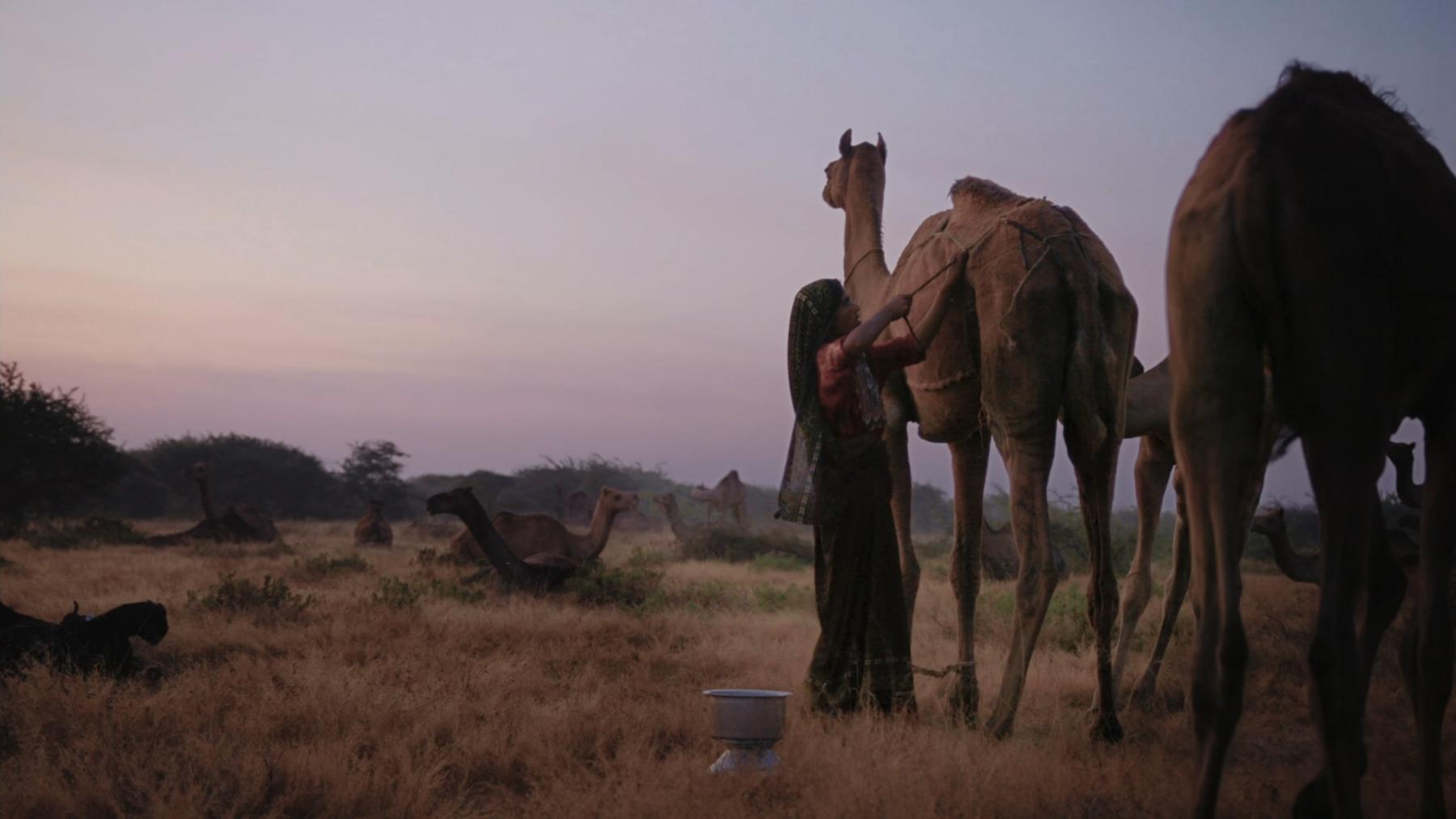
By the time we are introduced to Ahmed as “Father” in Sonum Sumaria’s feature documentary Under the Open Sky (2024), he has displayed such tenderness and warmth towards the camels he rears that one wonders whether the subject of the film is as anticipated—the struggles of a nomadic family amidst changes in a neoliberal economy—or the filial relationship between pastoralist and animal. As the story unfolds, one realises that the two are inextricable; the relationship between herder and camel mirrors that between parent and child. A mixture of play and protection, it grounds the relationship between humans and nature as one of understanding, mutual respect and nourishment. In this worldview, the perpetual strife for care, sustenance and interdependence with nature and community becomes a quiet meditation on a system of ethics that is in polar opposition to the logic of profit in capital. And what it reflects is not so much romantic nostalgia for a time past but, rather, a present struggling to survive and pushing itself into the throes of a future still pregnant with the possibility of alternative imagination. A future not yet stillborn.
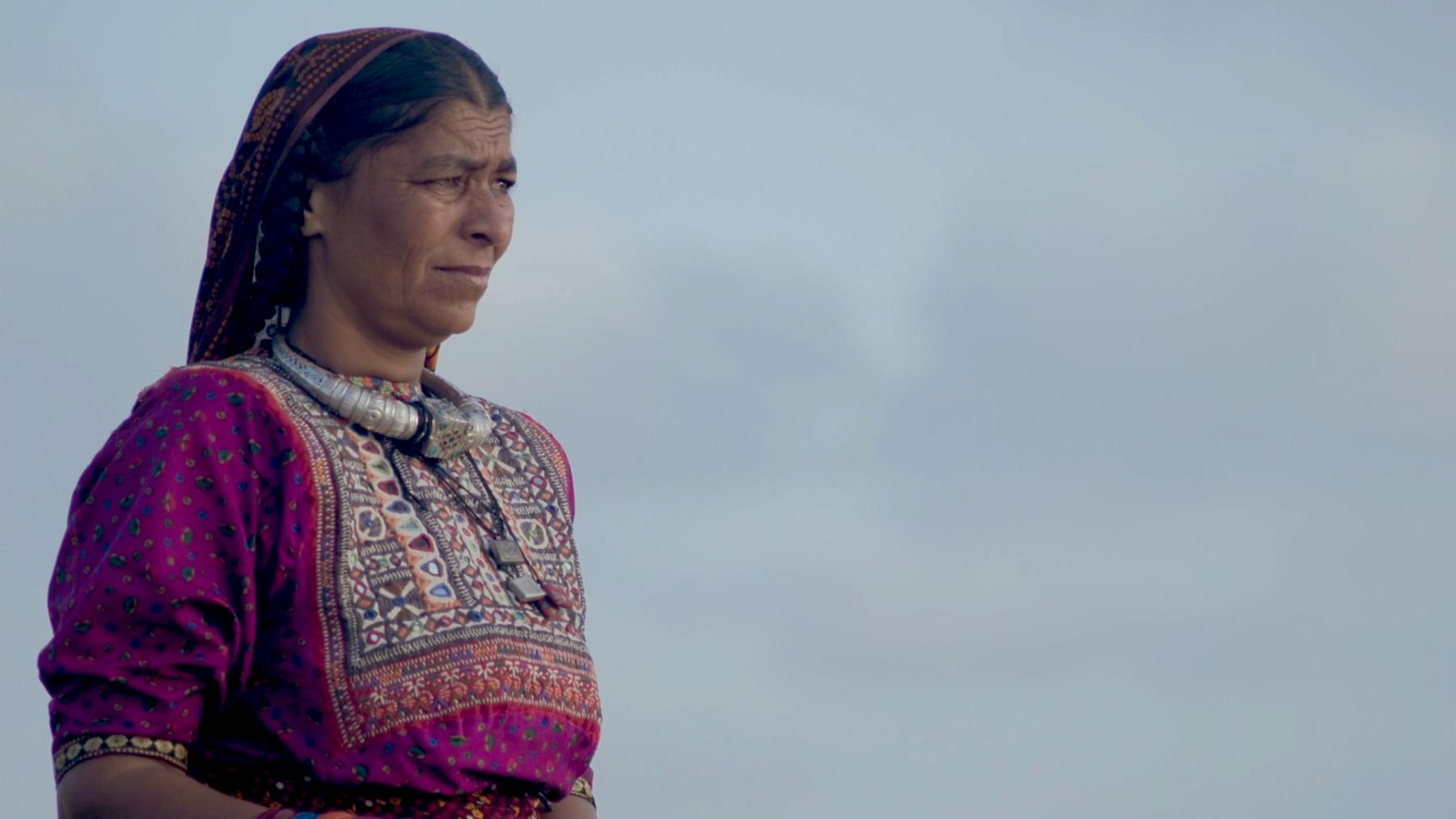
Before we are introduced to Sakina—“Mother”—we hear her voice call out to her younger children, Anwar and Noorbano, to not trouble the goat as she is getting contractions even as they jibe at the animal for the sounds she makes.
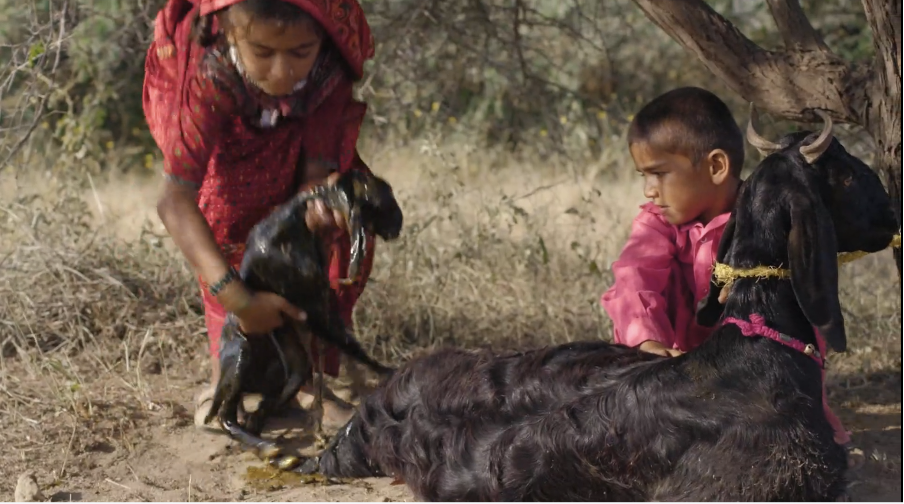
And just like that, Noora picks up the newborn baby and announces to the mother—Sakina and the goat—that the latter has had a daughter. Reared in herding and caring for animals, children learn indigenous knowledge and the values of shared labour through osmosis, as a patient parent guides. And yet, this is a reality fast fading into the past.
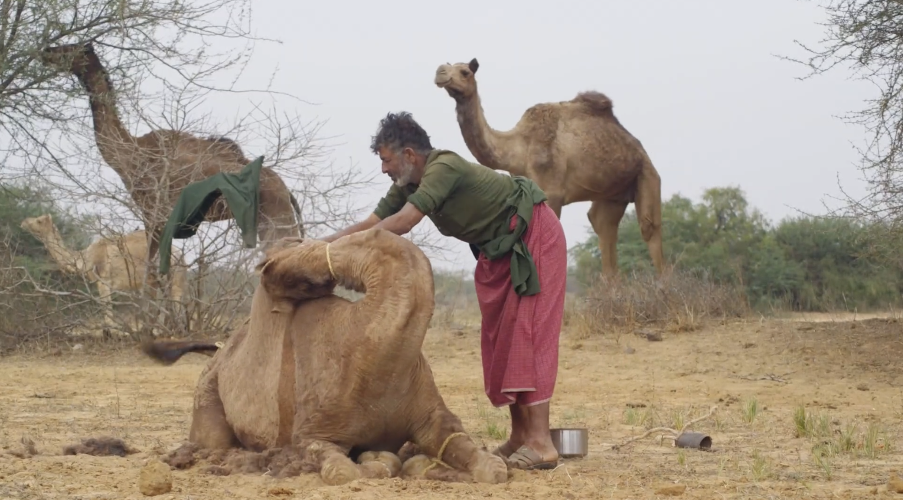
The Fakirani Jats, concentrated around the coast of Kutch and the Gulf of Khambat, claim descent from the Indus River Delta in present-day Sindh and Balochistan. Known for breeding Kharai and Kutchi camels, they are followers of Savla Pir, a revered Sufi saint, who lived with his camel heard about 400 years ago on an island in Kori Creek in Pipar village in the Lakhpat taluka of Kachchh. The seventy-year-old Aga Khan Savlani is the spiritual leader of the Fakirani Jats. A quarter into the film, Ahmed reminds his fellow pastoralists of Aga Khan’s warning—that the government would give away land to industrialists and that there would come a time when nobody would listen to the poor but the wealthy would have many people to support them. The time that Aga Khan was talking about has come, Ahmed says in a light but ominous tone.
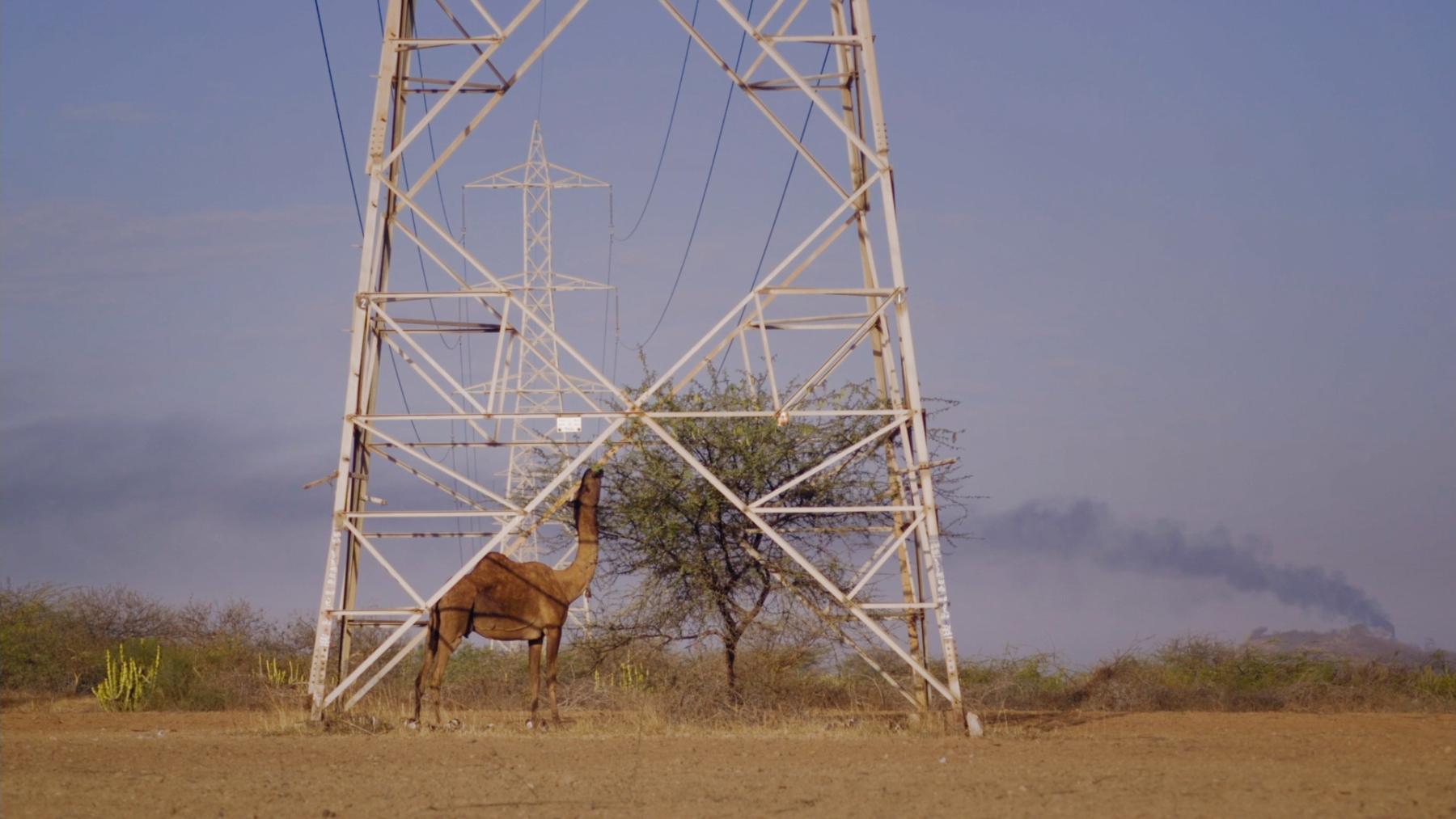
The struggle for survival faced by nomadic tribes is framed by an image of a camel navigating space between a telecommunication tower so it can reach for the leaves on the tree behind it, as Ahmed’s voice confirms his willingness to attend the meeting of pastoralists that is to take place in Bhuj. Here, the pastoralists dictate a letter to the chief minister and the collector stating that while 40 acres have been allotted per 100 buffaloes to farmers, this government has not provided any grazing land for sheep, camels or goats. Such discrepancy harkens back to colonial policy of land use and survey settlement that, despite being extractive, favoured arable farmers and agrarian systems of production at the expense of nomads and pastoralists. Wandering people, nomadic communities were considered suspect for being carriers of dissidence and many were categorised as criminal tribes, as Christopher A. Bayly argues in his majestic The New Cambridge History of India Vol. II (1988).
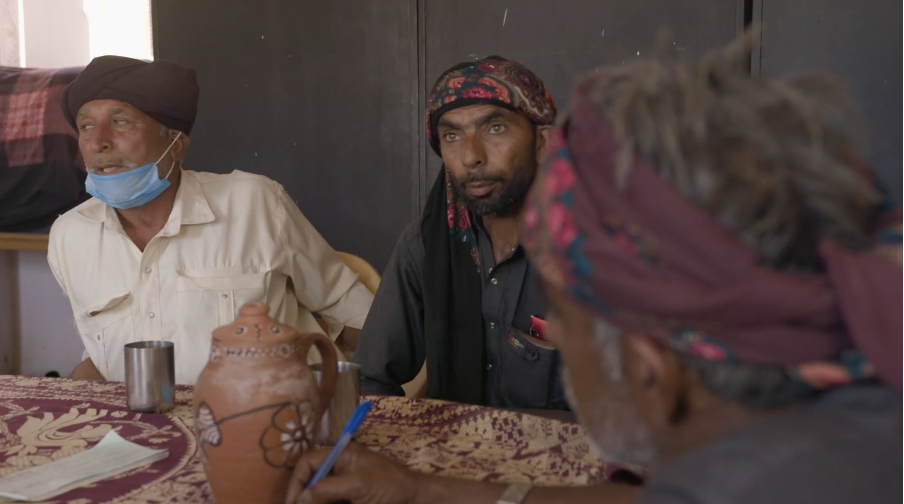
Further, the discussion of the pastoralists delineates the conflict, on the one hand, between the Forest Conservation Act 1980, which aims to prevent deforestation and on the other, the Forest Rights Act (FRA) 2006 , which recognises the rights of pastoralists such as the Fakirani Jats who have depended on forests for their livelihoods for over 500 years. Ironically, however, while the FRA claimed to reverse historical injustice of colonial-era forest laws such as the Indian Forest Act of 1865 and 1878 which prioritised resource extraction for imperial revenue over customary rights of indigenous communities and ecological conservation, the postcolonial, neoliberal state is repeating these injustices. And in its stead, as the pastoralists lament, industrialists are being permitted to grab land and destroy livelihoods. They are not even hiring locals so that there is a proliferation of joblessness that makes any argument for “State-led development” through renewable energy and mining a myth since mineral extraction results in utter depletion of land even as the people are left out, as is evident across Chattisgarh, Odisha and Jharkhand—states rich in mineral resources and indigenous communities.
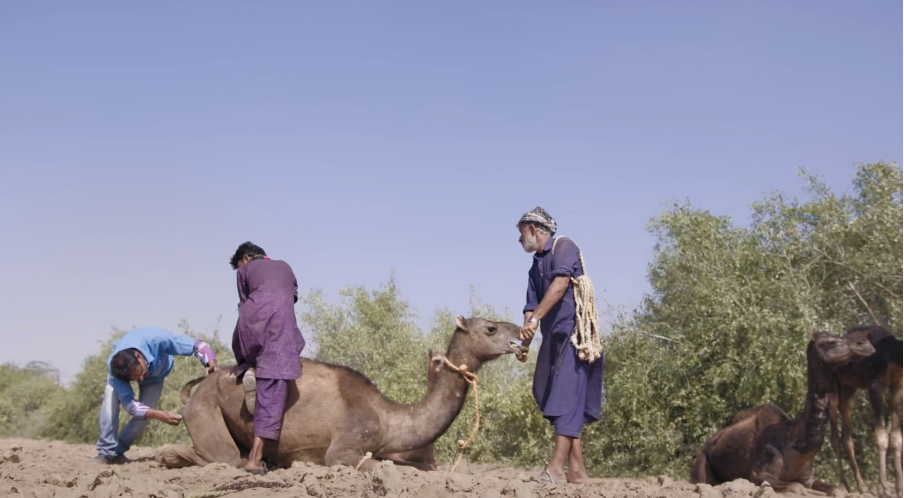
Sumaria took five years to complete filming, she shared, because an integral part of Ahmed Bhai’s family—the camels—began getting sick from pneumonia. As the film shows, eventually most of them died, and he was left with a loan of 7 lakhs that he had taken for their treatment, even as he was forced to shift to the rearing of buffaloes. He knows little about buffaloes, he shares, and while he can do any type of work—he had grazed many animals in the past and had even worked in a coal mine—he belonged to a nomadic community whose tradition it is to go from place to place in search of sustenance.
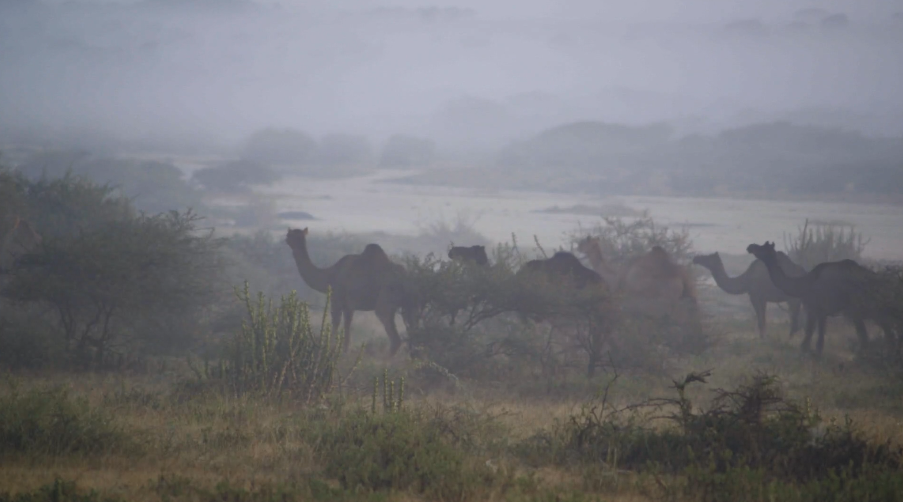
A well-wisher asks him why he does not accept the offer a fellow pastoralist from the Hindu-Rabari community made him. As per an origin myth of the Fakirani Jats, narrated by Umar Haji Sulemain, a Sufi poet from the region, there was once a disagreement between two Rabari brothers about the ownership of a camel. They went to Savla Pir to resolve the dispute. He created a camel out of beeswax and asked the brothers to choose between that and the real one; while the elder brother chose the living camel and went his way, Savla Pir blessed the younger one, Devidas, who was left with the beeswax camel. He assured him that a herd will follow him on his return journey and will continue to grow if he promised to not look back until he reached home. Savla Pir also instructed Devidas that were the latter to find himself with too many camels, he ought to entrust them with the Fakirani Jats. This is why Fakirani Jats still take care of camels that the Rabaris assign to them. Thus, when Ahmed Bhai declined the offer made by the Rabari, in contradistinction to the tradition of his community, it was because, he said, he was running out of luck, and had begun to lose faith in his fate as a camel herder.
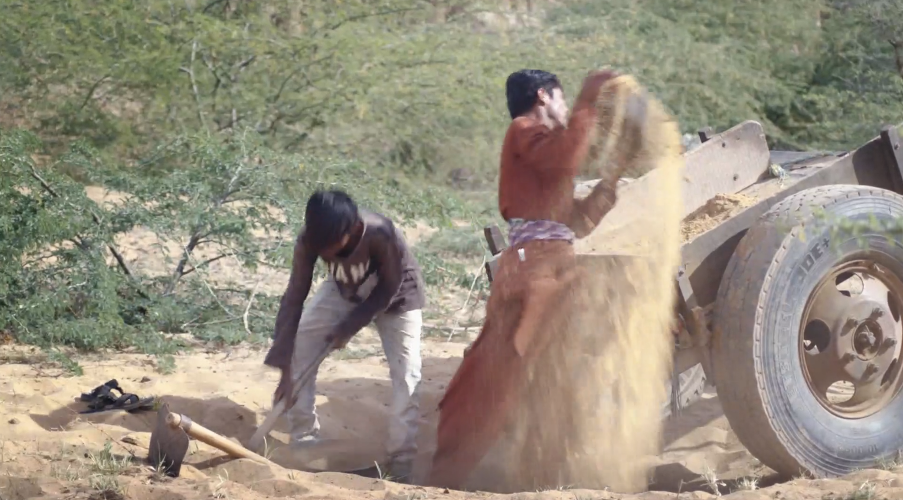
The conflict in the encounter between customary ways of life and livelihood against modern forms of expropriation of land and resources for profiteering lies at the heart of the film. On the one hand, we are made aware of the ways in which the forced disappearance of pastoral livelihoods is a microcosm of a broader story in which profiteering has become the motive of governance and Maldharis—pastoralists—across the nation are not legally recognised by the government. For families like Ahmed Bhai’s, there is little option left but to adjust and accommodate to new forms of living that enable expropriation by systems in power in the garb of “modernity.” Both Ahmed Bhai and his eldest son Tajmamad shift to digging, loading and transporting sand in a camel cart everyday, for which he receive between Rs. 100-150 for each lap. Anwar and his little brother Haneef are enrolled in a school, while the eldest daughter, Hanifa, is married into a “settled” family.
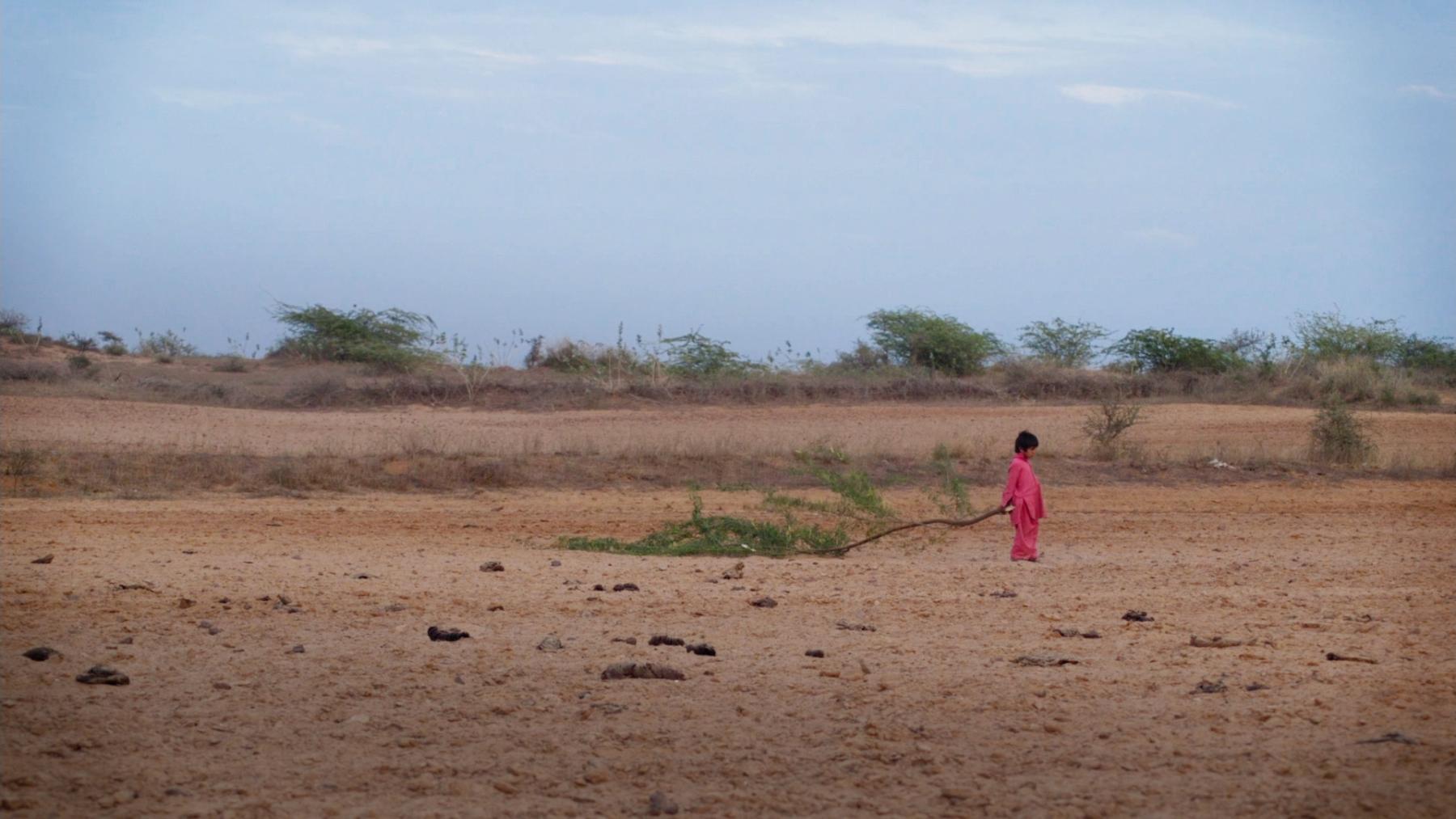
And yet, in the face of loss, the Fakirani Jats offer to us an enivable system of ethics that governs the relation of humans with oneself, with the other, with community and with nature. Instances of this are replete in the film. In an evocative scene, the camera fixes onto a frame wherein Anwar struggles to drag a branch more than three times his size to build a fire. Ahmed easily carries his share away and a tired Anwar, looking ahead at his father, brings himself to drag the branch forward. The camera, like the father, waits for Anwar to take his time. Soon after, while packing before moving to a new site, Sakina suggests leaving half their things behind so they do not have to carry as heavy a load, and dismisses any concern of rats tearing up their clothes by saying that “If we don’t harm them, they will not harm us.” And after the camels have died and the adolescent Tajmamad is now shouldering a significant share of the family’s responsibility, this aloof young man, who has been seen toying with the attractions modernity brings—a bike, a phone—is now writing poems of pride about his community and uploading them onto YouTube.
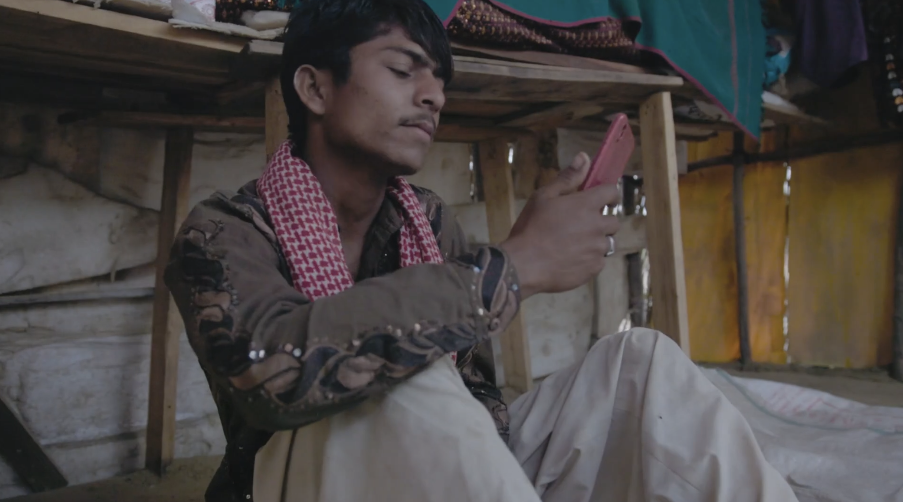
However, “loss”—if felt—cannot take on the quality of romantic nostalgia, as Sumaria says was the case with Hanifa’s husband’s family, who, now ordained to operate an alienating machine, fantasise about a “lost” nomadic, adventurous life that had once been theirs the loss of Fakirani Jats take on on life as songs of the soul, for instance, when we hear Musa sing of whom he belongs to, of his dear Maldharis who walk along with their animals despite the pain and hardship, and of where he belongs, of his native land Kutch, for whose happiness and well-being he and his community always have prayers in their hearts.
Thus, when Sumaria screened the film for the Fakirani Jats in February earlier this year, she shared that Taju came up to her with tears in his eyes. He was glad that his family had been immortalised on screen. “Even if our descendants do not continue what we do,” he said, “they will know what their ancestors did.” Like the Fakirani Jats who continued to remain camel keepers to retain the promise their reverend saint made, the film acts as a keeper of community memory for the Fakirani Jats. It also resoundingly demonstrates to us the possibility for the persistence of ethical modes of being inspite, despite and in the face of dominant systems of extraction. It tells us, the lands may have been taken, but the horizon is not foreclosed.
To learn more about indigenous communities facing dispossession from their forest lands, read Shivani Kasumra’s article on dispossession in the Anthropocene, Anisha Baid’s reflections on the displacement of the Tharu community from the forests of Chitwan and Nikita Jain’s documentation of Adivasi resistance in Bastar.
To learn more about the films screened at the Kolkata People’s Film Festival 2025, watch Vishal George’s conversation with Thomas Sideris on his film Gas Station or Pigeons of Lahore (2024) and read Sahil Kureshi’s reflections on Sanjiv Shah’s Hun, Hunshi, Hunshilal (1992) and Kshiraja’s observations on Sara Saini’s In the Wake of Remembering (2024).
All images are stills from Under the Open Sky (2024) by Sonum Sumaria. Images courtesy of the artist.