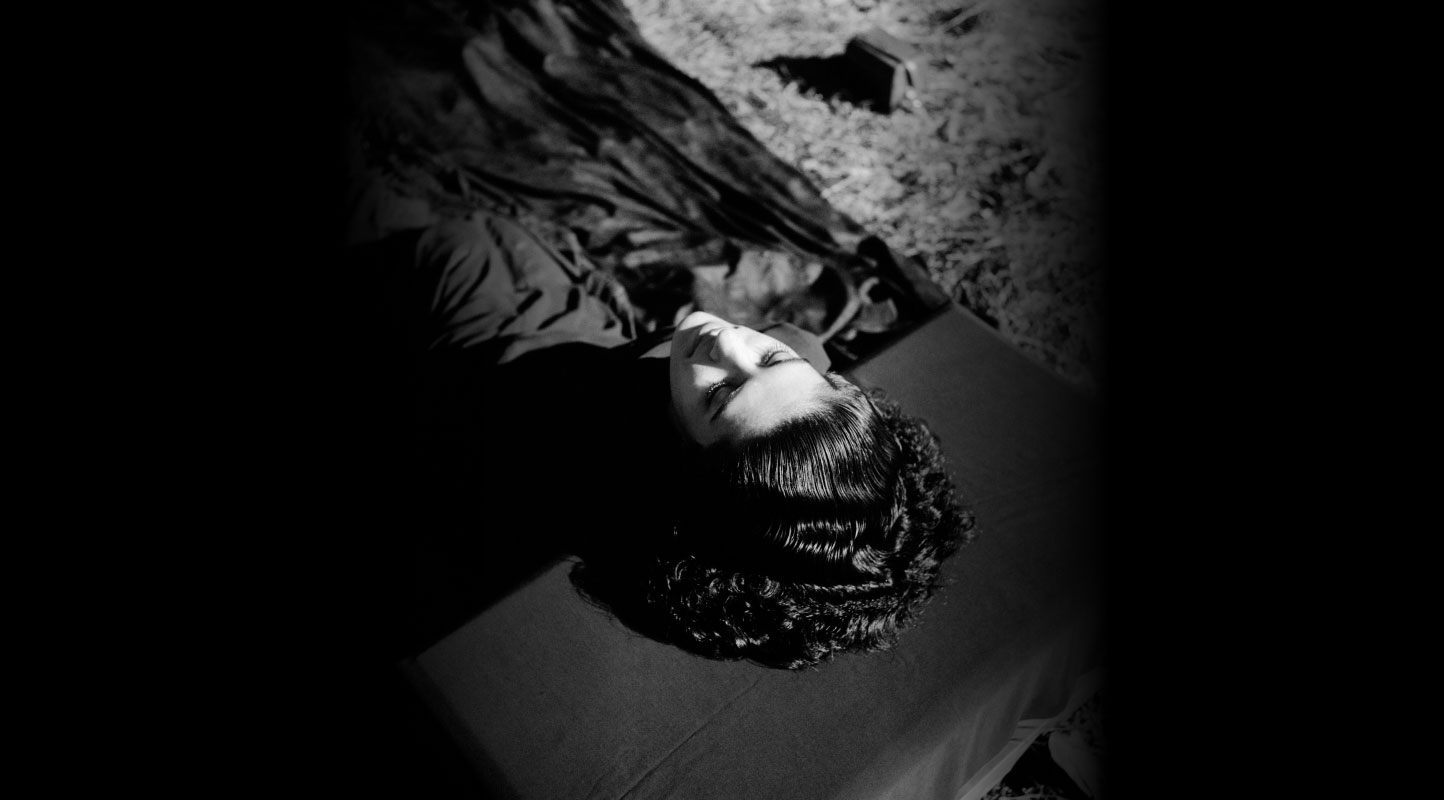

Becoming and Unbecoming Our Mothers: Bunu Dhungana’s Curatorial Practice
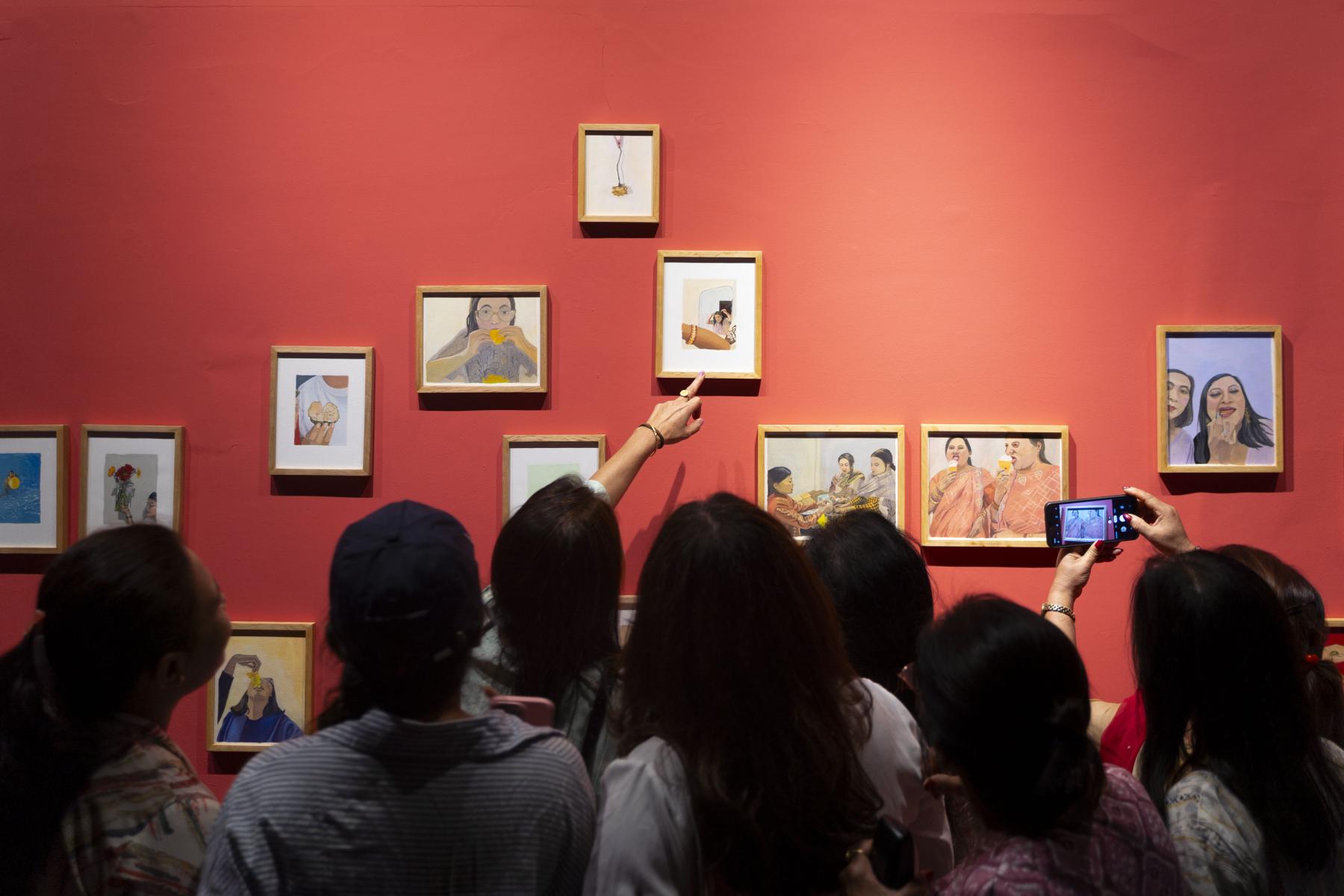
Women engage with Shristi Shrestha’s "Take Care," a continuation of her paintings which she began during the pandemic that reflects on memory, place and care.
At the opening of the exhibition some things in the belly at the Nepal Art Council in Kathmandu, Bunu Dhungana exclaimed, “I was so nervous. My first curation in Nepal!” The group exhibition ran from 3–16 May 2025 and featured the works of Asmita Badi, Shradha Devkota, Irina Giri, Rachel Lowe, Ujjwala Maharjan, Tripty Tamang Pakhrin, Shristi Shrestha and Prateebha Tuladhar.
The idea began in 2023 when Dhungana approached the artists and gave them the word “mother” to respond to. Before that, Dhungana had been working on it on her own since 2018. However, the first iteration of some things in the belly—which Dhungana did with Khoj as part of CISA (Curatorial Intensive South Asia) in 2023—was about instincts: listening to the gut and trusting non-verbal ways of relating, understanding, making and doing.
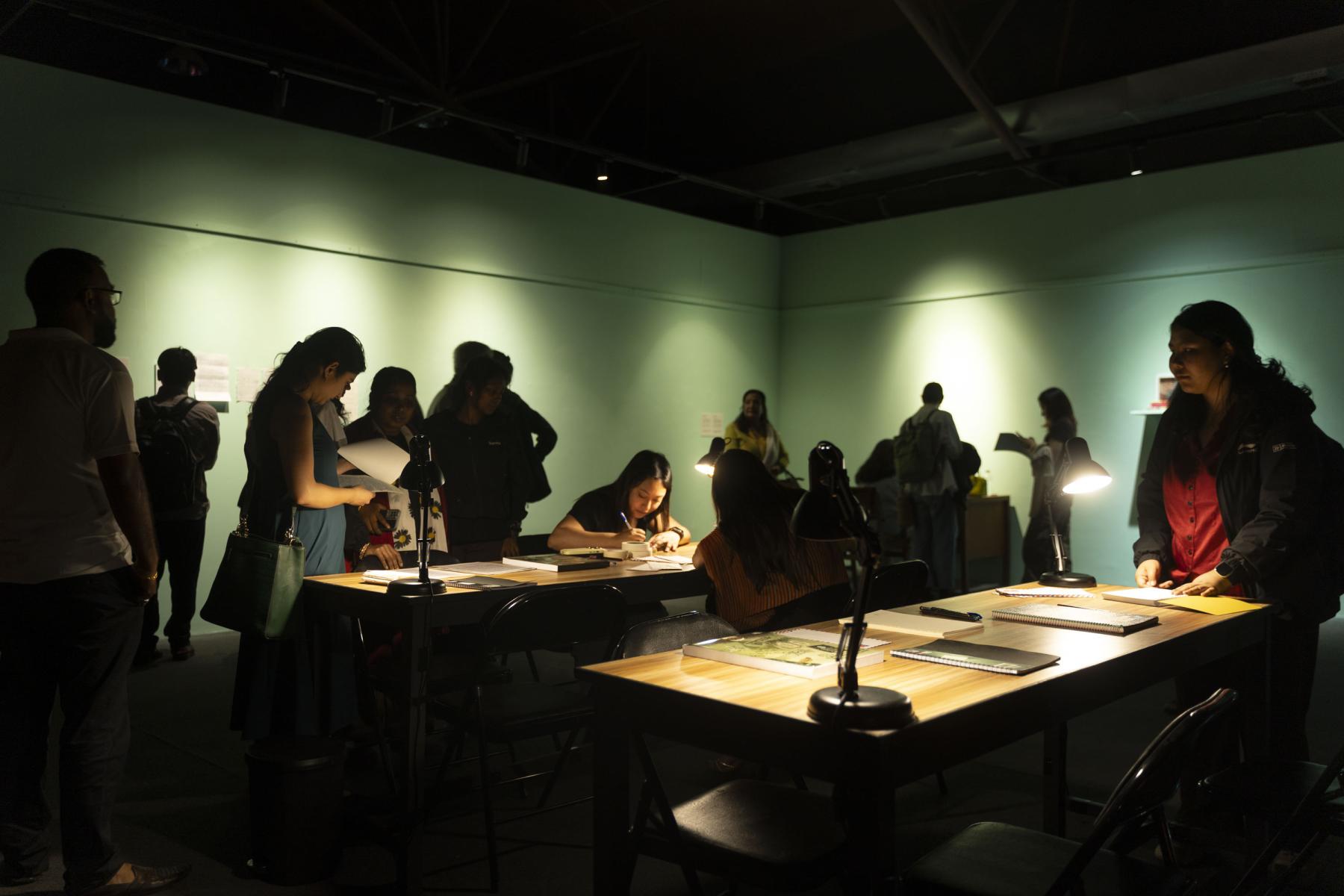
Visitors write at the desk set up for letters dedicated to their mothers.
Women often receive comments from other members in Nepali society that they cannot keep anything in their stomachs. So the artists just decided to take that and claim it for themselves as if to say, 'We can own it.' Dhungana retorts,“Oh, we cannot hold everything in our stomach? Why should we hold it within us? We are not going to hold everything in our bellies anymore.”
She first thought of reaching out to Irina Giri. Similarly, Tripti Tamang Pakhrin had been thinking about this kind of work in university with photographs. Shradha Devkota was in London, trying to make something too. “I love writers and poets, so I thought of Ujjwala (Maharjan) at that time,” Bunu says with a smile. Having admired all these people from afar, she wanted to know them more intimately. So she reached out to Maharjan, who introduced her to Asmita Badi. Sharing her meeting with Badi, Dhungana recalls thinking: “My god, this woman is so amazing! I have to invite her too.” As Badi agreed to come on board, a Zoom conversation in which Prateebha Tuladhar was interviewing Smriti Ravindra really struck Dhungana since it was about Tuladhar’s relationship with her mother. “I did a little research and thought of bringing in Prateebha to write something.” Dhungana credits her intuition.
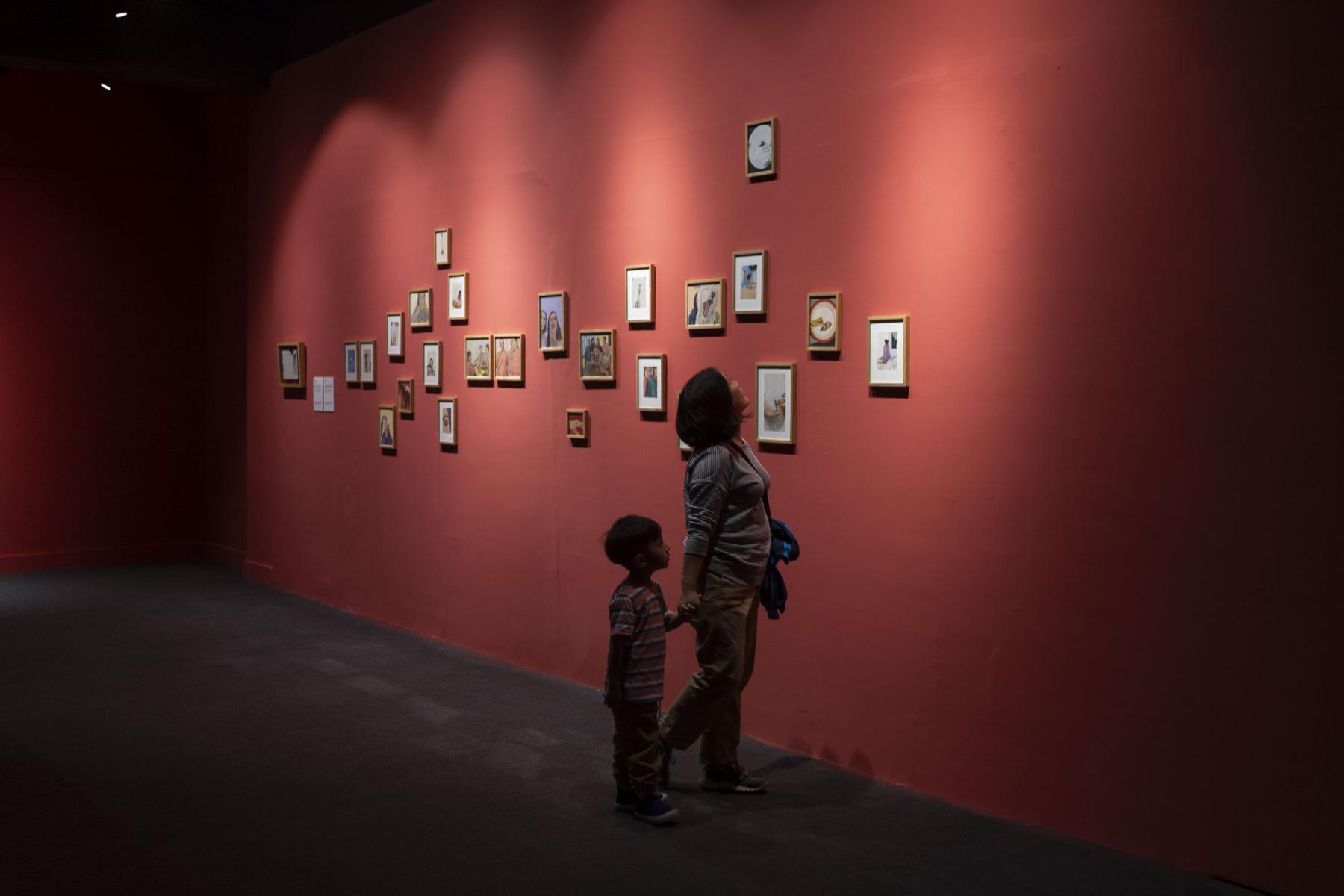
A mother and child pause before Shristi Shrestha’s Take Care.
In this manner, a thread of connection began to form. Badi wrote a poem titled “k bachnu bhaneko saans fernu matrai ho? (Does living mean breathing only?)” Likewise, Shrestha made a painting, and the project expanded and also started coming together.
All of the artists showcased practise art in different mediums. Devkota did embroidery for the first iteration and embroidered a curtain with the text “I have something to say to you.” Tamang Pakhrin showed her Polaroid work—where she realised her two mothers did not exist in each other’s photo albums, so she created her own family album. Tuladhar had written short stories. Maharjan had begun the journey of pwa (stomach in Newa language) , a musical monologue project. After coming back from the CISA fellowship, Dhungana wanted to expand the mediums beyond visual arts, particularly writing and poetry.
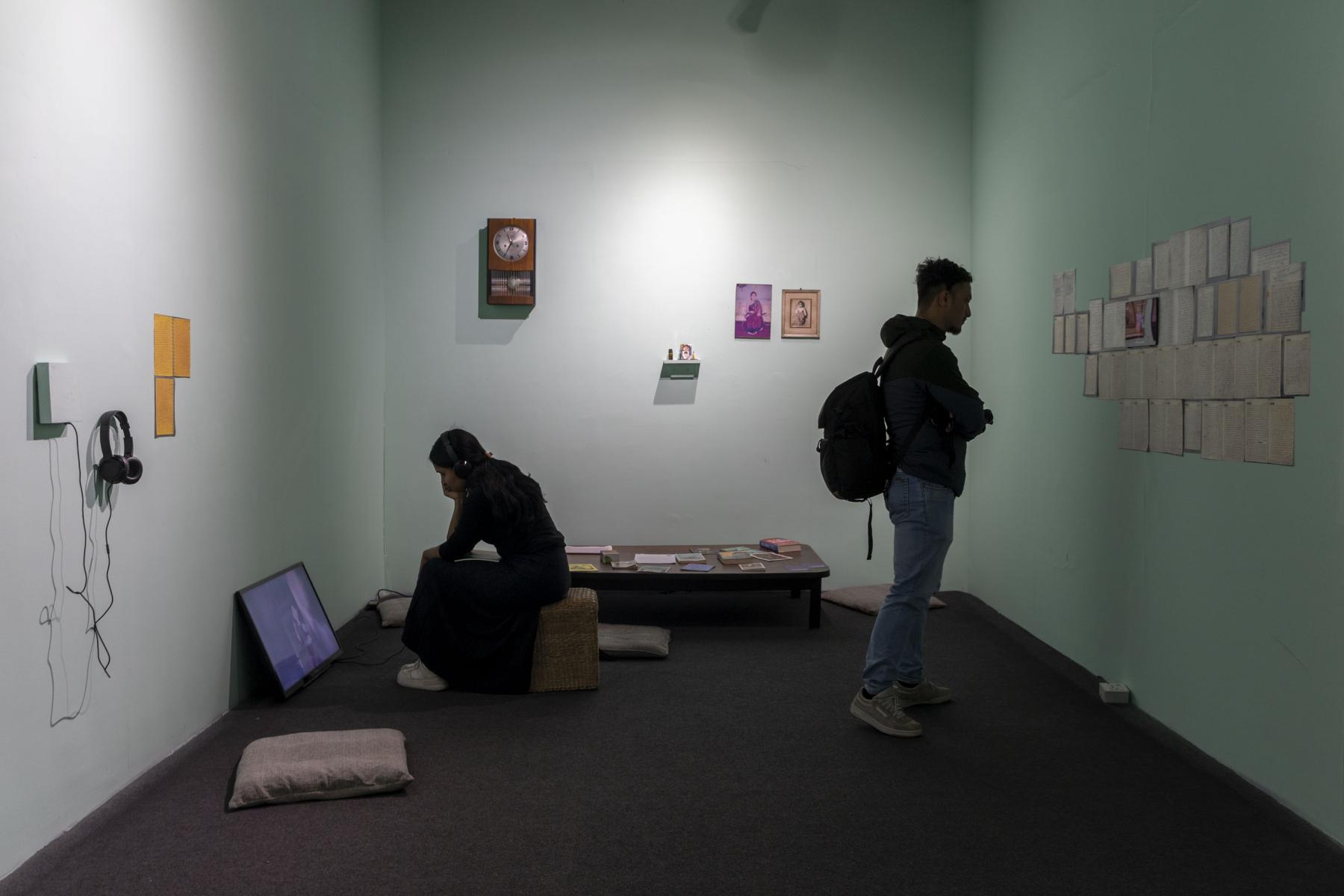
A woman listens to an audio-video installation from Ujjwala Maharjan’s "What I Wish for You," while a man looks at a wall of pages from the artist’s journal.
“I really wanted to show it in Nepal, but I also wanted to take some more time to talk more with each other and build a certain kind of sisterhood in the process.” All the artists agreed to continue with their same work in different ways, which birthed an interactive exhibition curated intentionally.
“The letter was at the heart of it. In 2018, my mother had written a letter to me, and we exhibited it,” Dhungana jogs her memory. Showcased as part of Confrontations at PhotoKTM in 2018, the letter resonated so well with people that they said it could have been written by their own mother. For this iteration of the exhibition, Dhungana told the artists to write letters to their mothers and vice versa. Ruminating on the question “How long will this form—letter writing—be with us?” Dhungana invited these women to join her vision, as she felt that she could not understand it alone. “Now the nine of us won't understand it, so let's invite everyone,” she adds with a hint of a laugh.
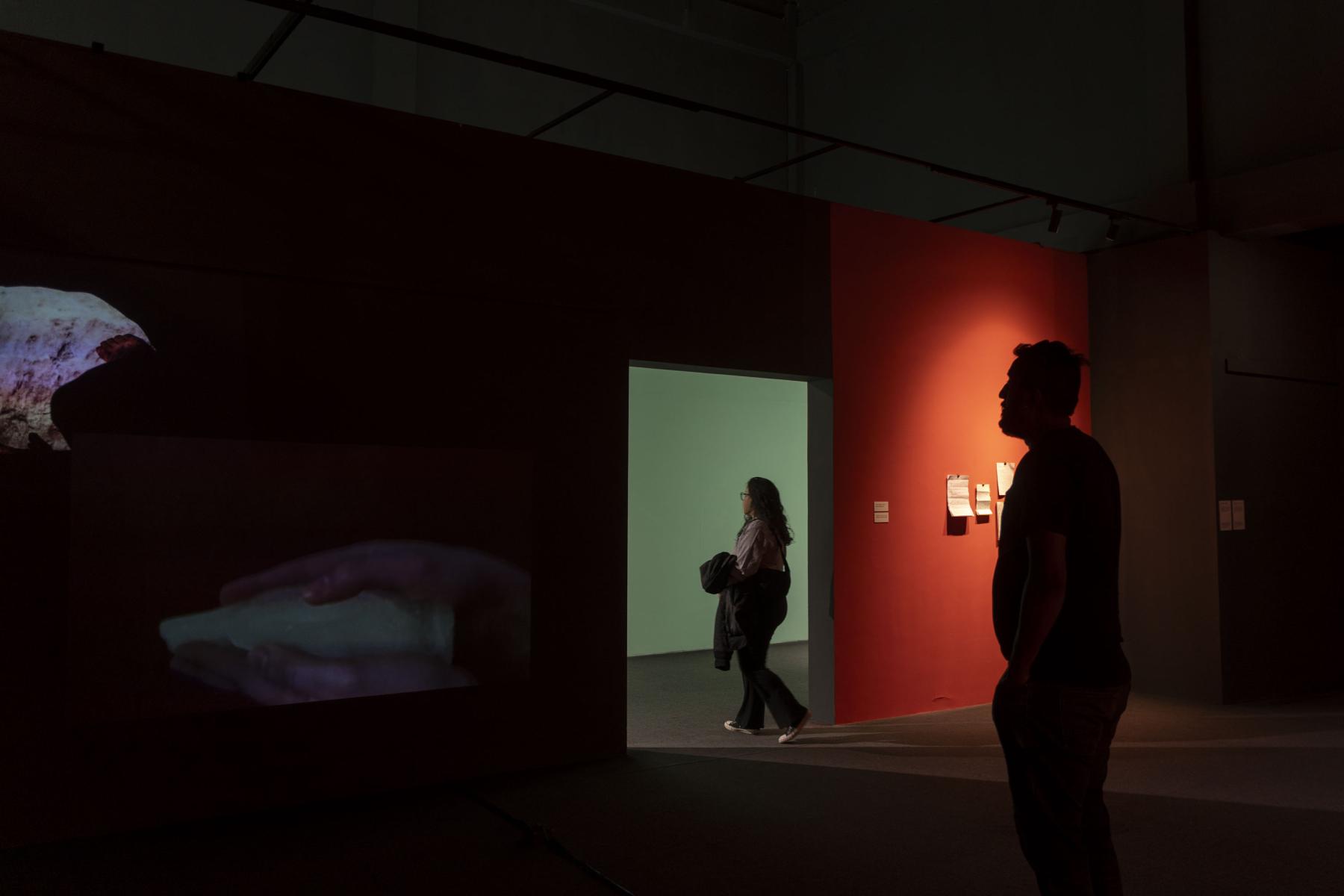
An image from the exhibition space with Shradha Devkota’s "The Urgency of Now" in the backdrop — a video installation engaging with themes of home, memory and the body as both material and site of performance.
Dhungana wanted to create a dedicated space where people could come and write without the fear of judgement. “They could just be themselves—write anonymously, tear it or drop it in the box or take it home. Nobody was compelled to share.” The artist wanted to hold space for discomfort.
However, the mothers were a bit hard to convince to write the letters. As mothers often do, they shrank themselves and hesitated. While they felt that they did not have much to say, their letters indicated otherwise.
Devkota made a video where she addressed her mother, asking, “How did my mother learn to become a mother without a mother?” As if in response, Devkota’s mother’s letter speaks about that absence. Despite being in two different places, they were in a synced conversation, responding to each other.
Shrestha’s mother’s letter imagines that her daughter's aunties were a big part of artist’s life in Nepal. This sense of motherhood through extended care could be seen in her paintings.
Badi asks, “Is living only breathing for my mother? What about her hopes and dreams?” Giri used sound to express herself, borrowing from other poets, including her sister. Not using words—but sound.
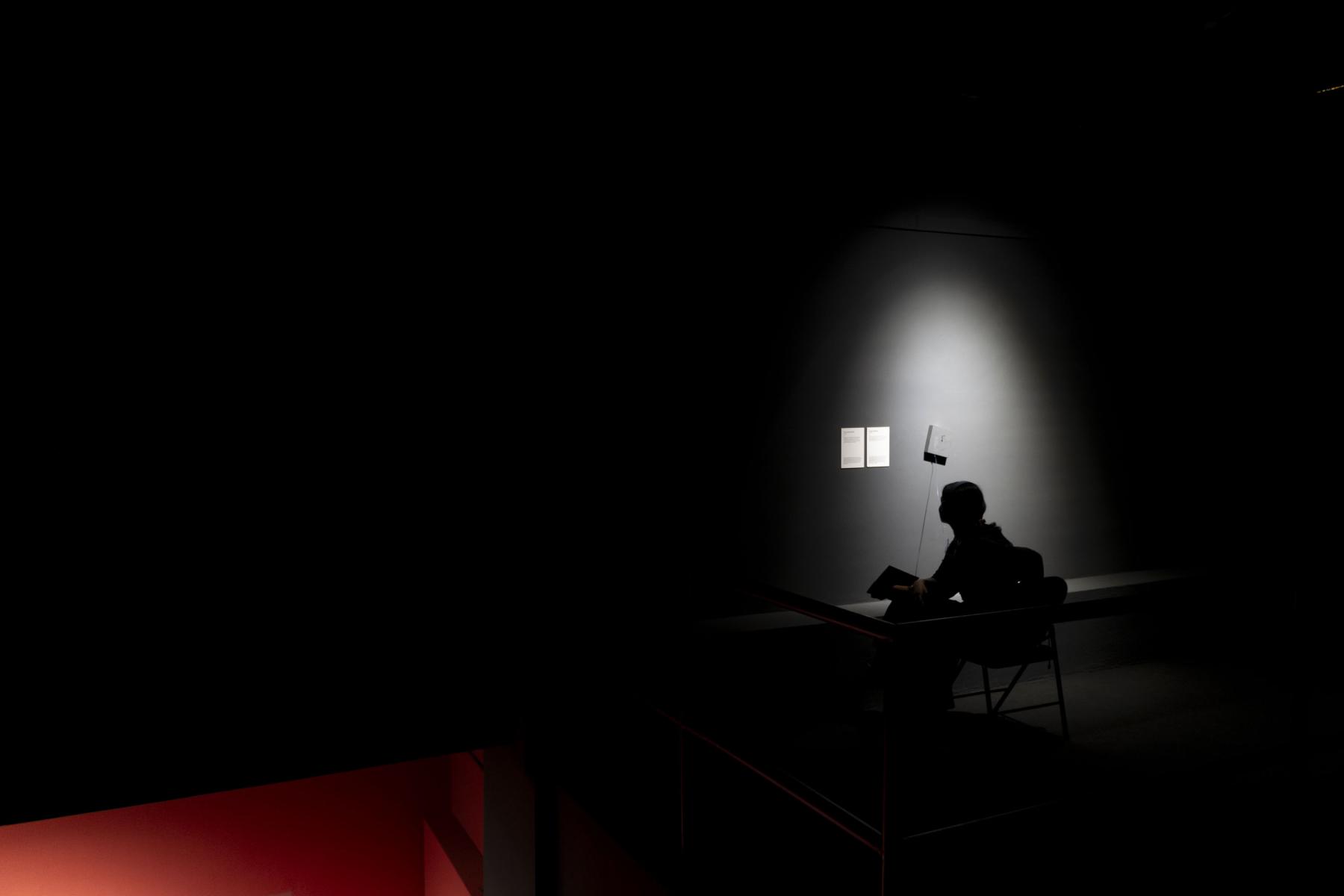
A visitor listens to Irina’s "The Mothers Selves," a sound work interpreting poems by Itisha Giri (Naniji), Ocean Vuong (Snow Theory), and Sylvia Plath (Morning Song).
In this whole process, Dhungana did a lot of back and forth with the artists because, as a curator, her duty was to listen to the artists and try to support what they had imagined. They went through a lot of conversations, trying to find common ground without trying too much to adjust and compromise, which is not something new to working as women artists. “Although it was difficult in some ways, I liked that they said, ‘No, I want that changed. The lighting is not working.’ That assertiveness was amazing to witness. Women artists saying, ‘This is what I want.’ That’s powerful,” She lights up.
When people came to Dhungana to thank her for the exhibition, Dhungana saw her mother beaming with joy. Usually her mother is at the receiving end of disapproving comments back home about how her daughter is unmarried and does art. "I no longer worry about what people will say or think because I do not want to wait till I am eighty-years-old to stop giving a fuck." Dhungana shares. Crossing forty-years-old definitely impacted her approach to the exhibition, simply because she felt she was able to do this—an internal shift she cannot exactly describe except that her life feels lighter now and she wants minimalism in her personal life.
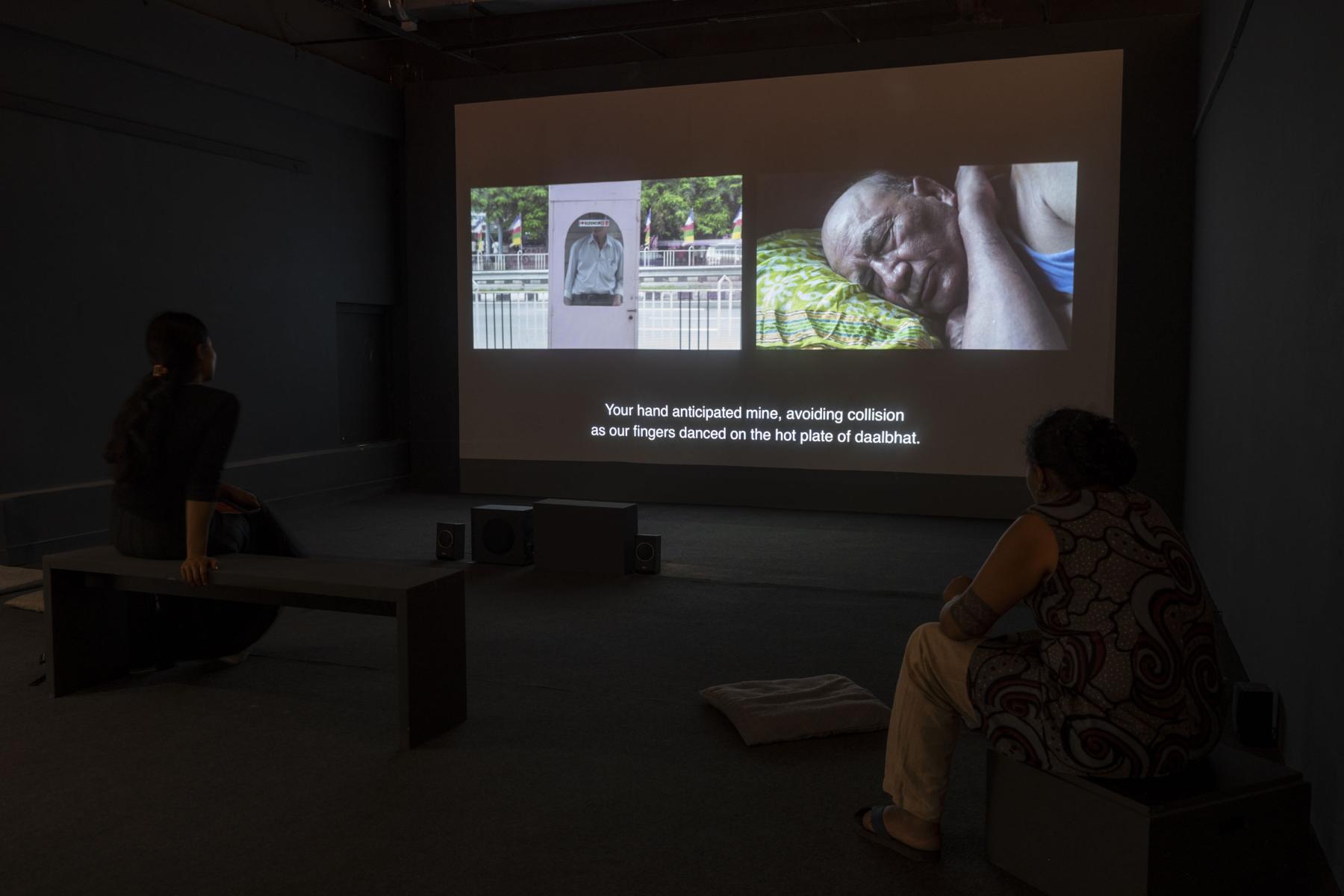
Two women watch Tripty Tamang Pakhrin’s "Welcome to Hotel Thai," reflecting on life in her family-run lodge and home on the Nepal–India border, managed by her birth mother, father and her father’s first wife.
Always conscious about wanting to work with women artists, Dhungana considers the exhibition a proposition to embrace femininity. “I think my intention was in the right place. I understand that there are absences or gaps within the show and other things I need to work on,” Dhungana speaks with honesty.
There is an acceptance in her tone holding resemblance to what she adds about being like her mother: “We didn’t want to be like our mothers, nor did our mothers want us to be like them. We ran away from it, only to realise we are not that different from them.” Dhungana echoes a common memory as she shares that at some point in our lives, most of us have thought, “Why do I sound like my mother?” “Why do I think like her?” But what are we if not constantly becoming and unbecoming our own mothers?
This constant push and pull was beautifully depicted in the exhibition to humanise our mothers and emphasise that they deserve better and should have a chance to live for themselves. Empathising becomes imperative because mothers are often seen as these figures who must commit to the thankless job of mothering. A friend of Dhungana’s told her at the exhibition that they had never thought about their mother as a woman.
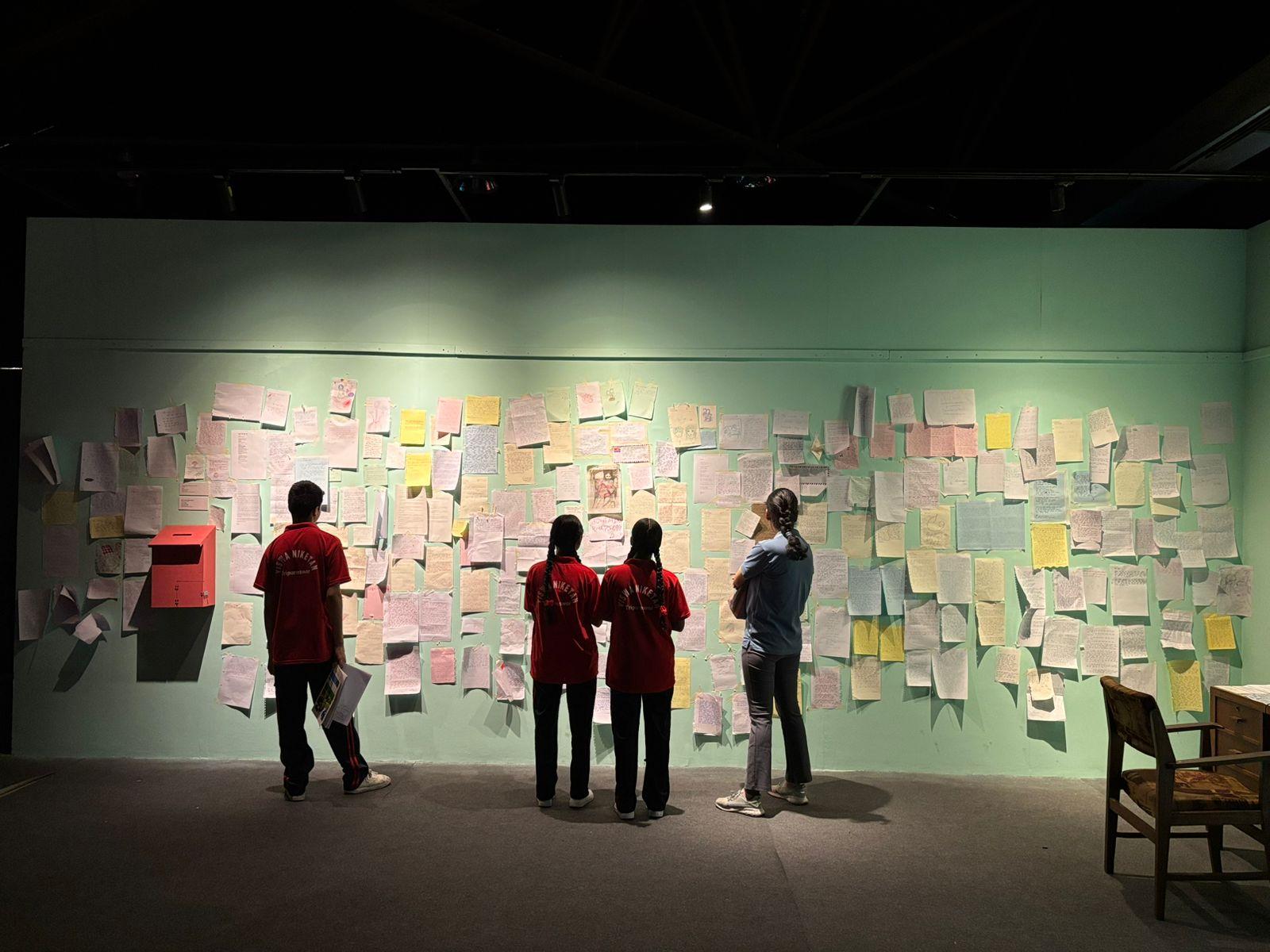
The wall of letters, where visitors left messages dedicated to their mothers.
The exhibition was made to reflect on the question: What are our mothers outside of being a mother? Our mothers are not some gods or some pity party. Our mothers danced, laughed and told stories. They are not just trauma. They are joyful too.
This reminder feels especially urgent right now. Nepal recently welcomed its first female prime minister as it goes through a tumultuous time. Yet people have already started her deification. Dhungana sees some things in the belly as resisting that very narrative—the glorification of mothers as goddesses. The exhibition asks us to see mothers not as divine figures, but as complex beings who shaped us through both joy and pain. Dhungana remarks, “Perhaps our mothers are the greatest loves of our lives in all their complications… We are who we are because of them.”
To learn more about Bunu Dhungana’s work, read Najrin Islam’s reflections on the artist’s series Confrontations (2017–18).
To learn more about artists exploring relationships to mothers and motherhood, read Shranup Tandukar’s essay on Prasuna Dongol’s Before You Were My Mother (2022), Sukanya Baskar’s reflections on Riti Sengupta’s photographic series Things I can’t say out loud (2020–Ongoing) and Banhi Sarkar’s observations on Vipin Radhakrishnan’s Angammal (2024).
All images are courtesy of the photographer by Samagra Shah.