


Memory, Materiality and Archive: Cinema and New Media Cultures
Shared Domains: Objects, Materials and Aesthetics in Film and Media Cultures was a three-day (21–23 March, 2025) hybrid conference for young researchers, organised by the Department of Cinema Studies at the School of Arts and Aesthetics, Jawaharlal Nehru University, New Delhi. The conference began with a provocative keynote address by Prof. S.V. Srinivas titled “Labours of Love and Hate” in which he posited that any manner of being online, even scrolling, might appear to be mere timepass; nonetheless, he said, it is actually hard labour, performed by the majority of us for free. This argument can be traced to Frankfurt School theorists Theodor Adorno and Max Horkheimer’s 1947 seminal essay “The Culture Industry” which indicates the narrowing of the work-leisure gap in the age of late capitalism. Adorno and Horkheimer state that “amusement under late capitalism is the prolongation of work.” In such circumstances, leisure becomes inseparable from work, and nowhere is that more apparent than in contemporary social media ‘prosumption’ (production+consumption) including gestural acts like scrolling, sliding, double tapping, dragging and dropping, etc. From obsessive fan and troll messages on social media to popular gaming YouTubers and ‘influencer’ careers, Srinivas highlighted the new kinds of ‘playbour’ (play+labour) emerging within the digital attention economy. Cinematic experience, then, according to theorists like Adorno and Horkheimer, amounts to “after-images of the work process itself” rather than a leisurely escape.
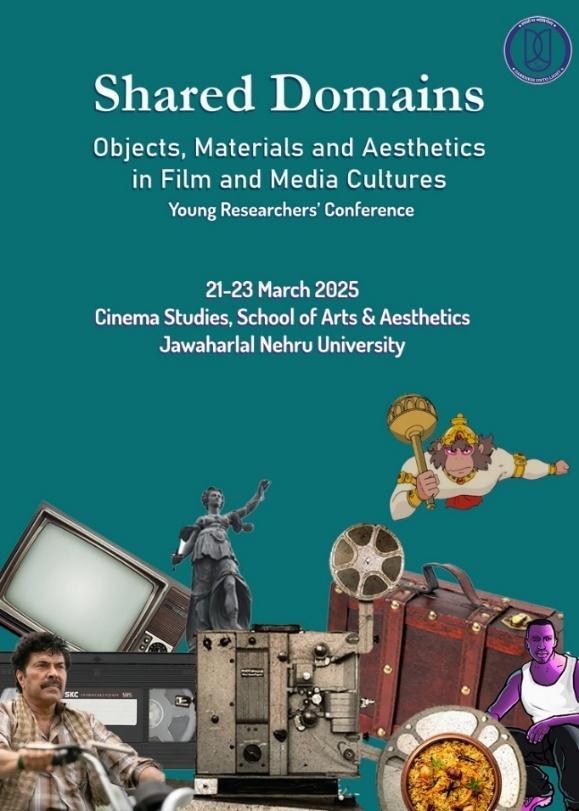
The conference poster (Image courtesy Shared Domains Conference Committee).
How does this shift our critical lens on cinema in the contemporary, expanded field of popular culture? And how is participation and subjectivity formulated in the digital simulacrum wherein algorithmic time and desires govern? In this essay I shall highlight a selection of papers presented at the conference which might allow us to think through new methodologies and frameworks to navigate the landscapes of cinema, memory, archive and contested materialities.
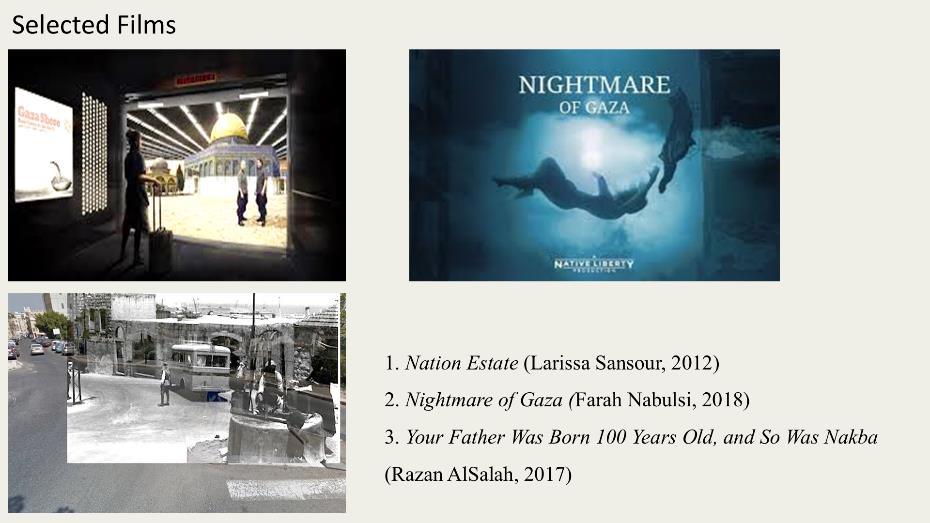
Slide from Adhila Abdul Hameed’s presentation “Fragmented Landscapes, Displaced Memories: Materiality and Aesthetics in Experimental Palestinian Short Films” focused on these three short films.
The panel titled “Material Memory: Histories, Aesthetics, Ideology?” chaired by Ravi Vasudevan had four stimulating presentations on the tensions between memory and oblivion in cinematic landscapes. Sargam Sundrani’s oral history investigation followed the demolished buildings of single-screen cinemas (talkies) in Sagar, a small town in Madhya Pradesh. The paper went on to explore the memories as well as habits of contemporary movie watchers in her close circles. She captures the transition to multiplexes like Platinum Plaza and the disappearance/reconfiguration of the buildings of Amar Talkies, Radha Talkies, Manohar Talkies, Alankar Talkies, Apsara Talkies and Paras Talkies—where the shift in nomenclature revealed certain attitudinal shifts in watching cinema. Adhila Abdul Hameed spoke on the use of digital distortions and glitch aesthetics as a conscious tool in Palestinian short films. By signifying the cyclical nature of violence and trauma embedded in these fragmented, speculative and often simulated landscapes, cinema becomes a site for the assertion of the right to identity and memory in the face of violent erasure.
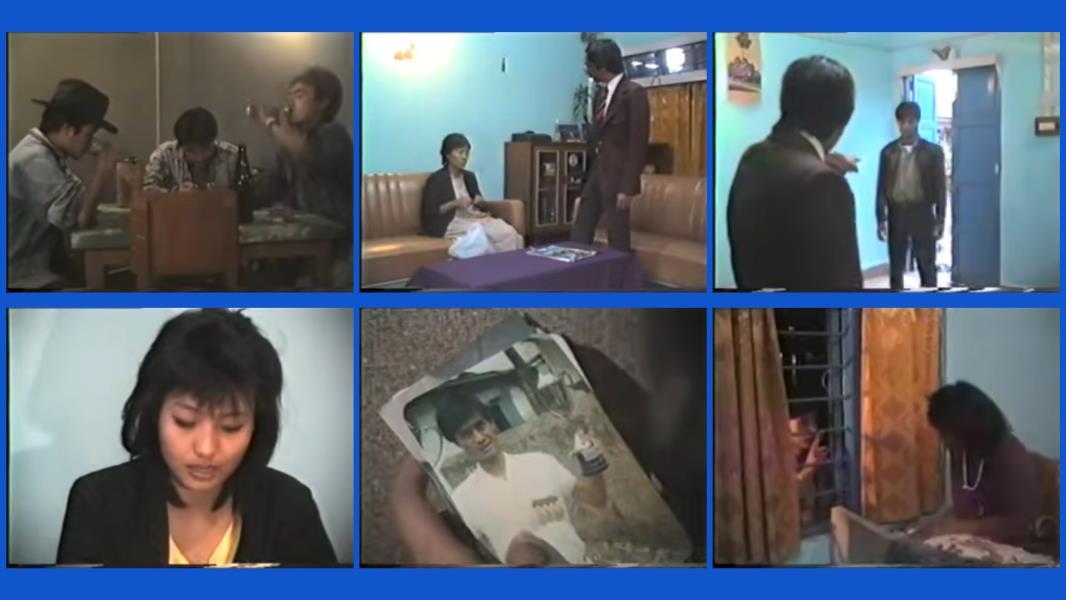
Slide from Thangkhankhup Hanga’s presentation “Love in the Time of VHS: Material Decay and Cultural Memory in Paite-Zomi Cinema” examined the films Lunglel Ken (Don't Be Worried, 1989) directed by Mangpu Tonsing and Chiam Pellou (Unbroken Vow, 1989) directed by T. Pumthianlal.
A poignant intersection of love and technology arose in Thangkhankhup Hangal’s study of the loss in quality of Paite-Zomi VHS films when uploaded on YouTube. This material degradation, according to Hangal, serves as an indicator of the precarious cultural memory and identity of the Paite-Zomi community in Manipur. Additionally, this ‘decay’ paradoxically authenticates the ‘vintage feel’ of these films and highlights alternate cultural strategies of preservation undertaken by the community (who themselves upload these films on YouTube) outside the institutional norms of archival purity. Finally, the recent trend of remastering and re-releasing Malayalam films was critically examined by Abhay Krishnan R., who argued that film aesthetics are themselves being commodified and fetishised in these remastered films.
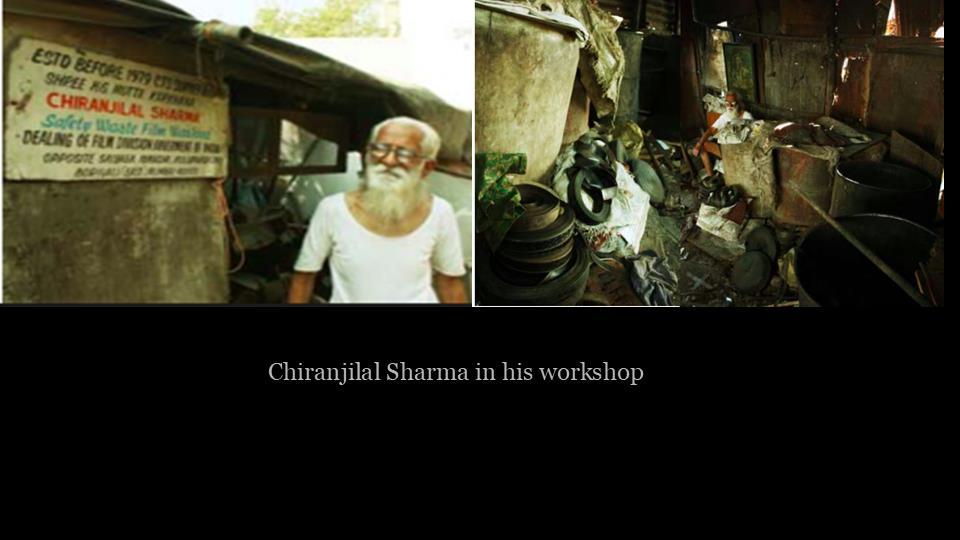
Slide from Keshavanandhan Rajaram’s presentation “Recycling and Archiving Indian Cinema: Intersections of Sustainability and Cultural Preservation” illustrating Chiranjilal and his shop.
This connected to the discussion in another fantastic panel; “Abundant and Invisible: Objects and Materials of the Production Cycle” chaired by Prof. Kartik Nair. The tensions between archiving and recycling were aptly captured in Keshavanandhan Rajaram’s paper addressing the ecological footprint/material excess of cinematic production. Taking the case of Chiranjilal Sharma who recycled discarded film reels into plastic bangles, Rajaram asks if it is the content which gains archival significance over the actual form (celluloid)? And also, who decides what to preserve? Moreover, he argues for the re-usability of painted banners over the multiple digital ones which cannot be repainted, urging us to consider the nature and volume of industrial waste generated by contemporary media industries.
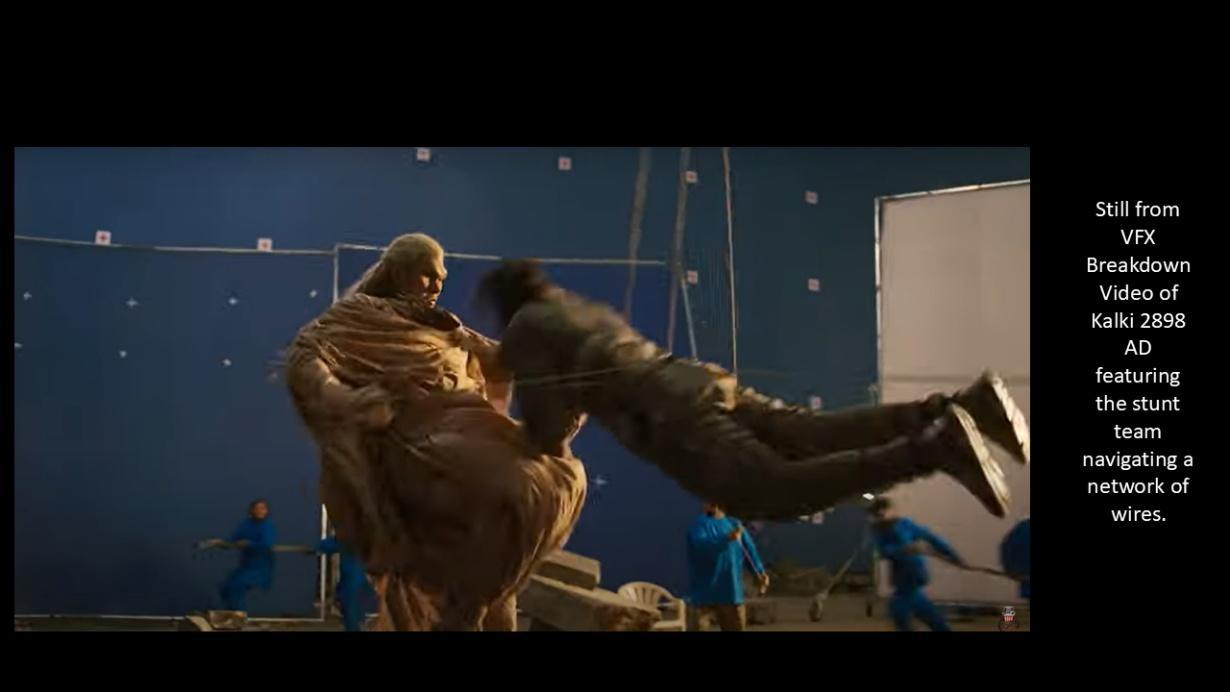
Slide from Rini Dasgupta’s presentation “The Obscure Objects of Film: The Circulation of Behind-the-Scenes Filmic Objects through VFX Breakdown Videos” capturing the stunt artist’s face which the VFX artists would later erase in the final version. (Image source: Kalki 2898 AD - VFX Breakdown by Haymaker VFX.)
Rini Dasgupta’s paper, titled “The Obscure Objects of Film: The Circulation of Behind-the-Scenes Filmic Objects through VFX Breakdown Videos,” initiated a much-needed discussion on archiving labour in film production by specifically analysing the circulation of behind-the-scenes video clips from Kalki 2898 AD (2024). The face of the stunt double gains visibility in such videos, and they also serve as repositories for objects like the green screen (fast becoming obscure as studios shift to virtual production), wires and spot markers, all of which will be eventually erased by the VFX artist in the final version.
Interestingly, the labour of the huge team of VFX artists collaborating on a single scene is not visibilised in these videos. The conversation also moved to the signs of bodily tiredness (thakaan) of such intense labour demanded by the film industry—would working in absolute darkness eventually make the VFX artist go blind, much like the bangle maker who works in similar darkness? Moreover, when the viewing experience itself has undergone a radical shift from the high-definition cinema screens to other (relatively) drastically lower-definition screens like smartphones, how does the intricate, hand-rendered labour of the VFX artist manifest? As Prof. Nair summed up, cinema needs to be investigated as not just the art of creating but also destroying images, and, for some, even vision.
The range of presentations at the conference demonstrated the shared domains of interrelated media objects and networks. As Prof. Kaushik Bhaumik indicated in one of the discussions, this responds to a deeper need for reconceptualising the new body of cinema as a resource to be mined for all kinds of content outside of the filmic realm—a body which has a diffused presence over multiple screens. From the hybridity of the VFX objects to that of the mode of the conference itself, the young scholars engaged with the most compelling challenges in thinking and writing critically about contemporary media networks. The engaging post-presentation discussions left much to think about in terms of the promising potential that the field holds for all future researchers and enthusiasts. In many ways, Shared Domains infused a renewed rigour into staging a productive dialogue between the machinic and human bodies, and their many "labours of love."
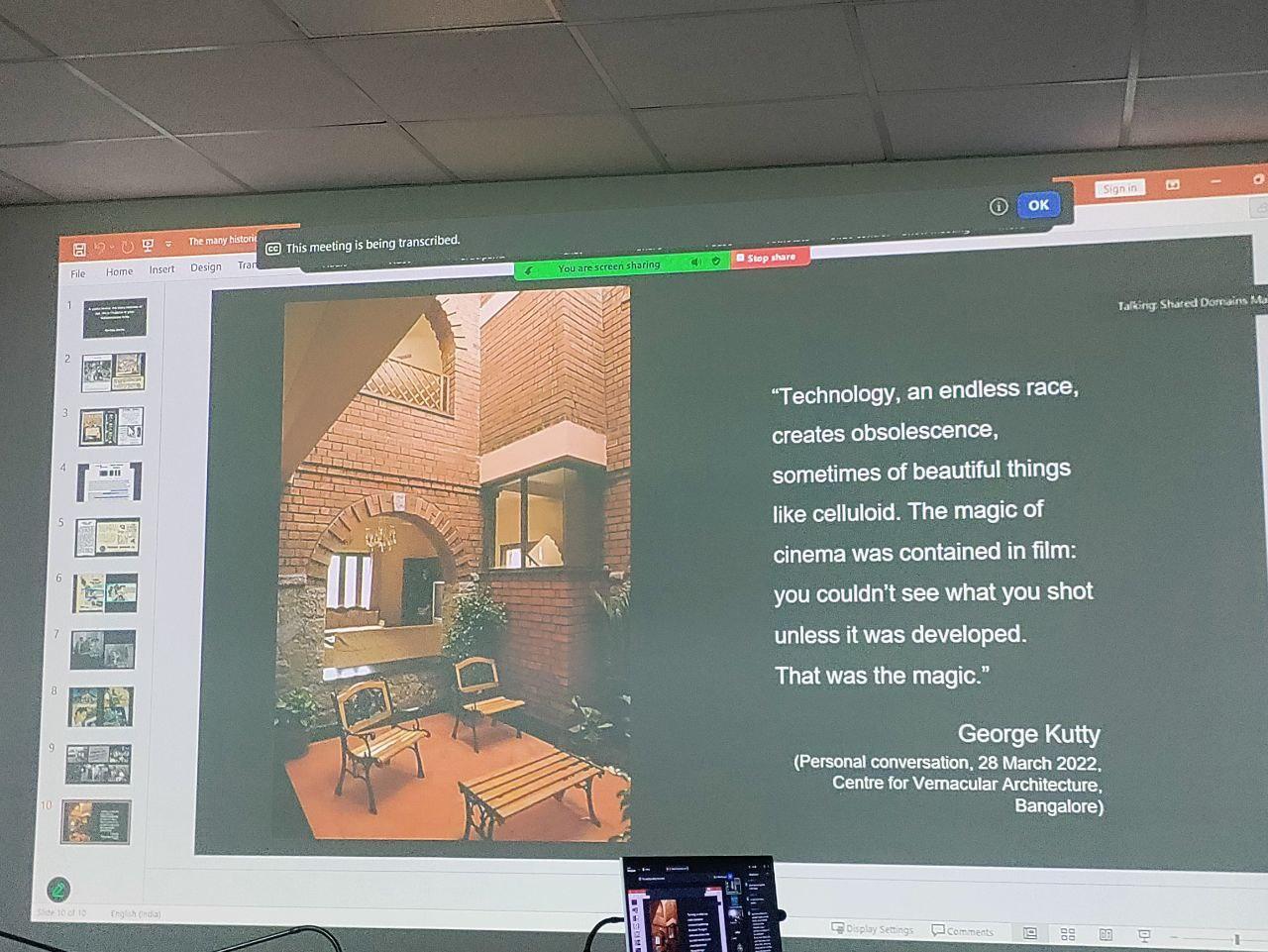
From Navdeep Sharma's presentation, "A Useful Device: The Many Histories of the 16mm Projector in Post-Independence India" (Photograph by author.)
To learn about more such student-led conferences, read Sudha Padmaja Francis’ reflections on the panel “Queering the Canon: Reimagining Art Historical Paradigms” and Vishal George’s observations on James Elkins’ keynote address as part of the School of Arts and Aesthetics’ Visual Studies postgraduate conference What do Images Want? Art, Identity and Difference.
All images courtesy of the respective presenters and the Shared Domains Conference Committee, Department of Cinema Studies, SAA.