

Shifting Perspectives: Forensic Aesthetics and the Economies of Gender in Cinema and New Media

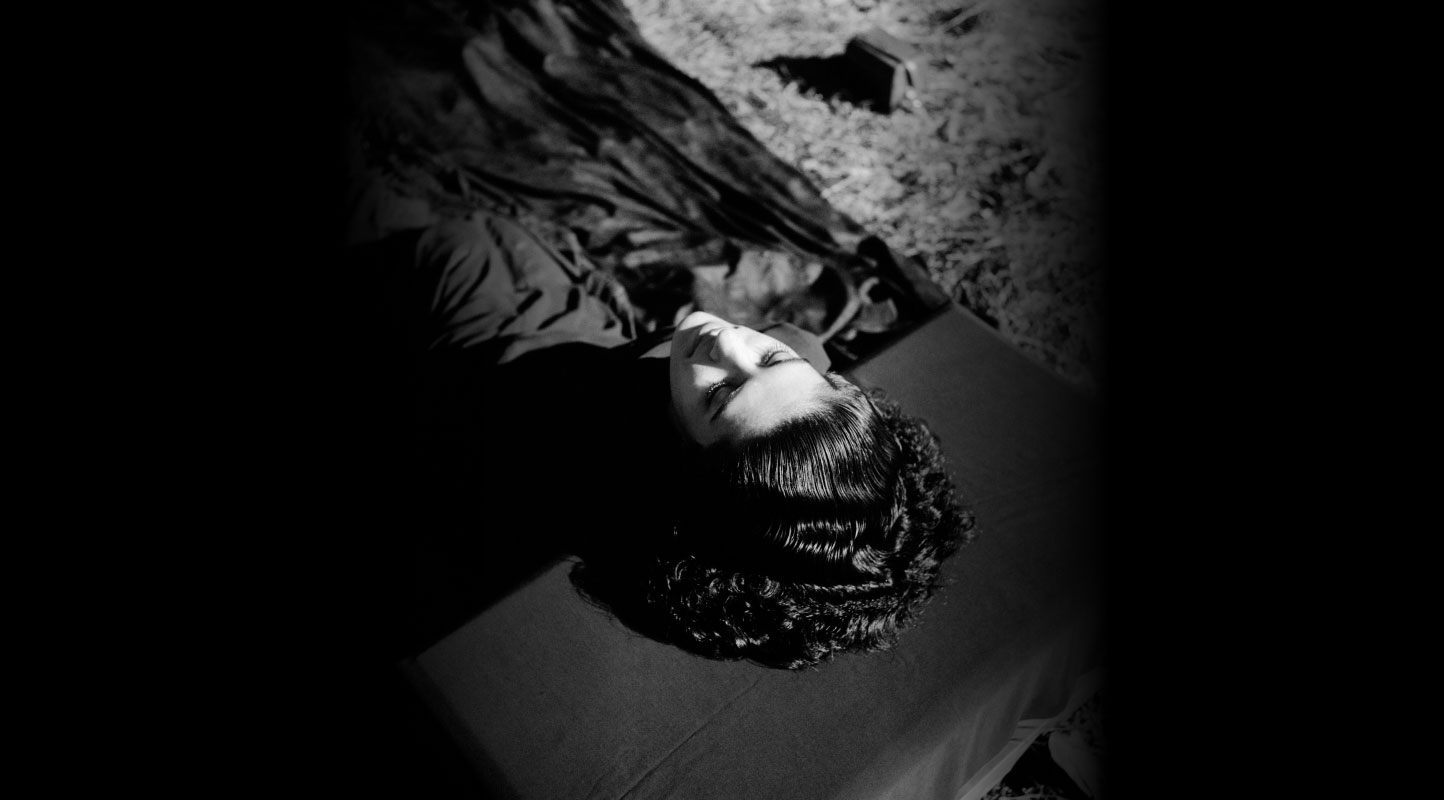
From Eyal Weizman and Thomas Keenan’s book Mengele’s Skull: The Advent of a Forensic Aesthetics (2012).
“It was a face wrapped over a skull, subject over object, an image of life over an image of death.”
This striking, graphic and unprecedented image emerges in Eyal Weizman and Thomas Keenan’s pathbreaking study Mengele’s Skull: The Advent of a Forensic Aesthetics (2012). In their dissection of the 1985 Josef Mengele trial, Weizman and Keenan trace the emergence of the object as evidence, as opposed to the earlier testimony of the survivor as witness (Eichmann trials). This turn to the object is predicated on the perceived unreliability of the faulty memory of survivors embedded in deep trauma. Thus, Mengele’s bones are reconstructed into a skull and photographed from various angles. This image is finally superimposed on his photographic portrait to confirm his identity, evincing that the bones are Mengele’s. It is in this context that Weizman and Keenan define the emergence of forensic aesthetics—an intersection of object, mediator and forum. The trial, in this case, emerges as a performance/construction of the truth based on the art of presentation and persuasion. The role of visual media like photography becomes crucial in such scenarios. The much-acclaimed works of Susan Sontag and Ariella Azoulay provide starting points for further exploring various roles of meaning/truth-making which images are made to perform in contemporary histories. The rise of social media trials along with an overwhelming presence of evidence derived from social media in actual courtrooms points to an epic shift in the very conceptions of truth, justice and legal frameworks.
What are the anxieties that arise with using any form of visual media as evidence? How does the circulation of such objects in current media ecologies affect their status? What role does that play in the construction of gendered sensibilities? In this essay I wish to discuss these questions in relation to a few presentations from the conference Shared Domains: Objects, Materials and Aesthetics in Film and Media Cultures held from 21 to 23 March 2025, organised by the Department of Cinema Studies, School of Arts and Aesthetics, Jawaharlal Nehru University, New Delhi. These presentations explore critical links between visual evidence, virality and gendered subjectivities in contemporary hyperlinked domains.
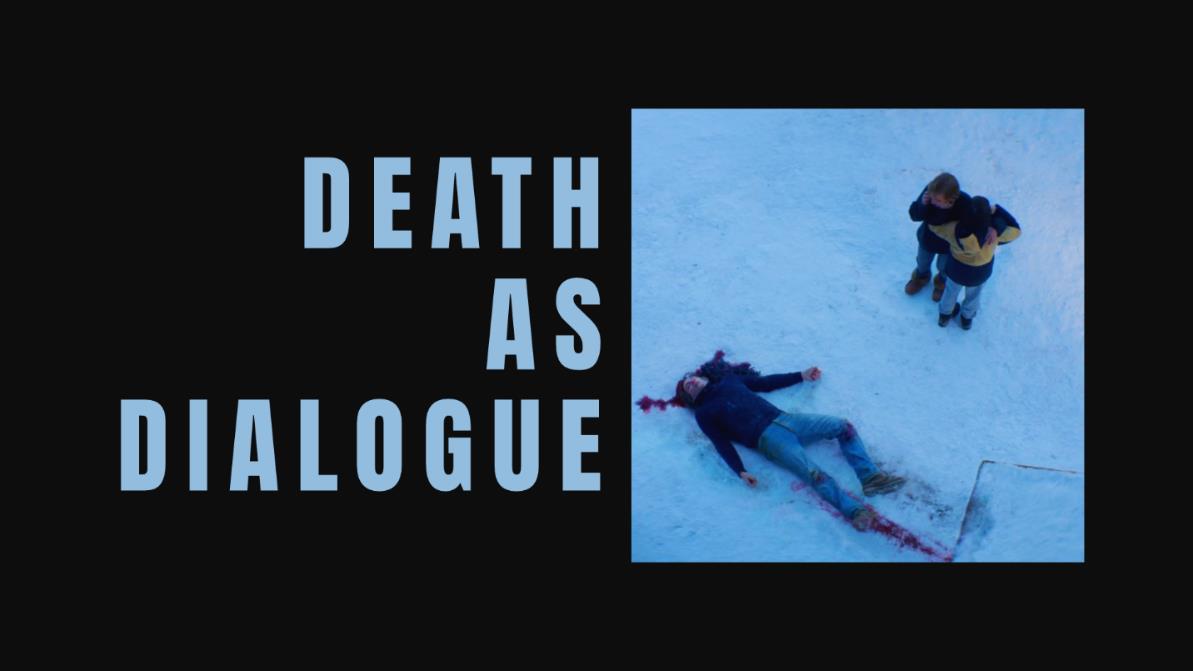
Slide from Kartikey Malviya’s presentation “Death as Dialogue”.
The panel titled “Law, Justice and the Perverse Pleasures of Evidence” was chaired by Pallavi Paul. Kartikey Malviya’s presentation “Death as Dialogue” probed into the fragility of law and fluidity of memory in Justine Triet’s Oscar-winning film Anatomy of a Fall (2023). Malviya asks if inscriptions distort truth more than preserving it; does the voice once recorded still belong to the speaker? When the protagonist Sandra encounters her dead husband’s surreptitious recordings of their everyday lives including a major fight, she almost cannot recognise herself. The recording—which plays back the heated voices and the audible clashes from their fight—fails to capture the essence of the multiple silences, glances and most importantly the prelude to the dispute and what follows afterwards. Thus, the recording is suspended in a time span that is absolute. This significantly changes the entire meaning of the spoken text as it stands separated from the very context that it was a part of. Malviya comments on the mediated nature of truth and reality, as recordings do not fix but can rather fracture meanings. Justice in such circumstances is always deferred as well as invented, Malviya suggests.
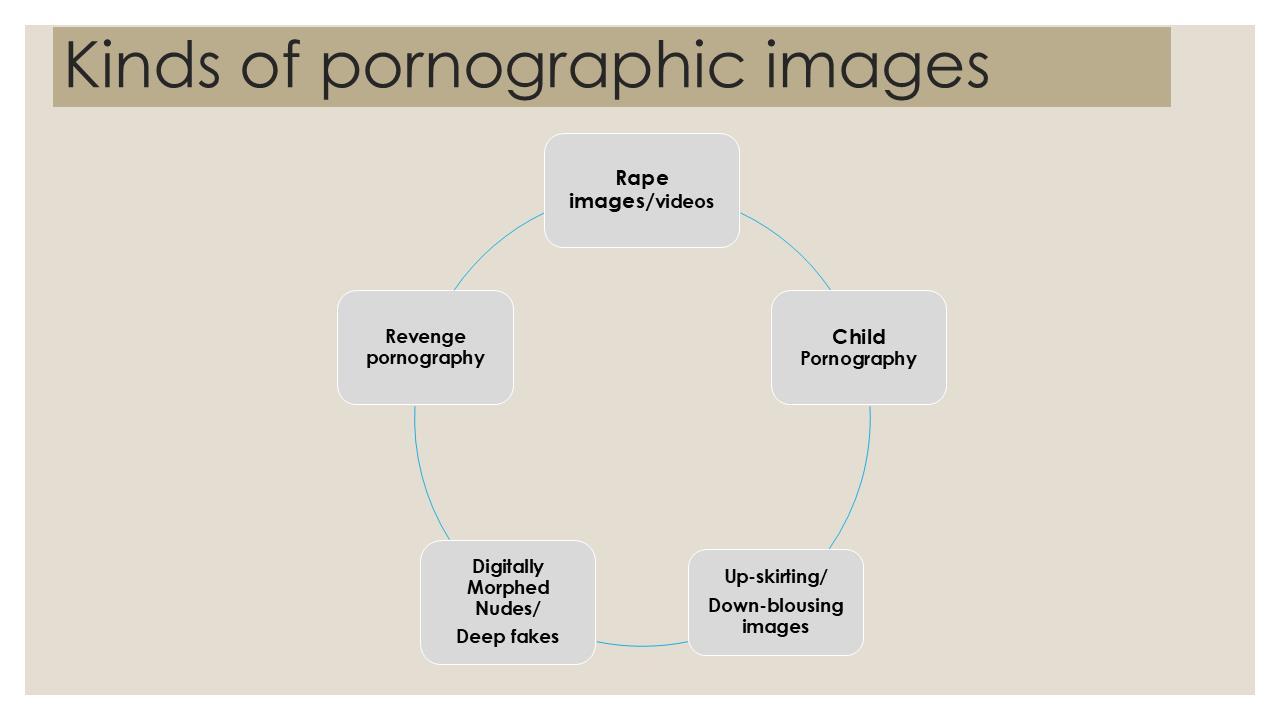
Slide from Chitrangada Sharma’s presentation listing out the various kinds of pornographic images.
Chitrangada Sharma’s presentation, “Images, Violence and The Law: Pornographic Images as Sexual Trophies and Evidentiary Objects,” delved into the circulation of sensitive evidentiary objects—especially pornographic photographs—within contemporary trials, based on her field notes from the Tis Hazari district court, New Delhi. She foregrounds the circulation of sensitive evidence as pornographic material as the file changes many hands in the course of the legal proceedings within male-dominated spaces of the police station and courtroom. The digital image has ensured some protection in the form of the ‘hash code’—an alphanumeric code that substitutes the actual image in the physical case file, while only a select group of people have access to the digitised image which corresponds to the code. However, the afterlife of such images remains ambiguous because there are no regulations mandating the destruction of such sensitive visual evidence post-trial.
The final presentation of this panel looked at online virality in the form of massive circulation of sensitive case details of high-profile rape cases like the recent R.G. Kar Medical College rape and murder, which sparked outrage across the country. In “The Aestheticization of Justice: Cinematic and Digital Mediations of Forensic Science in High-Profile Sexual Violence Cases,” Debangi Sanyal and Mohar Saha ask to what effect is this virality? Does it ever translate into legislative actions breaking the loop of deferred justice? Taking the example of the first season of the Emmy-winning web series Delhi Crime (2019), based on the Nirbhaya case, the authors argue that the cinematography and editing, especially using yellow lights, served to deliberately aestheticise the gruesome nature of the crime. Furthermore, the viewers are tied to the point-of-view of the investigator, rather than the plight of the victim (and her family), who is neglected. When testimony morphs into sensationalised content, truth is further disturbed. ‘Digital autopsy’ surfaces as the successor to the media trial phenomenon wherein there is a deliberate contamination of evidence by its social media virality.
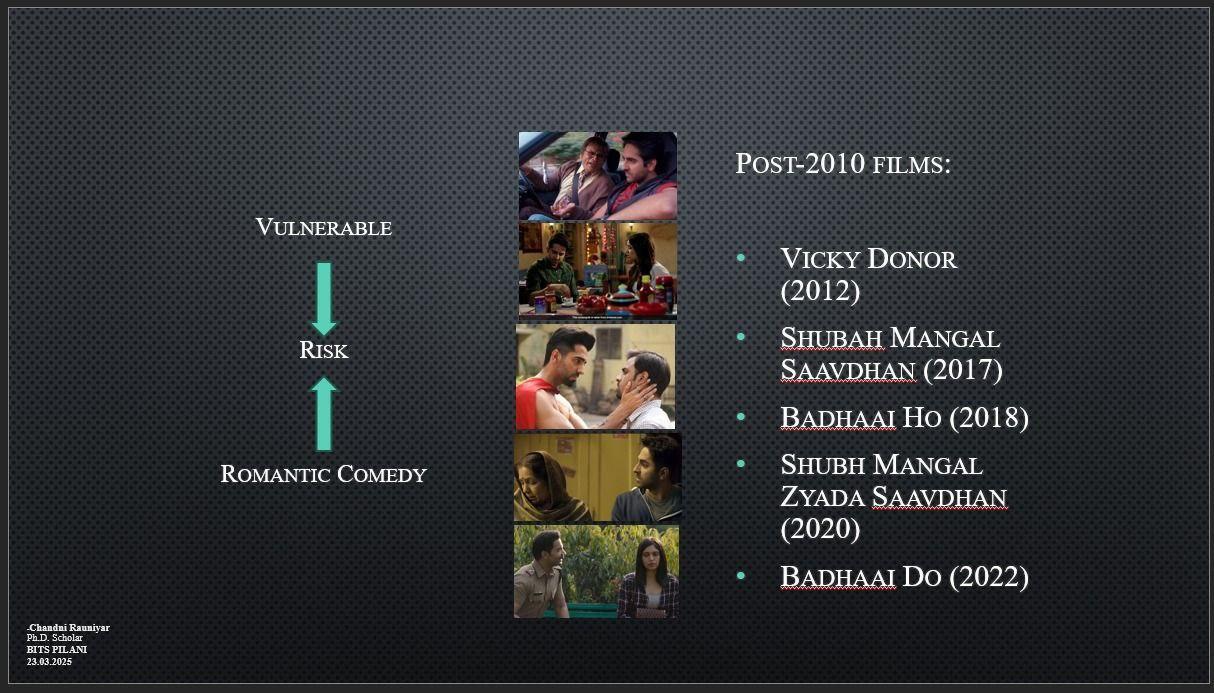
Slide from Chandni Rauniyar’s presentation “Less than a Hero, More than a Man: Gender, Genre and Affect in Popular Hindi Cinema” which focused on these five films, mostly based in small towns in North India.
The panel “Emergent Imaginaries of Gender,” chaired by Prof. Aysha Viswamohan, takes this conversation further. What are the nascent gender sensibilities brewing in such media ecologies? Apart from Anwesha Saha’s presentation on a nuanced depiction of womanhood through objects in Rituparno Ghosh’s Bariwali (2000), two papers focused on a complex understanding of masculinities in two diverse contexts—popular Hindi and Tamil cinema post-liberalisation. Chandni Rauniyar in “Less than a Hero, More than a Man: Gender, Genre and Affect in Popular Hindi Cinema” examines the emergence of vulnerable male subjectivities in the genre of romantic comedies in Hindi cinema as the affective order of neoliberalism. Risk-taking tied to the intimate, not heroic, is central in her analysis of the vulnerability, aspirations and desires in the middle-class lives of these figures.
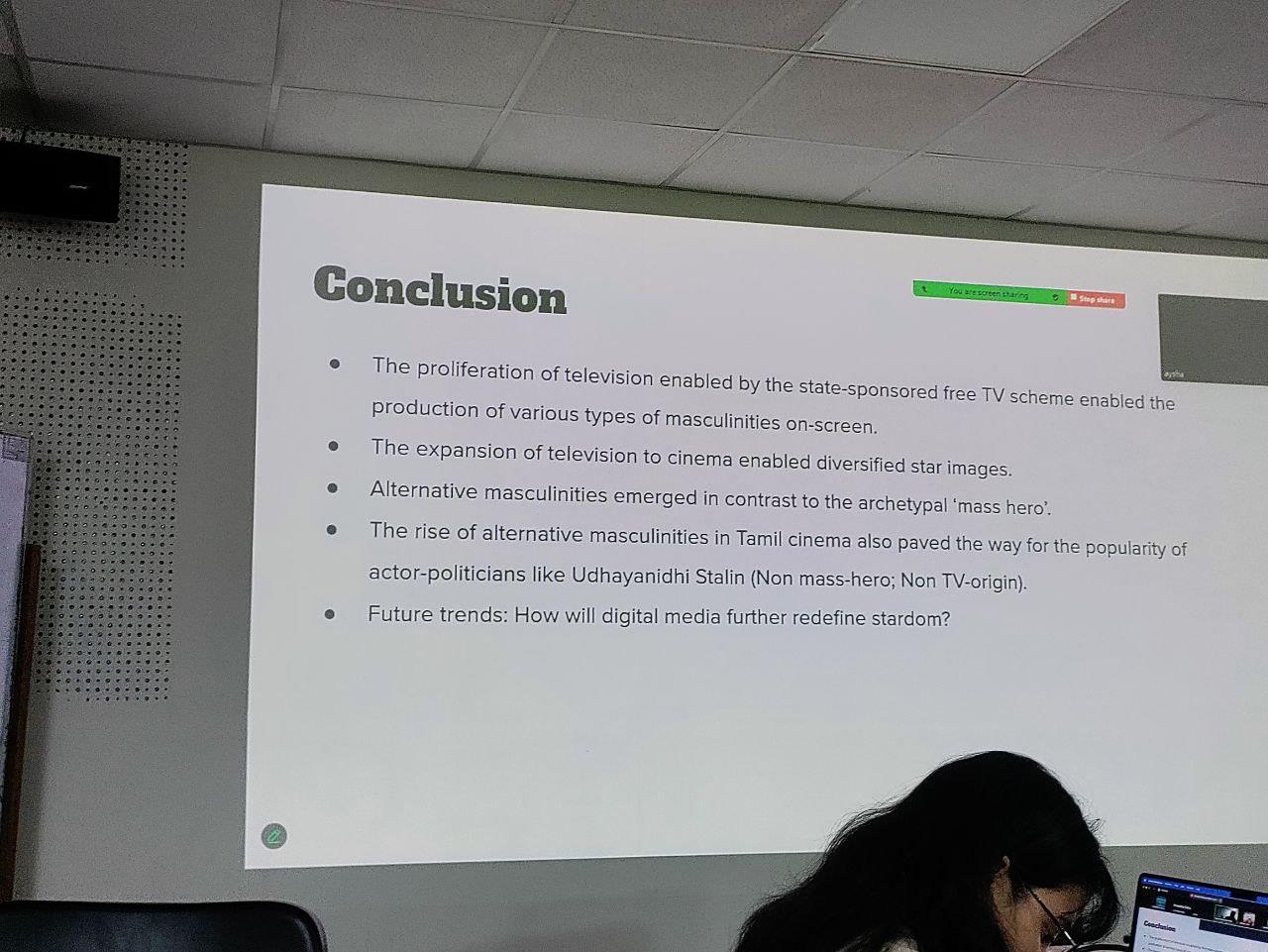
From Mohamed Ilyas R.’s presentation “Mediated Masculinities: Television Culture and the Transformation of Star Images in Tamil Cinema” (Photograph by author).
Examining the “alternative star trajectories” of actors Vijay Sethupathi and Sivakarthikeyan, Mohamed Ilyas R. argues for a similar phenomenon around the same time in Tamil cinema. In “Mediated Masculinities: Television Culture and the Transformation of Star Images in Tamil Cinema,” he signposts the pivotal role of parody and spoof shows airing on cable TV channels like Sun TV and Vijay TV in the rise of this new male star. While the 1950s and 1960s were marked by the hypermasculine, messianic ‘mass hero’ archetype (M.G.R. hits), post-globalisation marked a new era with Tamil new-wave cinema in the 2000s and TV programmes that foregrounded commonplace and relatable male characters. Ilyas terms this as the “post-mass hero phase,” where stardom depends on relatability and social media visibility. The conversation also hinted at the new kinds of masculinities manifest in anti-caste cinema from the region, for instance, in Pa. Ranjith’s films.
This makes one reflect on the representation of all kinds of male characters in Indian cinema and their glaringly disproportionate afterlives in popular memory. In an industry dominated by the hypermasculine hero’s ‘mass appeal,’ the success (box office and societal impact) of a Pushpa or Kabir Singh reverberates for many more decades than that of Lootera, Masaan or even October. Does this indicate a long-term trend where the ‘soft boy’ archetype eventually gives way to the rowdy gangster? Will Shahid Kapoor eventually be remembered in pop culture for Kabir Singh and not Jab We Met? The iconic change in male bodies onscreen is also inescapable—re-emphasising its difference from female counterparts—the perfect V-shaped back, toned limbs, washboard abs, etc. However, even pre-liberalisation, this tension between the ‘soft’ and ‘rowdy’ masculinities has always existed—for instance, in the 1970s (better known as the decade of the angry young man), Amitabh Bachchan co-existed with Amol Palekar. Maybe there is always some space, even if significantly smaller, for alternate male subjectivities onscreen.
To learn about other presentations as part of the Shared Domains conference, read Pronita Tripathi’s reflections on the panels “Material Memory: Histories, Aesthetics, Ideology?” and“Abundant and Invisible: Objects and Materials of the Production Cycle.”
To learn about more such student-led conferences, read Sudha Padmaja Francis’ reflections on the panel “Queering the Canon: Reimagining Art Historical Paradigms” and Vishal George’s observations on James Elkins’ keynote address as part of the School of Arts and Aesthetics’ Visual Studies postgraduate conference What do Images Want? Art, Identity and Difference.
All images courtesy of the respective presenters and the Shared Domains Conference Committee, Department of Cinema Studies, SAA, unless mentioned otherwise.