

The Postal Portfolios: A Little History of Photography in Early Twentieth-Century India
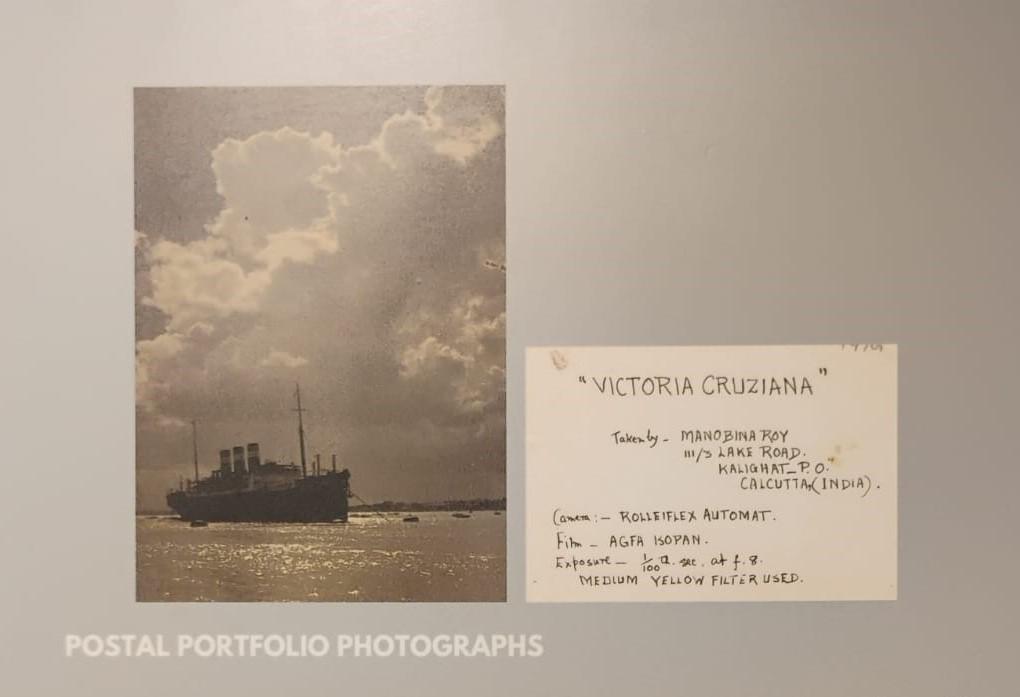
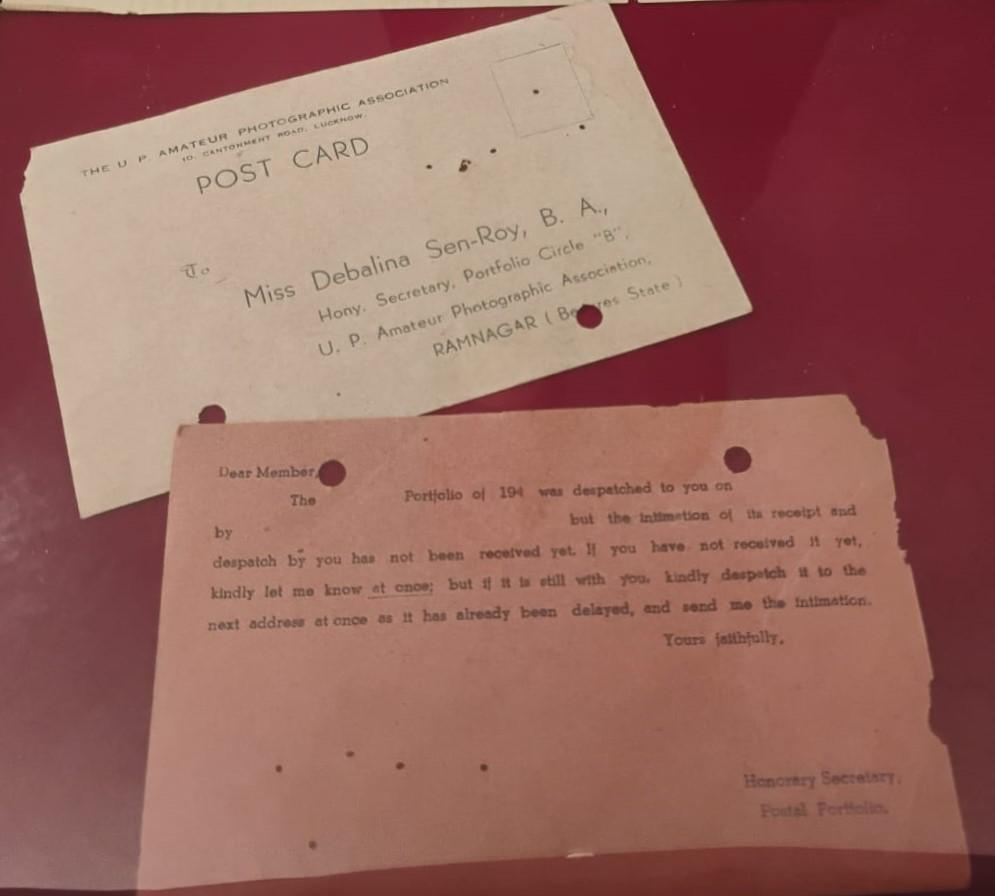
In popular accounts of photography in India such as G Thomas’ History of Photography, India, 1840-1980 (1981), the United Provinces Amateur Photographic Association (UPAPA) has been hailed as making postal portfolios commonplace across photography clubs in big cities and small towns throughout the 1940s. Established in Lucknow under the guidance of veteran photographer Syed Hyder Hussain Razavi, the association created a circulating portfolio—an album to which members submitted their photographs to solicit and offer feedback, which was sent by post from one contributing member to another. Such interaction not only made participation in club programmes more accessible for members in remote regions, but by bringing seasoned photographers and novices into the same space, it also served a pedagogical purpose, rarely available otherwise, and created a more equitable forum than the more hierarchical structure of club competitions.
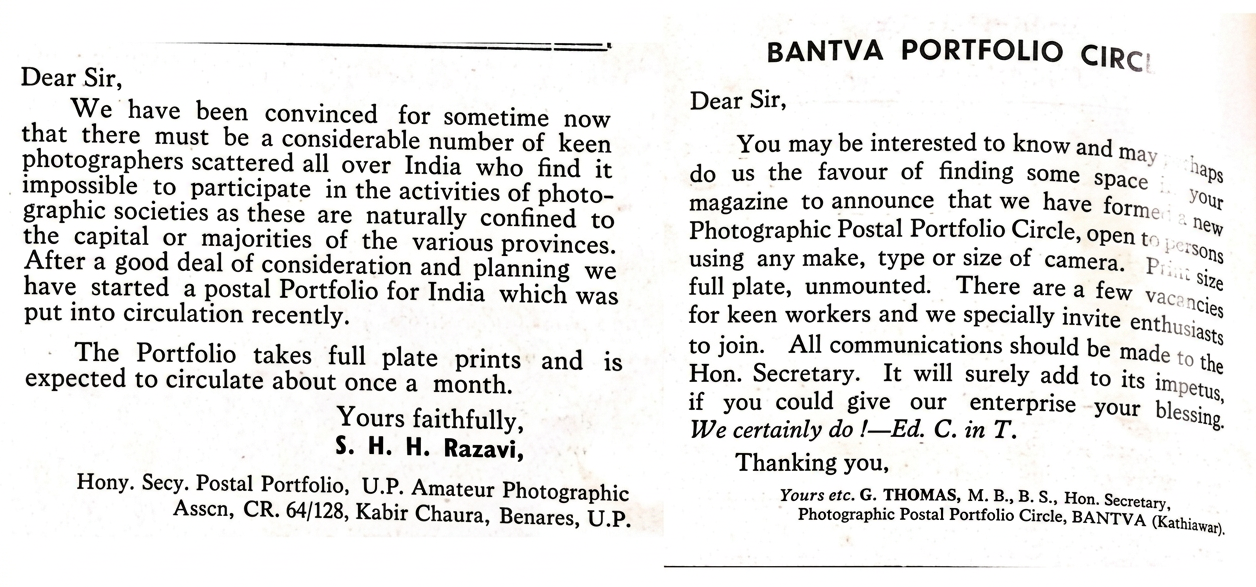
Left: Announcement by SHH Razavi introducing the UPAPA Postal Portfolio in the journal Camera in the Tropics. (September-October, 1940. Source: National Art Library, Victoria and Albert Museum, London.)
Right: Announcement of vacancies for the Bantva Portfolio Circle by G Thomas in the journal Camera in the Tropics. (July-August, 1940. Source: National Art Library, Victoria and Albert Museum, London.)
Among those inaugurating this new “movement” in photography, Thomas states, "The Photographic Society of India,... the Camera Club of Sind, Madras Amateur Photographic Society, Camera Art Faculties, Photographic Society of Surat and Camera Pictorialists of Gujarat" came together to form the “Portfolio Alliance” in late 1942, with Thomas himself founding the Bantva Portfolio Circle. Even though the possibility of a circulating portfolio was discussed as early as the 1910s, as photography historian Siddhartha Ghosh mentions in his book, Chobi Tola: Bangalir Photography Charcha (Taking Photographs: Bengalis’ Photography Practice (1988), the postal photography movement only gained momentum in the 1940s.
In December 1941, Ghosh says, an “All India Salon of Portfolio Circle” was organised at Lucknow University, which then travelled to Varanasi and Allahabad in January 1942. The salon constituted of four portfolio circles; there were forty-one members in total, and eighty-one out of one hundred ninety prints were chosen for the exhibition. The event featured only two women photographers—the twin sisters, Debalina Mazumder and Manobina Roy who were the only participants besides Razavi to have contributed five photographs each to the salon. Born in 1919, the sisters grew up in Benaras and Ramnagar, and learned photography from their father, Binod Behari Sen Roy, who was a member of the Royal Photographic Society in London. They themselves joined the UPAPA in the early 1940s.
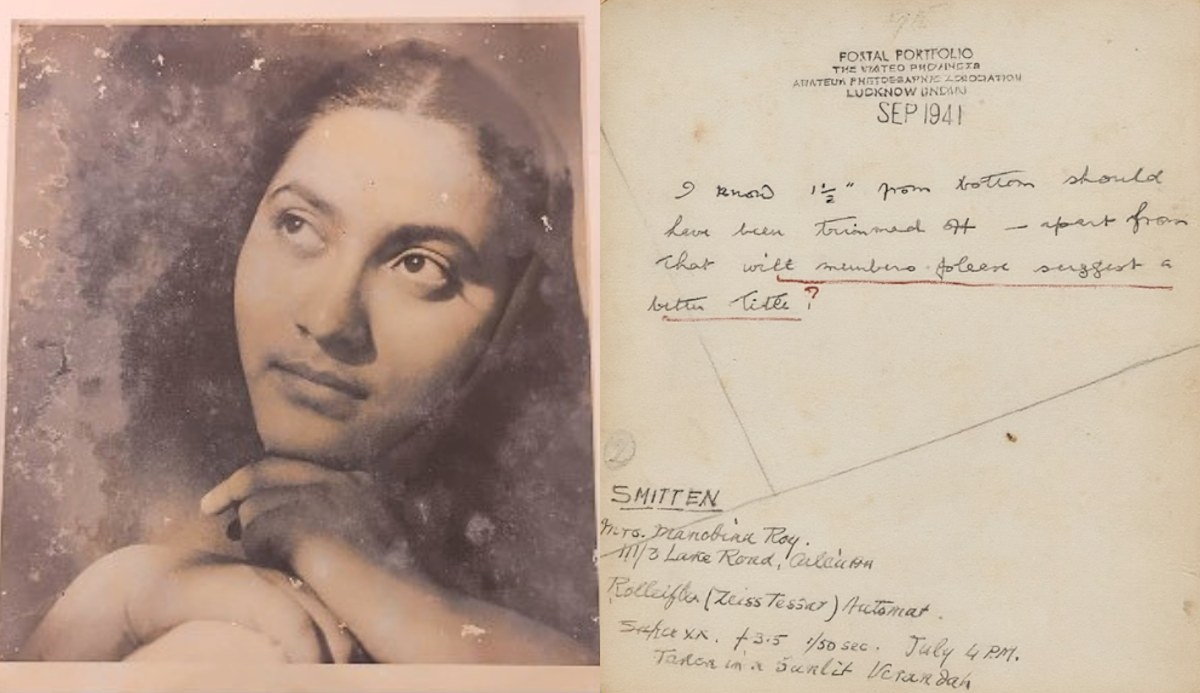
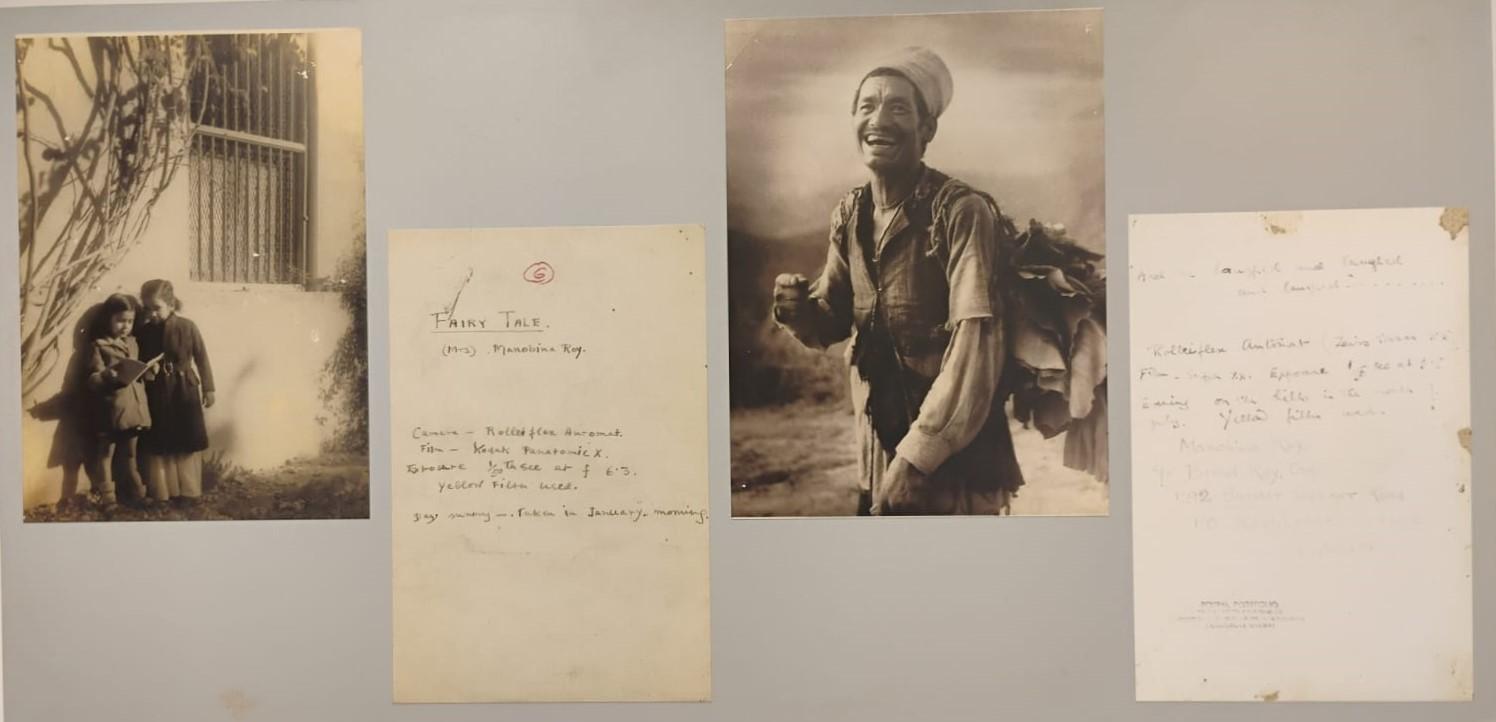
Left: Portrait of Debalina Mazumder captured by Manobina Roy, submitted to the 1941 UPAPA Postal Portfolio. Displayed at Twin Sisters with Cameras at the National Centre for the Performing Arts (NCPA). (Mumbai, 2025.)
Right: Manobina Roy’s handwritten note about her portrait of Debalina Mazumder, submitted to the 1941 UPAPA Postal Portfolio. Displayed at Twin Sisters with Cameras at the National Centre for the Performing Arts (NCPA). (Mumbai, 2025.)
A range of portfolio photographs by Mazumder and Roy have been showcased in the "Postal Portfolio" display at the exhibition Twin Sisters with Cameras. After its 2022 debut at the Jadunath Bhaban Museum and Resource Centre in Kolkata—which was curated by Tapati Guha-Thakurta, Mallika Leuzinger and Sabeena Gadihoke—the exhibition travelled across India, evolving with each iteration, with the most recent edition curated by Gadihoke at the National Centre for the Performing Arts (NCPA), Mumbai from 09 to 26 October 2025.
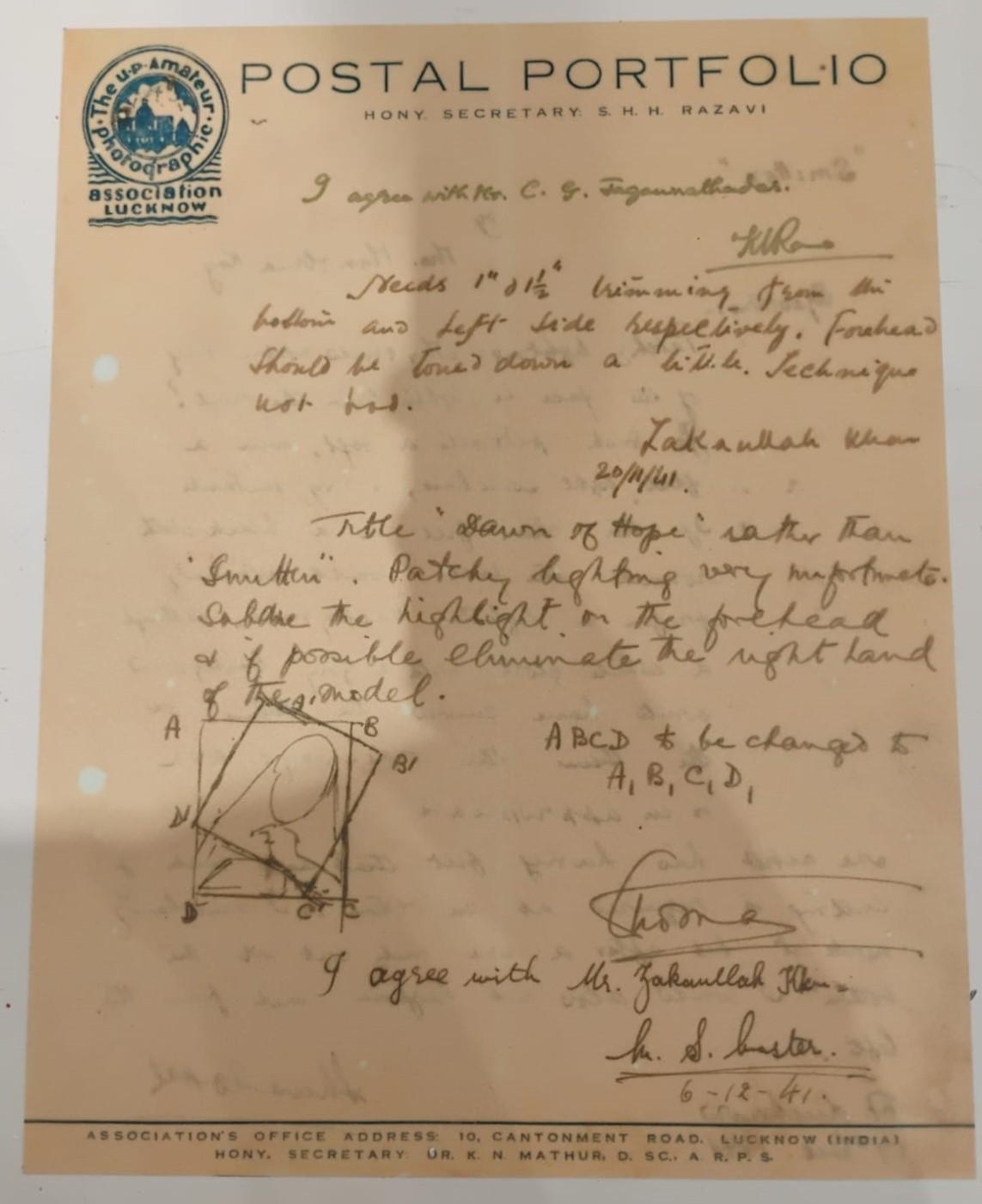
The "Postal Portfolio" display at the exhibition featured a note supplementing one of the submitted photographs—a portrait of Mazumder taken by Roy—which provided details about the camera used, the lens, the focal length and the time of day when the image was shot. Next to it were comment sheets, each containing copious handwritten criticism of the photograph. Submitted in September 1941, Roy’s portrait of Mazumder, with her hands folded together under her chin as she looks upwards evading the camera, had travelled until February 1942 and was reviewed by over a dozen members before being returned to its owner. The photograph received mixed responses, including appreciation for the expression and pose; apprehension about the lighting and finish; request for clarification on stylistic choices; and suggestions to improve the composition.
The criticism of the portfolio submissions marked a departure from previously established writings on photography. While institutions of industrial and art education had long published on photography, there was an emphasis on exceeding the camera’s mechanical reproduction to strive for an aesthetics resonant with traditional fine arts. As Ghosh notes in Chobi Tola, the Indian Art Academy, where photography was taught, published its magazine in the 1920s, in which its editor routinely argued that the “mechanical skill [of the camera] be conjoined with the artistic” or that “the soul of art” lies in overcoming the “limitations of a mechanical instrument.” Art and photography were thus conceived as discrete domains that had to be yoked together by surpassing the affordance of the camera. However, by the 1940s, the critical discourse on photography—while committed to the registers of fine art—shifted from a language of abstract artistic ethos to technical finesse specific to photographic work, as is evident in the criticism of Roy’s photograph.
While there were differences in opinion about the success of Roy’s composition—one praising it as the “best portrait study” and another proclaiming it “uninteresting”—commentators note its overall “good technique.” Contributors seem to have paid as much attention to framing and composition as to a range of adjustments that follow the click of the shutter. Thus, some point out unexpected highlights on the subject's face whereas others suggest retouching the image to enhance the subject's expression. One of the most persistent points of contention was Roy’s choice of trimming and almost every commentator suggested alternative measurements to her original. Thomas, who was one of the founding members of the UPAPA, even sketched a diagram to suggest suitable framing. The image's caption, too, was considered crucial enough to warrant suggestions for modification so that it would be able to convey the photograph's intended message. With such in-depth observations and detailed descriptions on technicalities of the medium, the 1940s postal portfolios may be seen as heralding a new direction in appreciation and criticism of photography.
The photograph by Roy and its criticism not only exemplify the kind of interpretive exchange that proliferated within the postal photography circles but also help trace its network of members, several of whom would later emerge as some of India’s most influential photographers and critics, shaping the discourse of photography for the greater part of the twentieth century. For instance, Thomas, who reviewed readers’ submissions for the Kodak India Magazine in the 1940s and founded the Federation of Indian Photography (FIP) in 1953, went on to become a familiar presence on juries at competitions in India and abroad. While Roy and Mazumder never turned professional, they regularly published their work in magazines, with the latter becoming the chairperson of the Photography Association of Bengal (PAB) and the Secretary of the Ladies Wing of the FIP.
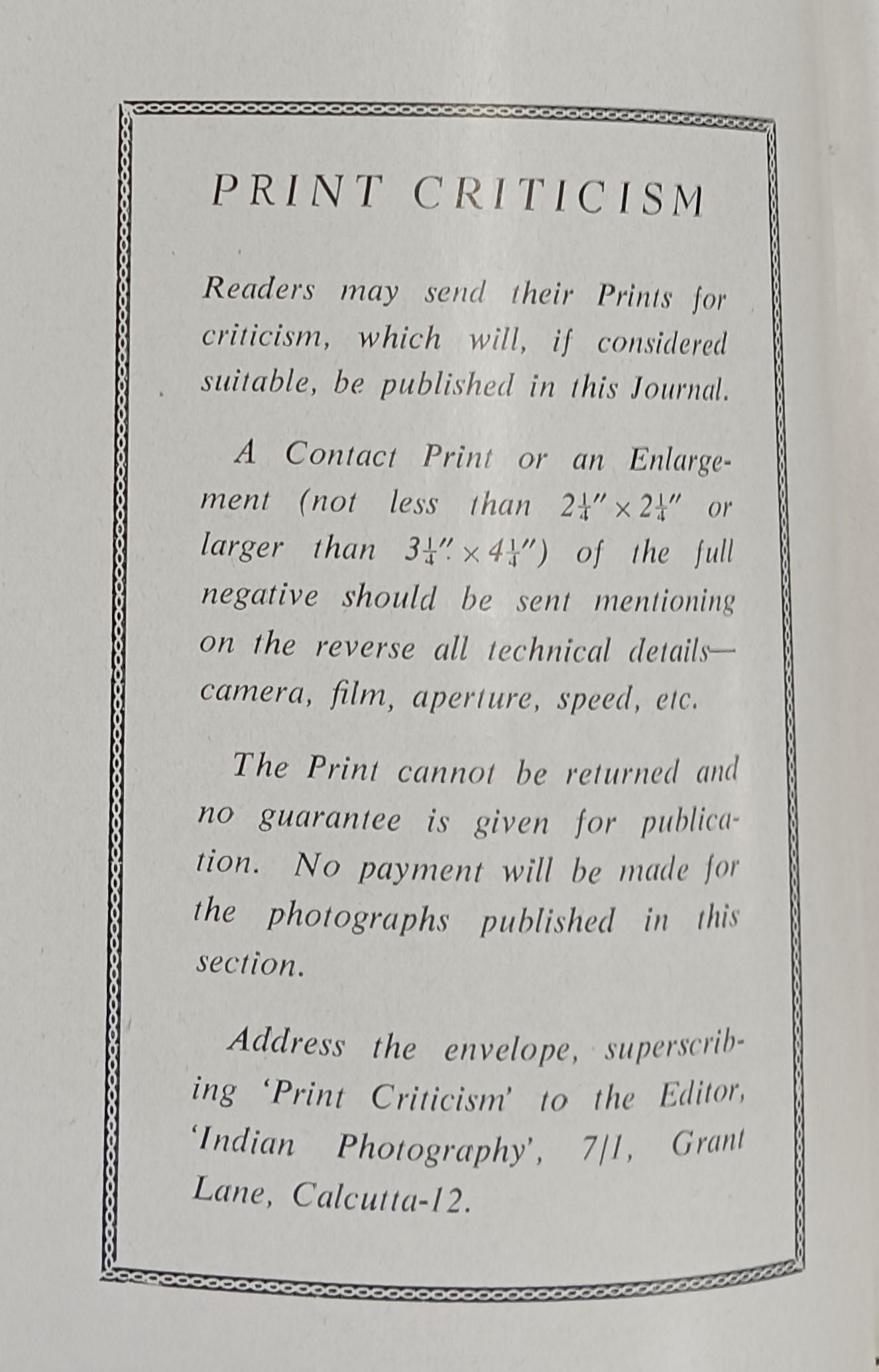
Although little is known about these portfolio circles after the 1940s, the critical vocabulary shaped by Thomas and Razavi had a lasting influence. Years later, magazines replicated the model established by the 1940s Postal Portfolio circle; for instance, an announcement for “Print Criticism” in a 1950s issue of Indian Photography instructed contributors to share “all technical details—camera, film, aperture, speed, etc.” The Camera Monthly Magazine carried a column titled “Our Readers’ Comments,” where subscribers responded to submitted images and the photographer could, in turn, reply to the feedback. Moreover, the approach of these circles was reinforced by a fraternity of writers and teachers, including figures such as Stanley Jepson and Gurmeet Singh—editor and columnist respectively at the widely read Illustrated Weekly of India—who were instrumental in defining India’s vibrant amateur photography culture between the 1940s and 1960s. For decades, the language forged and popularised by the 1940s Postal Portfolio shaped how photographs were judged, debated and understood. Only in the 1980s did that lexicon begin to change as galleries and the contemporary art world ushered in new frameworks for seeing and writing about the image, in an attempt to imbricate the politics of photography with the aesthetics of the image.
For more archival insights into early twentieth-century photographic practices in South Asia, read Sukanya Baskar’s review of the exhibition The New Woman Behind the Camera (2021), and Anisha Baid’s essay on Homai Vyarawalla and reflections on the exhibition Inner and Outer Lives: The Many Worlds of Homai Vyarawalla (2015).
To learn more about modern photography in South Asia, read Jigisha Bhattacharya’s essay on professional photography in twentieth-century Calcutta, Samira Bose’s observations on Wahab Jaffer’s archive of Ahmed Parvez, Sujaan Mukherjee’s reflections on a 1930s body-building manual, Sukanya Baskar’s mapping of Zia Qadri’s oeuvre and his photographic practice in 1940s, and Ankan Kazi’s translation of the interview between Sunil Janah and Siddhartha Ghosh.
All images are installation views of Twin Sisters with Cameras curated by Sabeena Gadihoke at the NCPA, Mumbai, 2025-26, courtesy of the respective artists and the NCPA, Mumbai, unless otherwise mentioned. Photographs by Sreerupa Bhattacharya.