
Palestine and Global Action: To Witness Images from Gaza
Today marks two years since 7 October 2023, after which Israel began the ongoing genocide—the most recent phase of brutal torture in a 78-year-old history of colonial occupation in Palestine. In this span, our eyes have witnessed horrors that have thus far remained beyond the realms of our perception or that we have only read about in dystopian novels, in instances of medieval torture, in the holocaust which is now ironically and horrifyingly used as an excuse to justify the present genocide or in histories of colonialism. And it is precisely between a discourse that ruminates on the “postcolonial” and the “decolonial,” and civil society that struggles to access the freedoms made available by colonial capitalism and subsequent political decolonisations—of property, speech, liberty, association, movement, etc.—that we are finally compelled to shatter the illusion and confront the fact that the era of world colonialism has not passed. As Robert Meister says in After Evil: A Politics of Human Rights (2011), the notion that it is the past that was evil and that evil is now in the past has proven itself to be false—not just falsifiable, but a blatant lie. On the contrary, the beast is in the present. This is the time of Empire. The question that we are then confronted with is: What is to be done?
I want to think through this question by asking: Where to look? How to see? What to witness? With uncertainty and responsibility, by looking at three sets of moving/still images, I try to pay attention to what emerges when these pictures are placed together, in conversation with one another.
.jpg) The first set is
The first set is
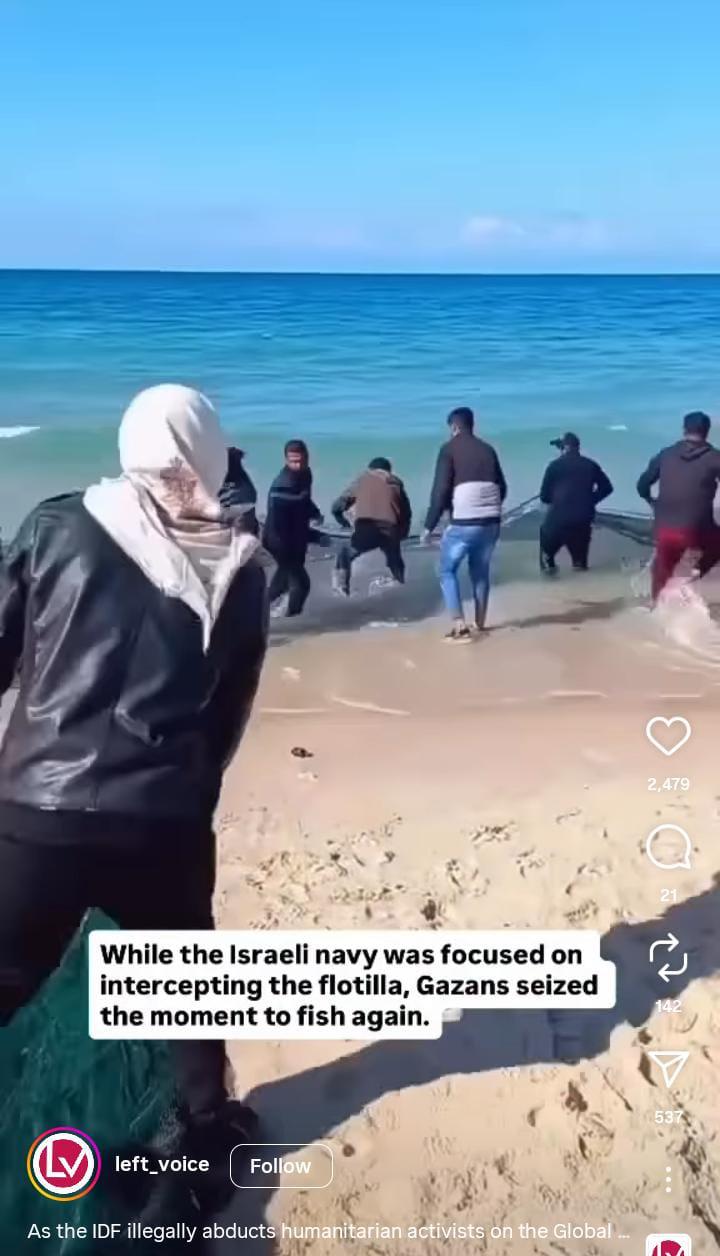
(i) a reel of Gazans fishing while the Israeli navy was preoccupied with blocking the Global Sumud Flotilla (GSF) between 1 and 3 October 2025, in which over 450 activists from 40 countries tried to reach Palestinian shores to deliver humanitarian aid;
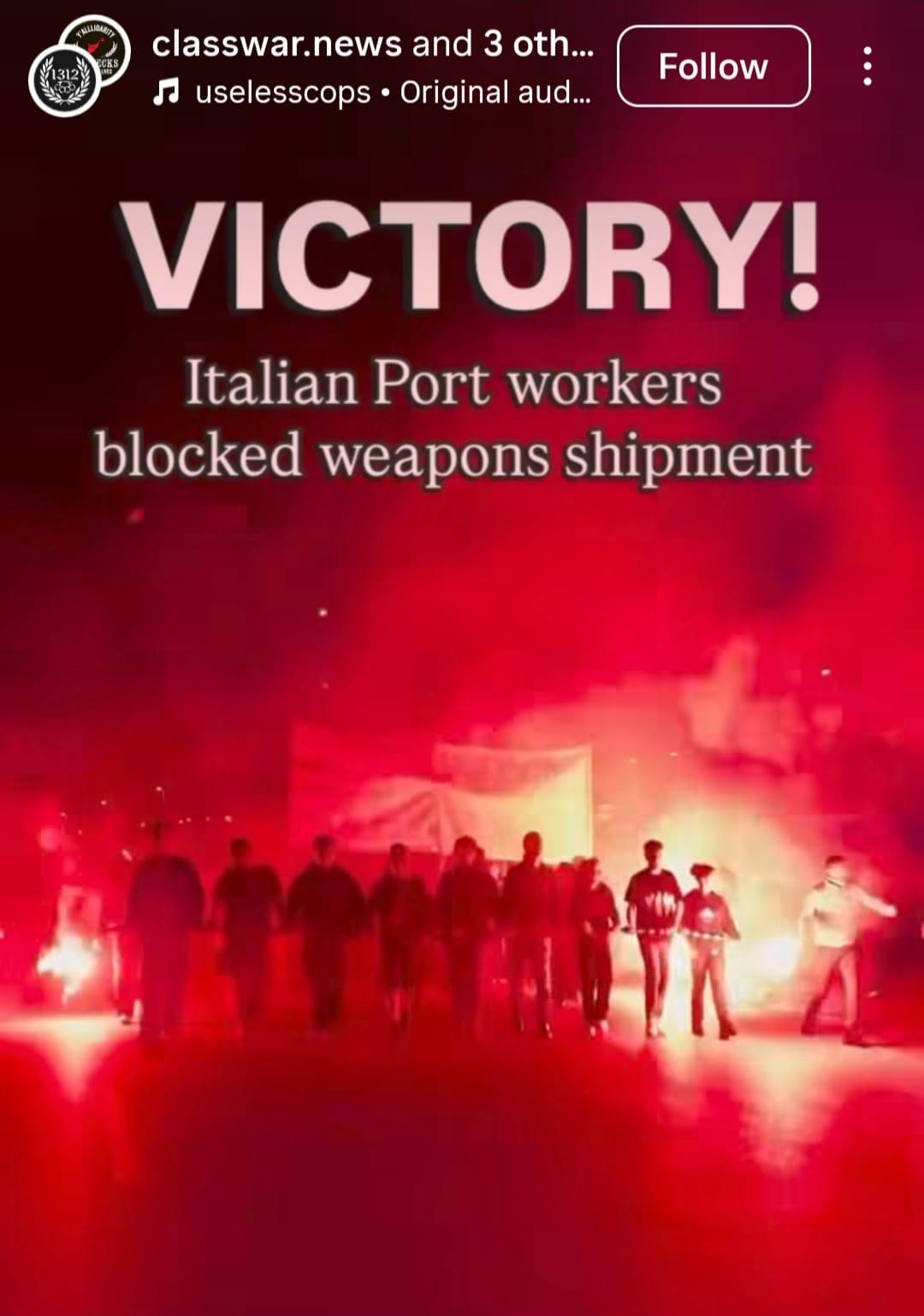
(ii) an image of the Italian dockworkers’ blockade on 22 September 2025 of ships that were bound for Israel that carried weapons and military technology to be used against Palestinians.
Palestinians have been unable to access their own waters for fishing amidst a man-made famine in which over half a million people have been stuck in a cycle of “starvation, destitution and death,” even as Israel continues to shell, bomb and destroy the Gaza Strip and Palestinians living in Gaza. Italy enables this genocide directly as the third-largest supplier of arms to Israel, following only the U.S. and Germany. When Italian dockworkers blocked the ports in Genova, Trieste, Venice, Livorno and Salerno, this was not merely symbolic support of the GSF but a material disruption of production and distribution of weapons from Europe to Israel. Labour militancy is capable of disrupting the global arms trade—precisely because a port is inherently “connected.”
While the GSF was unable to deliver humanitarian aid, it was the first time since Israel imposed a naval blockade in 2009 that any flotilla had come closer than 70 nautical miles to Gaza. This moment marked a breach of Israel’s blockade that has renewed the possibility of voluntary humanitarian action in the absence of available international institutional support. In fact, the sailing boat Mikeno even managed to cross into Gaza’s territorial waters and was only nine miles off the coast before being intercepted. Israel required the deployment of its entire naval resources to maintain its blockade. Gazans were left alone for momentary, temporary relief. They fished for themselves.
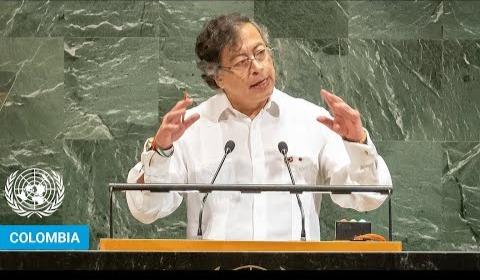
Gustavo Petro Urrego, President of Colombia, addresses the general debate of the General Assembly’s 80th session. (Laura Jarriel. New York, 23 September 2025. Image courtesy of UN Photo.)
The second set is
(iii) an edited video of a part of Che Guevara’s speech at the United Nations General Assembly on 11 December 1964 in which he conveys Cuba’s unwavering stance against American imperialism;
(iv) an image of Colombian President Gustavo Petro’s address to the UN General Assembly in New York on 23 September 2025, calling for the creation of an international armed force composed of states that reject genocide.
On 5 March 1960, Fidel Castro coined the slogan "¡Patria o Muerte!" ("Homeland or Death!") during a speech in Havana at the funeral of the victims of the French cargo ship La Coubre. The ship had been carrying weapons to Cuba for its right to defend itself, but it exploded in what was suspected to be an act of sabotage by the U.S. This call went on to become a rallying cry of the Cuban Revolution and Che would deploy it in rhetorical fashion in his UN General Assembly speech. Here, the central themes were the denouncement of U.S. imperialism; support for non-aligned countries that struggle against colonialism, imperialism and neo-colonialism; and the right to sovereignty and self-determination for the people of Africa, Asia and Latin America. The cry can be read as reality and as resolve. Inflected onto images of Palestinian martyrs today, it reminds us that “the final hour of colonialism,” as Che imagined, “has (not yet) struck.” The past is in the present. And so Che’s revolutionary spirit must persist.
In a much-needed demonstration of the use of imagination and readiness for action toward political justice, Colombia’s President Gustavo Petro, in his address to the UNGA on 23 September 2025, called for the creation of an international army. This “global army for justice” would have as its first mission the liberation of Palestine from Israel’s occupation and an end to the genocide in Gaza. The invocation of Simón Bolívar, that “We are tired of words… It is time for the sword of liberty or death,” is then also an ode to Che and a prayer for Palestinian martyrs. It is an awakening call that we must either struggle to live or await death—wrapped, without glory, in the silhouette of justice yet to be delivered.
The third set is
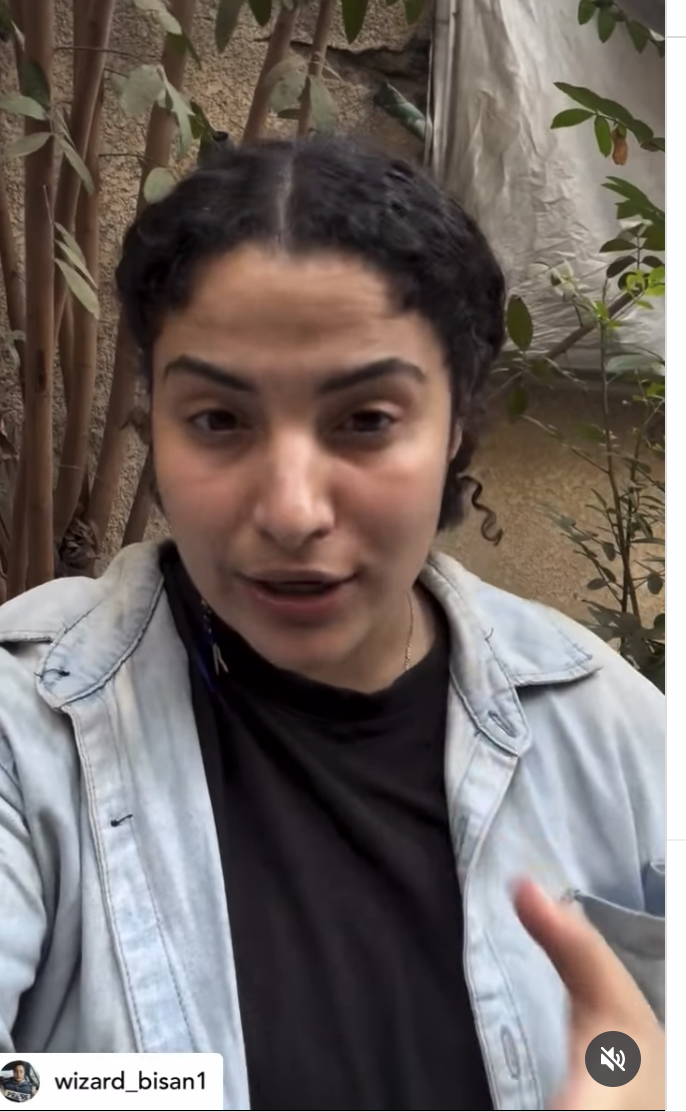
(v) Palestinian journalist Bisan Owda’s video diary from 28 September 2025;
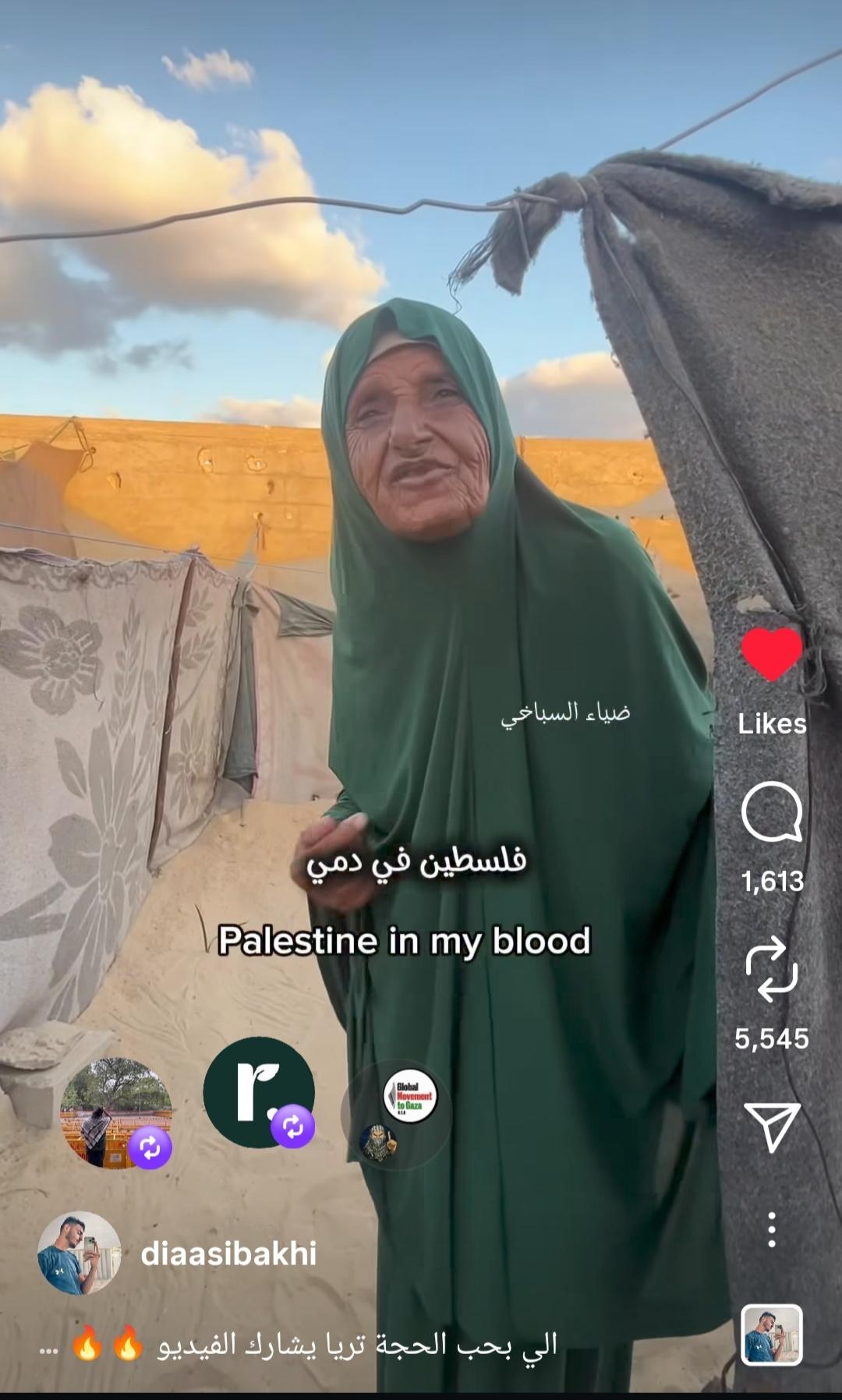
(vi) a reel of a Palestinian grandmother in a UNHCR refugee camp.
“This is Bisan from Gaza. I am still alive from Gaza City.”
The twenty-eight-year-old Palestinian journalist has been giving us news of the genocide and calling upon the moral conscience of the world to see and to act, to not allow this to happen. In a painful video released on 28 September, she said, with tears in her eyes, “we tried.” If people leave, she said, they know they will lose their homes forever. The question is not merely one of being alive, as the Human Rights Discourse will have us believe. The fight is for life in the homeland. Staying is resistance. Staying is the struggle. Staying is sovereign. In a second video uploaded on the same day, and amidst the sounds of Israeli bombs we hear going off, she tells us that two million people in Gaza are now squeezed in the west of the city, in what is merely ten percent of the area of the city, and that since the ground invasion of Gaza City, the suffering is accumulating. That Israel is trying to make the place unlivable, uninhabitable, so that people do not return to live in it. “A 78-year old occupation is erasing a 6000-year old city. But... we have the memory and the voices and our acts to change. And we need to start changing more, and faster.”
In a UNHCR camp, Diaa Sibakhi makes a video of a Palestinian woman—daughter, mother, grandmother. The comment says, “Palestinian men show daily the meaning of manhood because they were raised by mothers who kiss the ground they walk on and instill in them a love for their land and their identity.” And in the video, we hear, we see, we witness this love. She recites, in poetic cadence:
“Palestinian, Palestinian
I am Palestinian, Palestinian
Displaced Palestinian
Palestine in my blood
In my veins, the sun does not set for me, the sun does not set
Understand me Palestine, the sun is not absent…
I went to the pictures, I saw my house
All roses have grape trees
Grapes with guava in them, with pomegranates in them,
A lemon with an almond, in it has peach, in it
Orange in the same picture…
I am steadfast”
The image conjured up for us ought to be our cue to cultivate a practice of sumud or steadfastness and develop courage and compassion to act in solidarity with the global struggle for the liberation of Palestine. We must take as guides radical political praxis from the past that seeps into the present through communities across the world that are not afraid to resist. There is a limit, after all, to the consumption of images—in, despite, or precisely because of capital’s imperative to consume. A genocide is being televised. So is a revolution.
To learn more about the ongoing genocide in Palestine, read Asim Rafiqui’s essay on the politics of visibility with reference to Gaza, Ankan Kazi’s reflections on Abdallah Al-Khatib’s Little Palestine: Diary of a Siege (2021), Santasil Mallik’s observations on Gaza Lives as part of Filmworks for Palestine in Toronto and Kshiraja’s essay on Yousef Srouji’s Three Promises (2023).
All images are screenshots from videos sourced from various Instagram handles, unless otherwise mentioned. The video has been sourced from the United Nations YouTube channel.