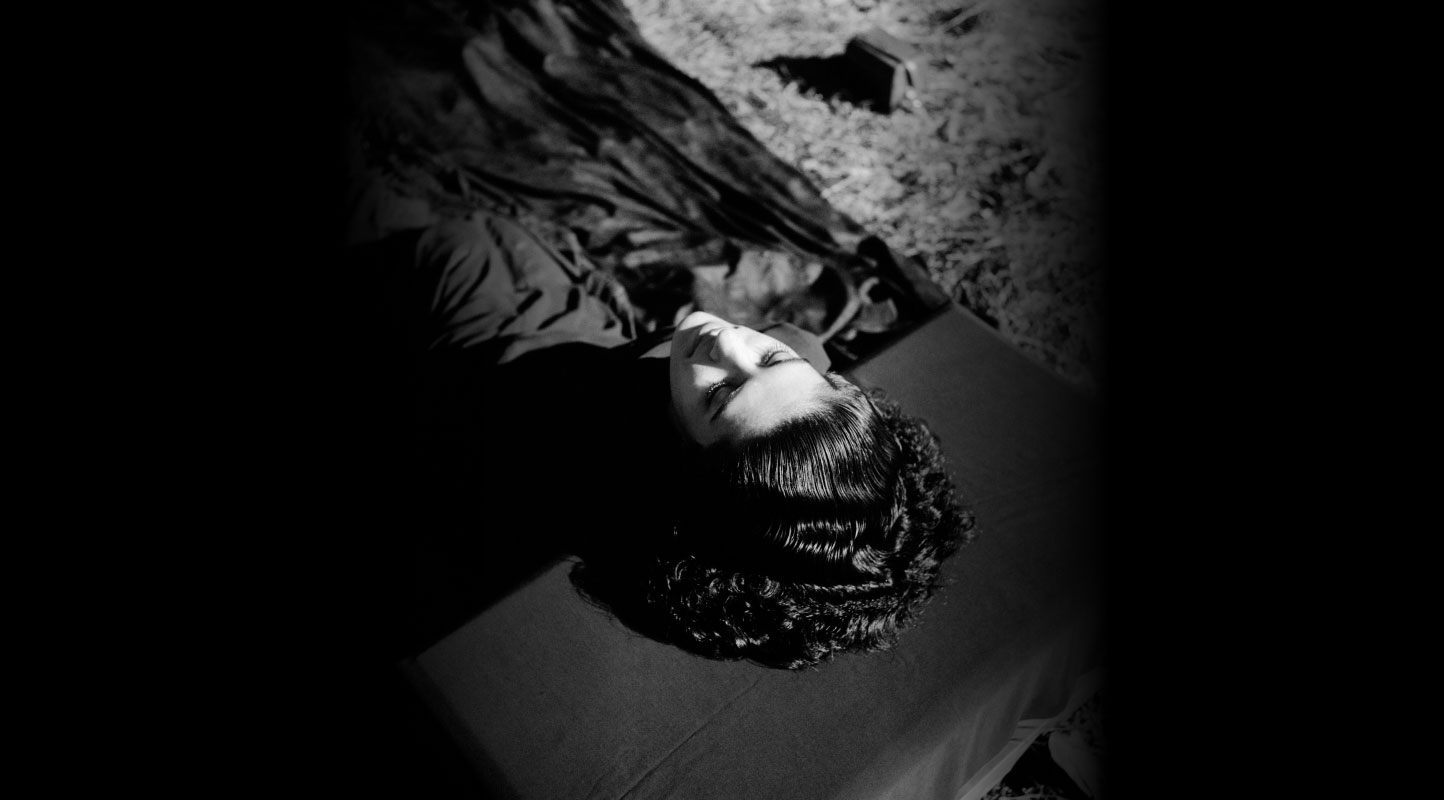


Textile as Spaces of Strife: Kallol Datta’s Clothes-Making Practice
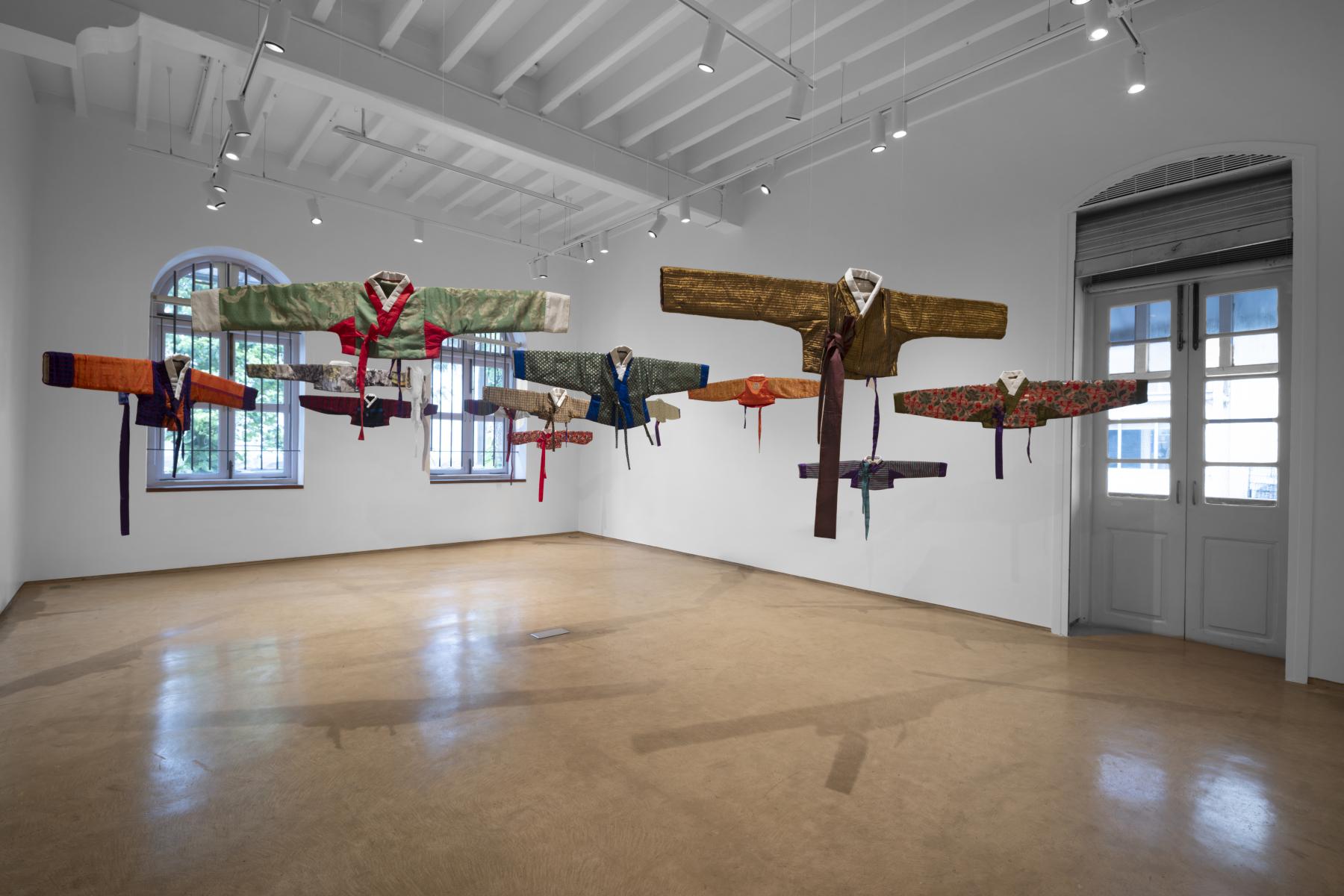
Installation view of Volume IV: Truths, Half-Truths, Half-Lies, Lies by Kallol Datta at Experimenter—Colaba. (Mumbai, 2025. Photograph by Anil Rane.)
Embroidered sarees and blockprinted tunics reconstructed into eighteen Korean jeogoris (upper garments of the traditional Korean dress) hang like phantoms bearing witness at Experimenter’s Colaba gallery as part of Volume IV: Truths, Half-Truths, Half-Lies, Lies by clothes-maker and researcher Kallol Datta. Even with all their sashes neatly bound into tight bows, some—if worn—can be imagined to have allowed fluidity as they wrapped around the body, while others were tight and crisp-ironed like children’s uniforms with the bust coverage gradually decreasing as if made for a tinier person. “Someone said I really like the miniatures in this gallery,” said Datta, but “these are actual life-size, corresponding to excavated jeogoris and those held in museums in Korea today.”
Datta has been preoccupied with the jeogori for many years, which first came to the fore in their research around their show Volume 3 Issue 2 held at the gallery’s Kolkata space in 2022, where they took from their ongoing inquiry into native clothing practices in Southwest Asia, North Africa, the Korean Peninsula and India to amalgamate the basic forms of kimonos, haoris, obis and sarees into near-anthropomorphic textile forms floating about against specially painted dark blue gallery walls. It was during distilling such native-wear to its template-like form while on a residency at Aomori Contemporary Arts Centre (ACAC), in 2021, that Datta noticed the similarities between garments like the Korean hanbok with the South Asian angharakha and the Persian chapkan.
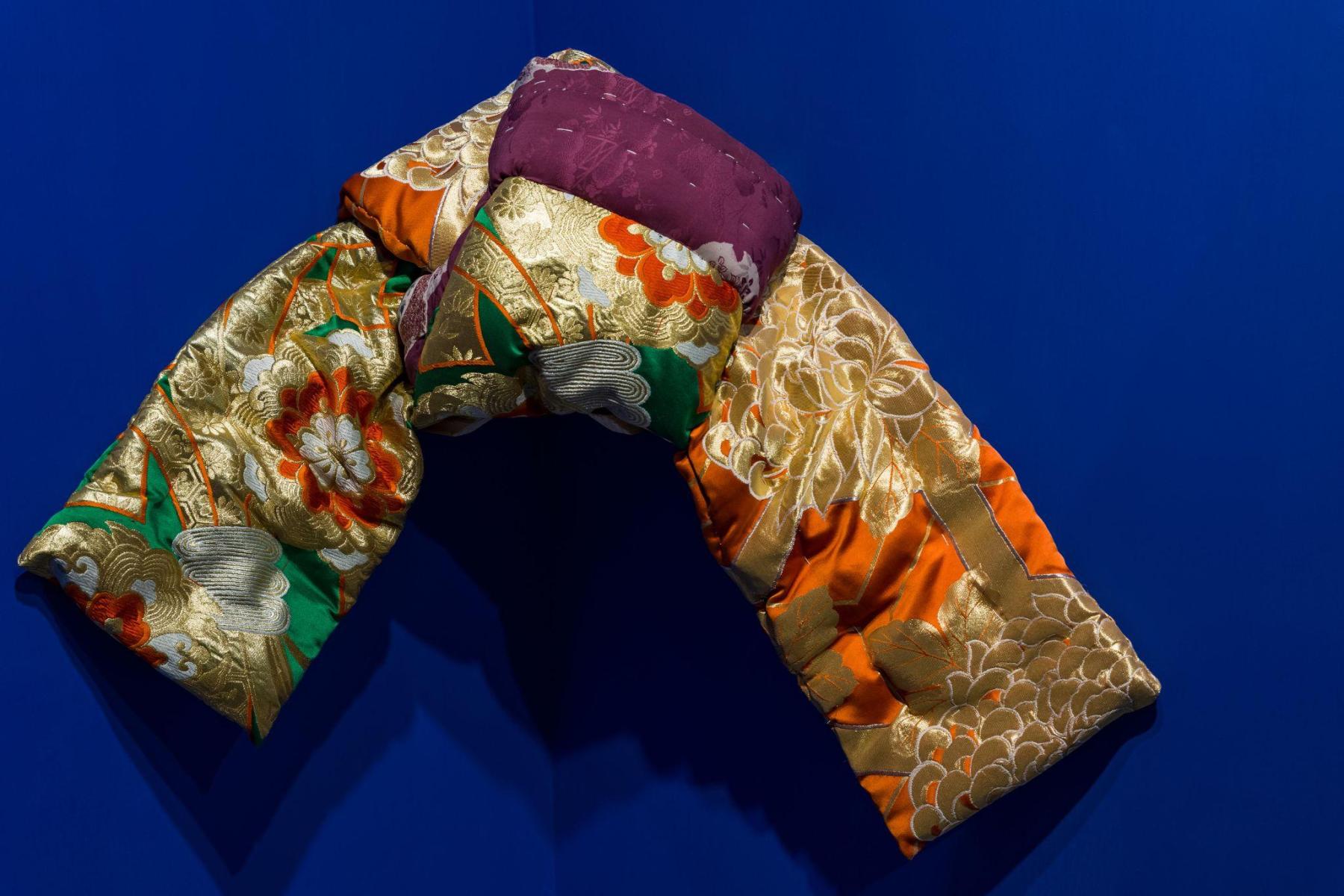
Object 3. (Kallol Datta. 2021. Repurposed Obis and Obi textile; silk and cotton wadding, 29 x 39 x 7 inches.)
“The Korean hanbok is a layered garment,” they told me after Volume 3 Issue 2:
“You have a skirt portion called the chima and a blouse called jeogori. Towards the end of the Joseon period during the late eighteenth and early nineteenth centuries, the blouse kept getting shorter and the armhole kept getting tighter. It went up to such a point that they had to incorporate a breast cloth to wrap around themselves and then wear the jeogori because it went above the bust.”
This transformative decision about the jeogori’s design and build was taken by Confucian scholars in the sixteenth century. It ultimately stopped women from leading public lives and becoming members of merchant guilds or even going to school. They were instead forced to remain sequestered within the interior quarters. This detriment translated into another aspect of their clothing, namely their shoes, which were not coated in perilla oil for waterproofing or made well, like men’s footwear—as why would they need such shoes anymore?
Clothing since inception has been used as a tool to intimidate and subjugate the minority, Datta would say after Volume 2. “In every culture, garments like the Korean hanbok and jeogori, or the sabai in Thailand, or even the kedia in India, started off as the same for all genders,” Datta explained. Then their shapes became boxy and conducive for male work environments, while for women, they got tighter and more difficult to deal with, like the jeogori. In our last conversation two years ago, they recalled the Breast Act in Travancore, where Dalit and Bahujan women were required to pay a certain amount to the governor so they could afford to cover themselves, revealing oppressive notions of caste-based modesty compliances. “Even in Thailand, which was never colonised, they went through a nationalist movement where decrees dictated how Thai people should appear to be more civilised,” they said, adding how it changed the way the sabai or breast cloth was worn as women now had to wear a blouse underneath for modesty.
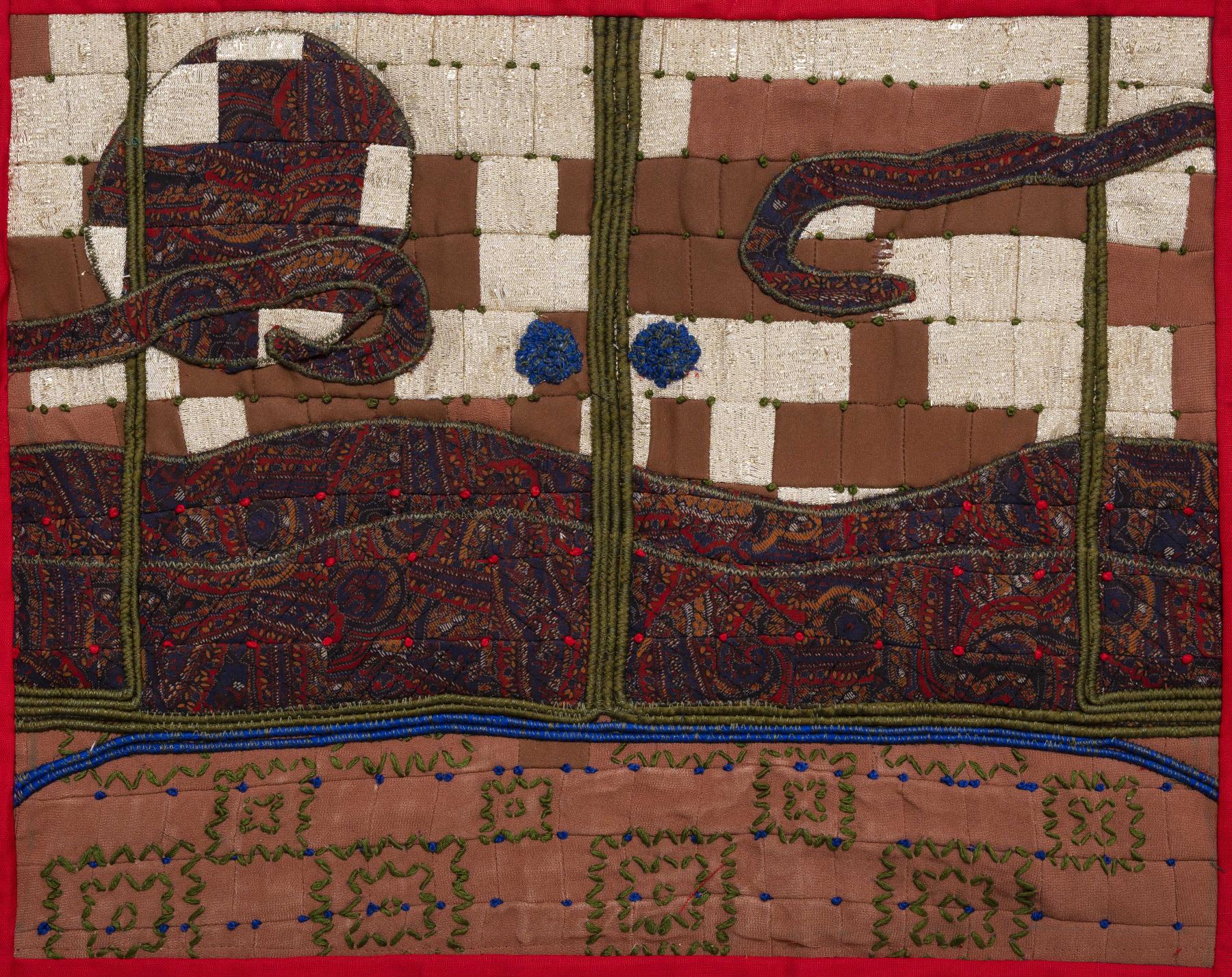
Poster 13. (Kallol Datta. 2024. Reconstructed skirt, blouse and jacket; silk, thread, cotton, viscose and polyester, 13 1/2 x 16 1/2 inches.)
In the current exhibition, Datta divided the space into sections based on the syllables in the subtitle. Each corresponded to the four directions their research took and source material like advertising posters or maps, where he beckons the viewer to go beneath what was and what has been presented. In the “Half Truths” segment, a textile poster derived from Datta’s research around advertising posters from the Meiji, Taisho and Showa periods replicates brick walls as the moon shines. This perspective makes us imagine ourselves behind bars much like many high-class women who were married to the Shogunate. These women were held hostage within Edo while their husbands were allowed excursions. Debarred from leaving the city’s bounds, they could only look outside. “It also alludes to the nighttime curfews that were extremely common in East Asia,” said Datta, “but you also see two tiny camellia flowers in the centre, which just exist as bearers of witness or small acts of dissent.” The camellia has been used in revolutionary and abolitionist movements across the Global South.
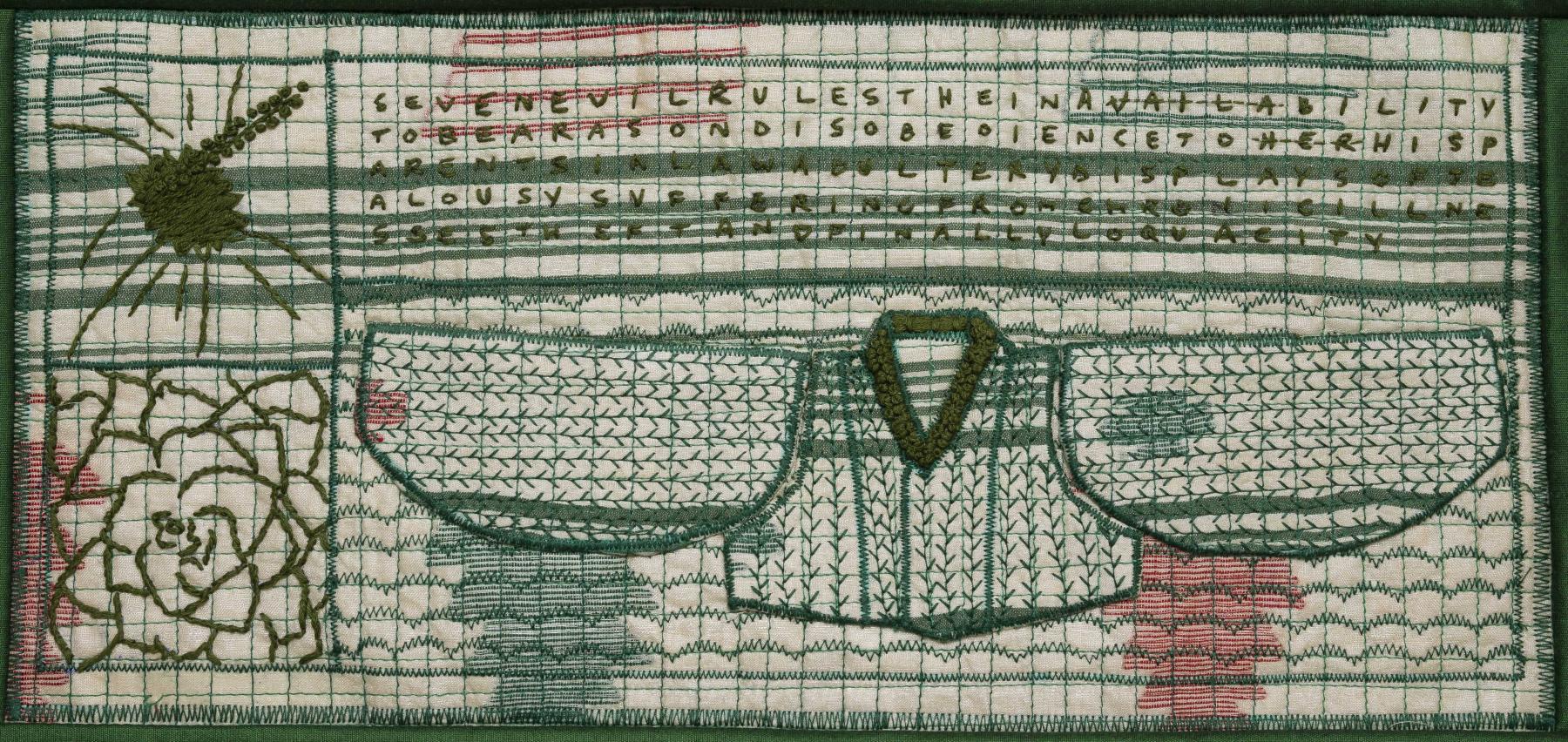
Poster 01. (Kallol Datta, 2025. Reconstructed saree; silk, thread, cotton and polyester, 6 1/2 x 14 inches.)
These advertising posters also worked as calendars—much like today. However, printing with woodblocks meant that they were expensive to produce. A consortium of merchants would print them together, each having their own segment within a single poster. Datta replicates this in one textile poster, replacing the advertisements with imperial edicts. The artist treats text like a crossword puzzle. They consistently switch how the text should be read, generating what they term as “random access’—also the title of their show at Experimenter in 2017—where the eye has to keep getting reacquainted and engage in an act of re-reading as they move from top to bottom or left to right in an attempt towards “absolute access.”
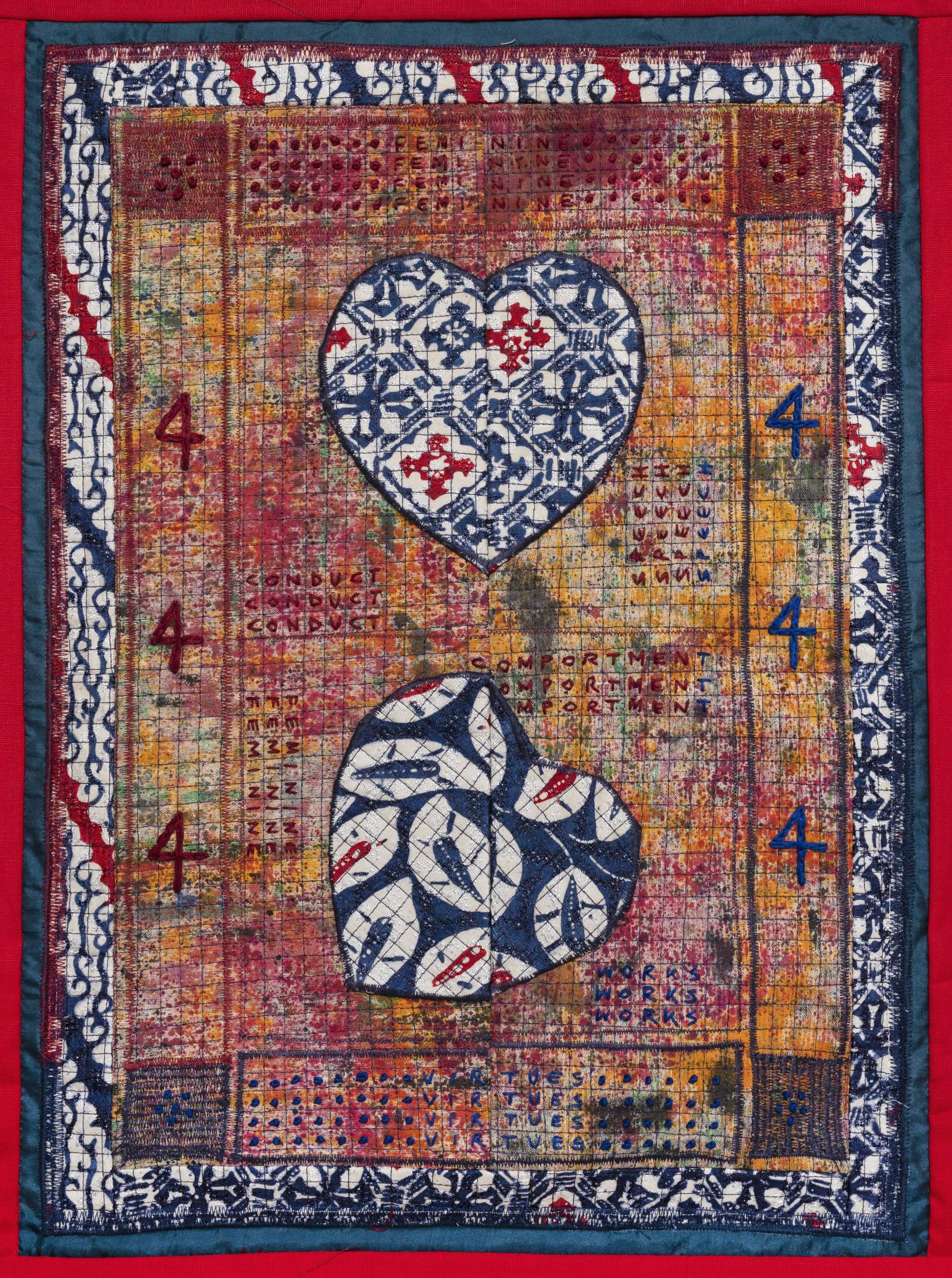
Poster 03a. (Kallol Datta. 2025. Reconstructed haori, kebaya and saree; silk, thread, pigment, cotton and polyester, 17 1/2 x 13 inches.)
Datta creates a symbolic world within textiles and leaves a trail of hearts filled with texts like candy or wave-shaped woodblock prints across many textile posters. They share,
“The heart seems like a very recent symbol but a lot of them were used in posters when missionaries were moving from China to the Korean Peninsula and then to Japan. In their posters, they would talk about the principles of Christ and left these heart-shaped symbols found in many Chinese and Persian posters. People clearly did not have the time to sit and adapt artwork to regions, so in some parts of Eastern China religious texts would have Persian calligraphy.”
Taking away the figurative focus that advertising posters across centuries have been wont to do, Datta abstracts their figures into faceless, genderless shadows shrouded in the garment they are wearing—their faces often turned into camellias, blooming symbols of hope.
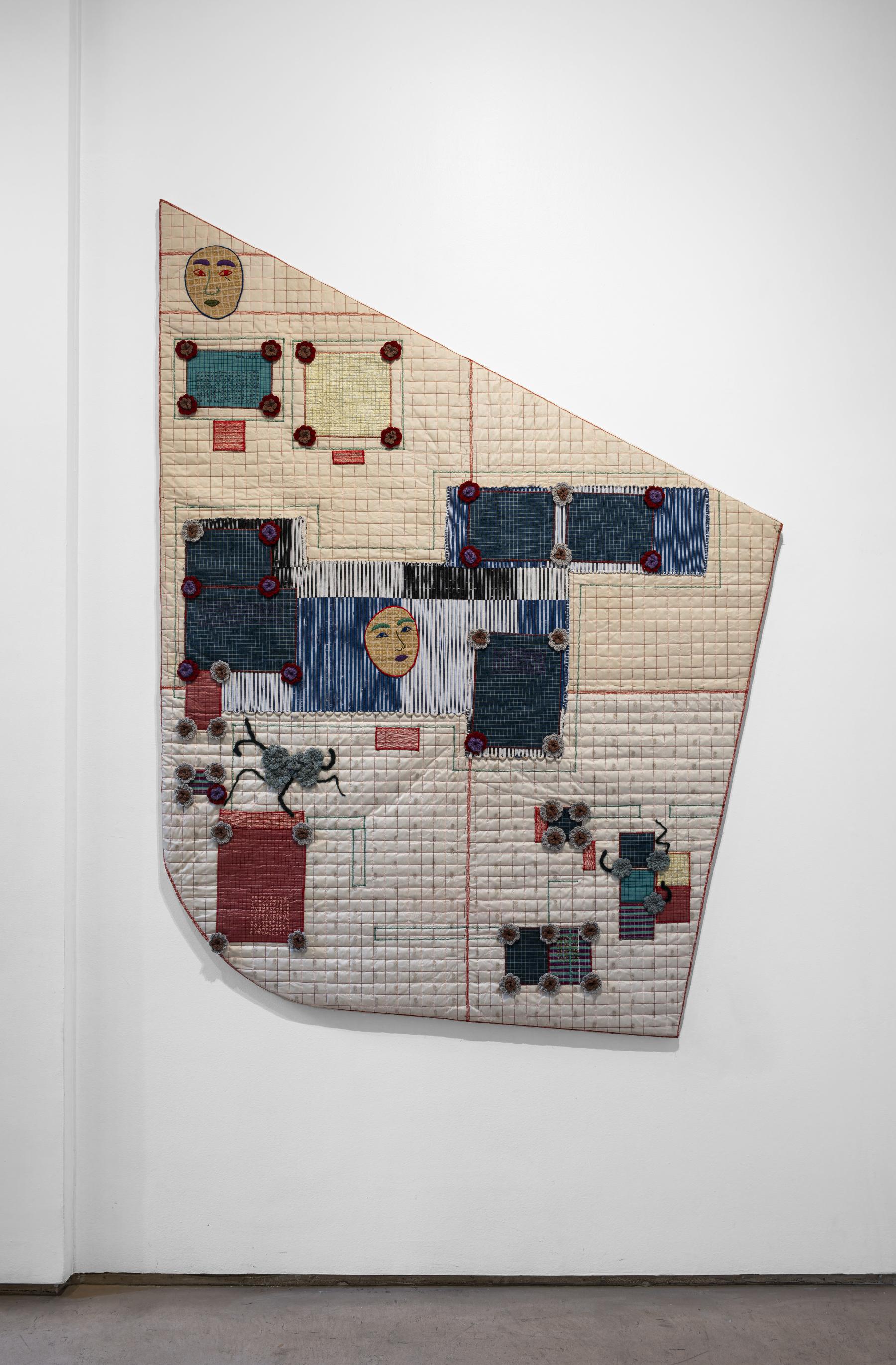
Blueprint 02. (Kallol Datta. 2025. Reconstructed phaneks, sarees, haori, home linen; repurposed yarn; cotton, silk, paper, wool, polyester, thread, acrylic and nylon, 72 x 53 1/2 inches.)
Once within the house, the women controlled very little. Reflecting this, Datta graphically delineates such boundaries in a blueprint of a hanok (traditional Korean house), as part of the section “Lies Our Clothes Told Us.” Printed textiles made from repurposed kimonos, sarees, sarongs, kebayas and haoris swirl through the interiors of a constricted Korean house, with a colour decipherer we have encountered on a typical textbook map. Datta explains,
“That’s an architectural textile drawing. This is the actual plan of the hanok occupied by the Resident General of Japan who was appointed to look after Korean Affairs. According to Confucian principles, married couples also could not share space. They had different quarters in their houses and women did not have access to outer courtyards—they had inner courtyards that men of the house could access—and women could not access male spaces. The quilted camellias map out these restrictions.”
Datta reimagines this through another blueprint in the show, where they propose a plan for an entire hanok designed for only female residents with airy rooms and open pathways. “There are more leisure spots and multiple entry and exit points,” they explain, “the shape moves away from the hanok’s rigidity.” Two disembodied yellow faces taken from advertising posters of the era, once again echoing phantoms or guardian spirits, bob about with tinted eyebrows and lips stitched from colourful thread and cloth—a visual placeholder of two women sharing the space.
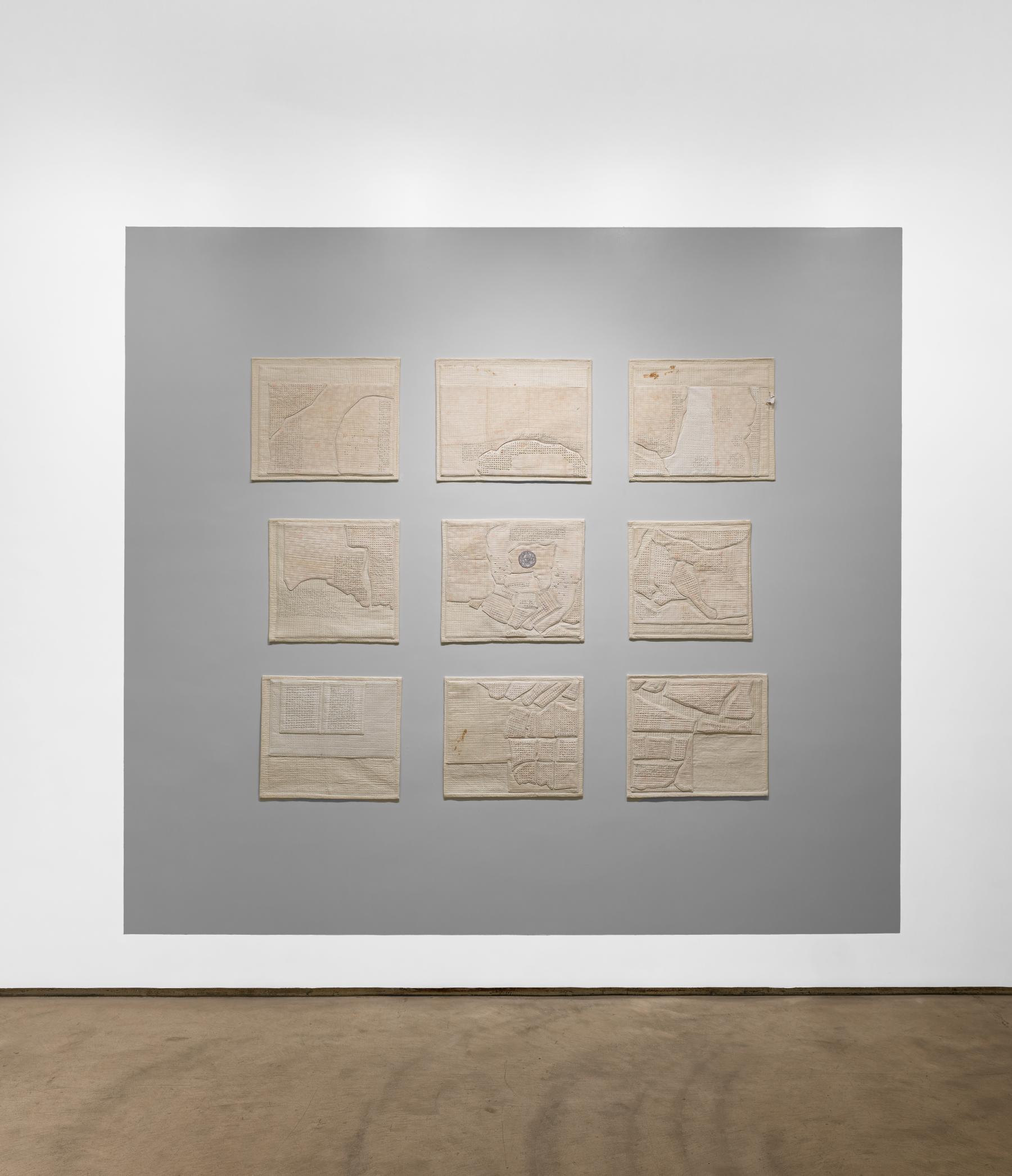
Surveying Edo. (Kallol Datta. 2025. Reconstructed kimonos and saree; cotton, silk, thread and polyester, suite of 9, 17 x 20 1/2 inches each approx.)
Datta engages in a personal cartographic survey of mobility that’s rooted in history, which takes form as a series of nine textile maps of Edo in the section “Half Lies.” His double engagement with movement is intriguing, considering the maps too are made on reconstructed garments which once had their own motion, as textile does. “The maps show how the working class was ghettoised into poorly planned neighbourhoods,” remarked Datta. A grey, wizened camellia, as if devoid of life, stands guard right in the middle, which marks the highlands and residence of the imperial family. The artist pointed out,
“That area has scant markings of activity, congregation or commercial activity,” They were segregated from the crowded segments of banks, and the wards of working-class people. Many of the French knots map out areas of leisure, which would be shared by all classes and would occur on temple grounds or courtyards where they watched theatre—lewd and bawdy—and ate from food stalls, after which they would all go back to their demarcated living quarters.”
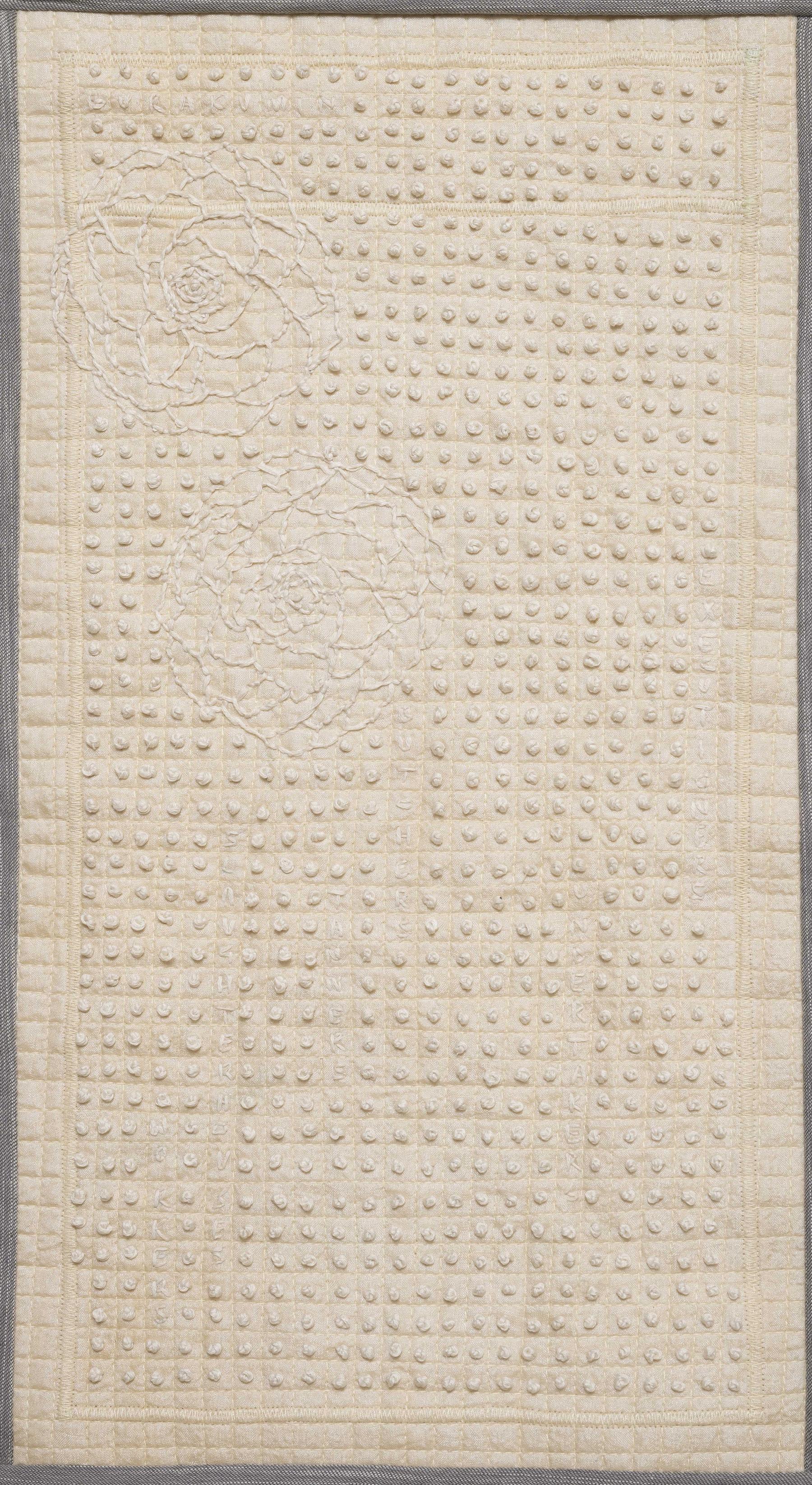
Poster 05. (Kallol Datta. 2025. Reconstructed kimono; silk, thread, cotton and polyester, 15 x 8 inches.)
These French knots recur in another textile poster with two camellias, supposed to delve into the burakumin caste in Japan, who continue to face oppression today. Datta notes,
“There were multiple forms of caste systems in Japan and Korea. You would not find a lot of information on the burakumins even today, but the Buraku Liberation League and others are fighting against their stigma. They could not even register on the koseki (family register) which is why access to governmental or municipal facilities was denied to them. Even today, in a lot of traditional family weddings, there is a background check for those with burakumin ancestry.”
Looking at the poster is like telescoping into a region of Edo from the larger maps in ‘Half Lies’.
All this is contemporary in the sense that not much has changed today, considering schoolgirls in France are not being allowed to wear abayas, Datta retorted as we looked at a purple poster of a figurehead made from a reclaimed printed saree. They add,
“I wanted to highlight the terms ‘accepted and preferred,’ for as you go through these religious edicts, imperial proclamations and social codes, you keep finding these terms. I do not think there has been any culture which has come out with such a rapid succession of edicts like Japanese imperial courts. During the World Wars, they wanted to use clothing as soft power… It was like, World War II is ending—now what?”
Datta had mentioned after their previous show, “A lot of the imperial edicts were about what people could or could not wear. How many yards could one use to make hakama trousers or kimonos?”
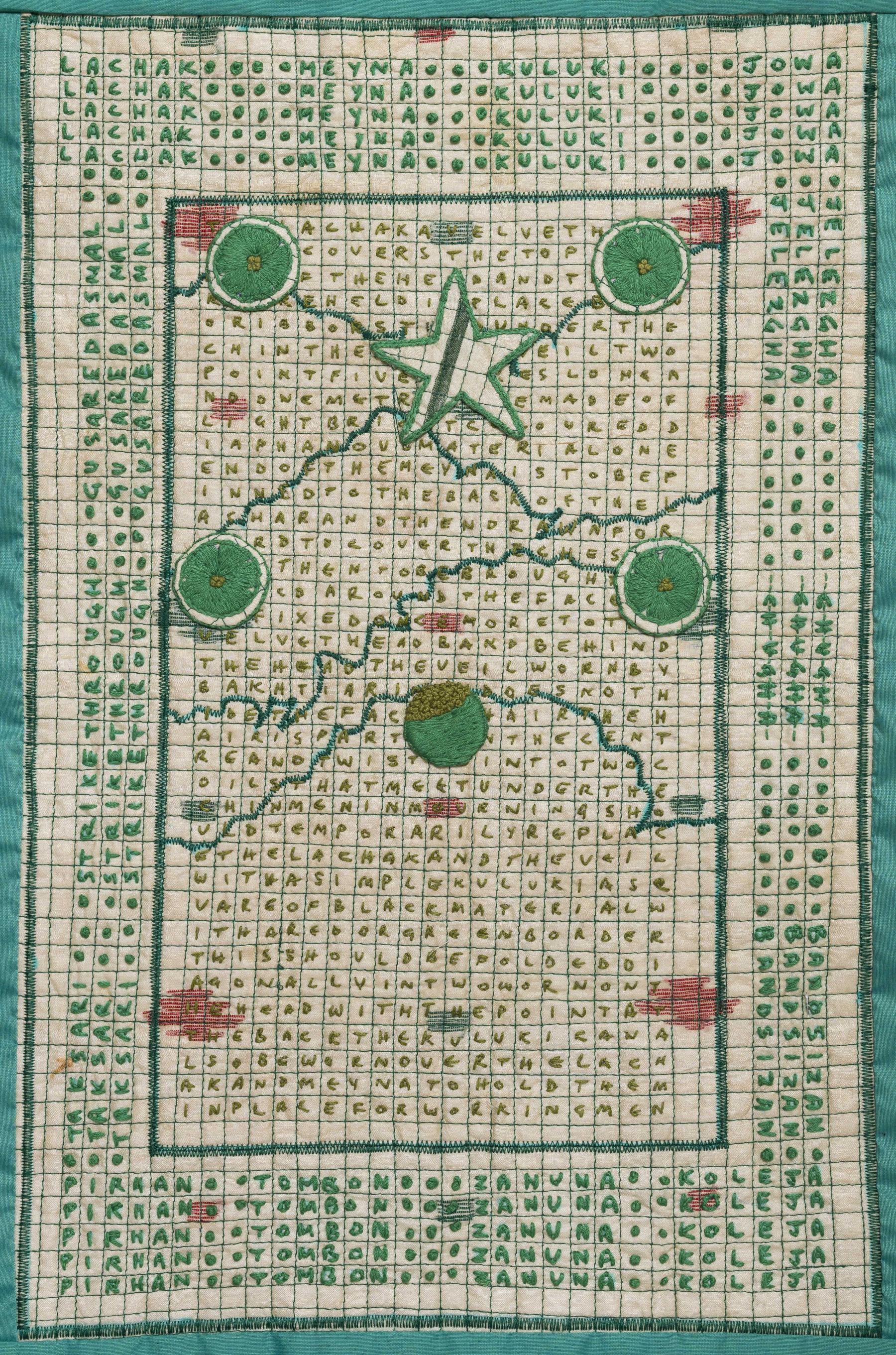
Poster 08. (Kallol Datta. 2025. Reconstructed saree; silk, thread, cotton and polyester, 17 x 11 inches.)
The artist spent significant time in the archives of newspaper photographer Shoichi Kudo. Working during the late Showa era, Kudo documented idyllic scenes of everyday life, which invariably captured people's clothing. Photographers then were trying to document what was happening during the World Wars and Kudo’s archives were forgotten until his daughter discovered the negatives and compiled them into a publication. “That is where I discovered forms that I was not aware of,” said Datta, “I came across the kakumaki for the first time in Kudo’s work and immediately drew parallels with veiling and hijabs, as every culture has some form of veiling to cover up women and, in some cases, even men.” On one of the posters is an embroidered star helmed in by four green camellias above a moon which shines above the hills of the Korean Peninsula. “This is about veiling practices for men but using Persian clothing items, which are spelt out like ‘Kuluki’ or ‘Phiran’ all around,” said Datta, “it talks about how carefully men must wear the veil while they are working, and mourning, and how much of the hair is to be covered under how many layers.”
Political histories and memories embedded in Datta’s clothing make them sites of tension, particularly as he works with donated clothing—either made, acquired, gifted or bought during the Showa period. During Volume 2 he had recalled working with a kimono donated by someone whose mother wore it for her fuji musume (dance performances). Datta noted,“She was so happy to get rid of it, and I said, ‘Why are you getting rid of it?’ as she had not used the word ‘donating’.” The artist then proceeded to recall the donor’s (for the lack of a better term) mother’s sardonic remark which propelled this:
“Her mum was what you would call a classical Japanese beauty. She found her daughter to be very ugly. So, she would always tell the daughter about why she did not look more like herself, and why she ended up looking more like the father. She just could not deal with all of that—that heaviness. And she was so glad to be able to give it to me—because then she did not have to hold on to it anymore.”
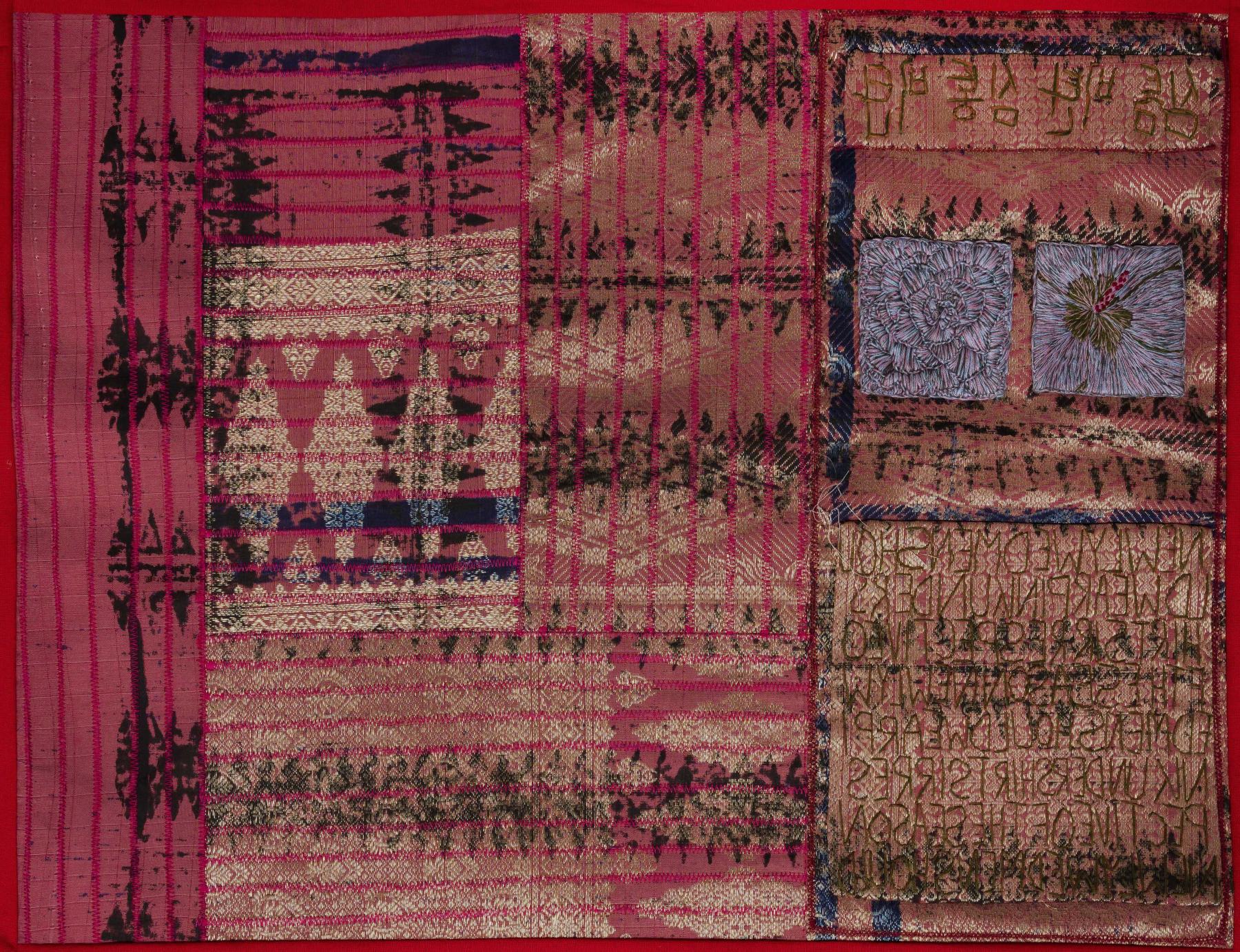
Poster 09. (Kallol Datta. 2024. Reconstructed saree; silk, thread, pigment, cotton and polyester, 16 x 21 inches.)
ACAC had a drop-off collection centre and people from all over the Tohoku region donated. “I had also asked everybody who donated to leave a note, a photograph or a voice message as to whose item of clothing it was, why they were donating it, or any memory or incident attached to that particular garment,” said Datta. They received letters and photographs from family albums. Datta was also sourcing sarees during the same time period from his extended circle of contacts in India. The artist shares,
“There were a lot of heritage sarees. All of them are being produced on machines now, and what I got still looks so contemporary in terms of the weave, colours and patterns. I got some fifty- or sixty-year-old Kanjivaram sarees. From the north, there were what we used to call ‘hazar buti’ sarees, where you have buti in metal or pure zari. The sarees are really heavy. Now in the market you will get hazar buti sarees, but it has evolved into something different.”
Thus, a lot of these were like lost textiles for him.
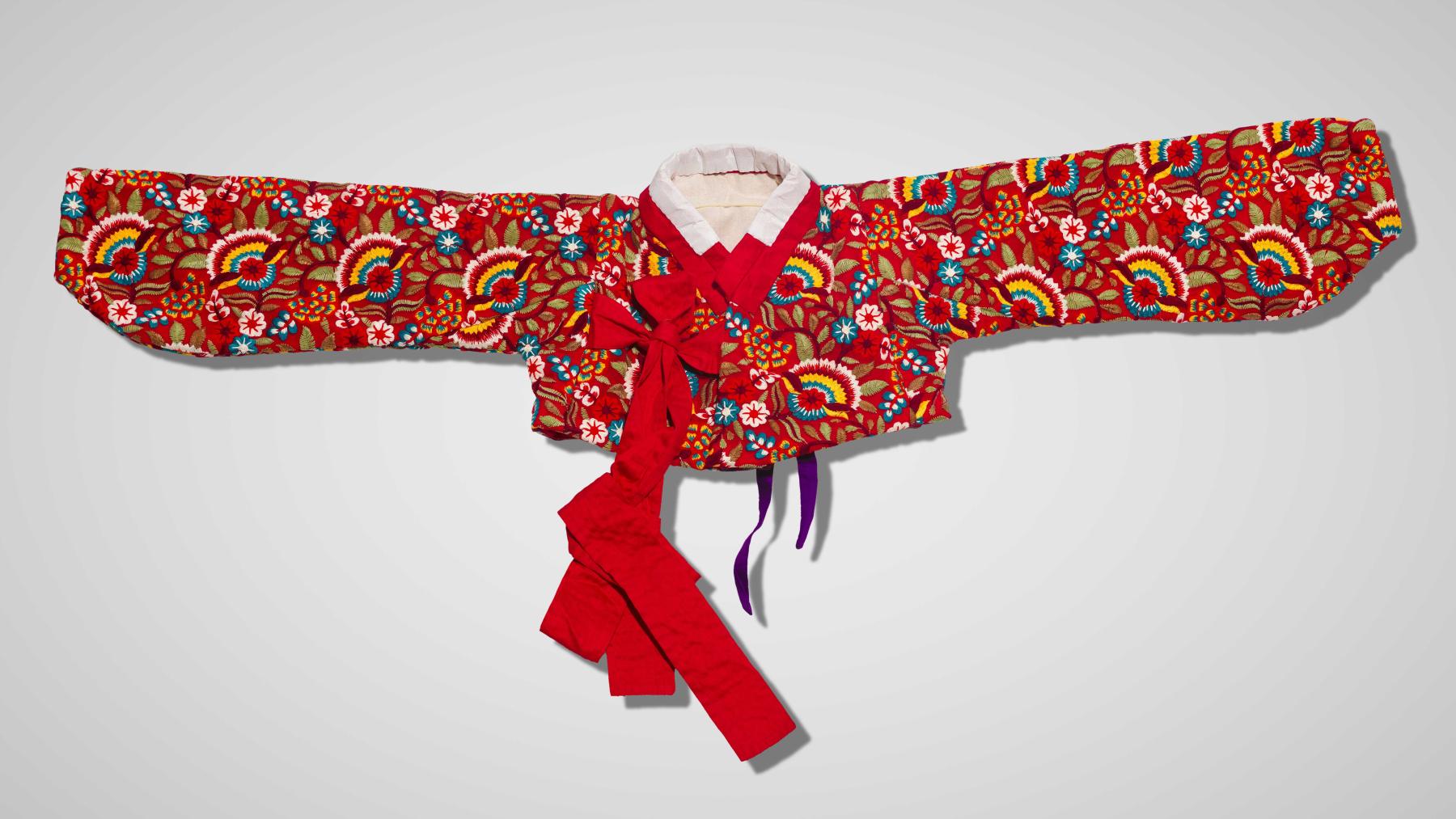
Jeogori 15. (Kallol Datta. 2025, Reclaimed textile; polyester, embroidery thread, silk, cotton and paper, 12 x 44 inches.)
Here too, while looking at a fiery floral-printed jeogori, Datta shared that it belonged to someone who lived in Mumbai and has passed away. Datta did not follow the usual design principles of colour swatching but rather a more unconscious process of choosing. Preferring to call himself a clothes-maker, Datta focuses on process; abandoning constant flux and movement within fashion seasons—unlike the materials he works with—Datta decided to quit the fashion industry so they would have time to research. I recall an eight-foot garment which spun on its axis while its mount was stationary in Volume 2. “One full revolution happens every ten minutes,” Datta had said, “I really enjoy doing that with fabric; even if it is meant to be static, it may not obey you because of the way it has been pieced together or cut. That is my main craft, I will say.”
To learn more about artists working with textiles, read Aparna Chivukula’s interview with Jayeeta Chatterjee on her practice, Sukanya Baskar’s reflections on Habiba Nowrose’s exploration of gendered expectations and Anisha Baid’s curated album of Habiba Nowrose’s series Concealed and Life of Venus.
All images are courtesy of the artist and Experimenter Gallery.