

Kashmir: The Poem and the (Impossible) Picture (Part Two)
This continuation from Part One deepens the attempt to describe the overwhelming encounter—of Qudsi Mashhadi, a seventeenth-century Mughal court poet, and of Samuel Bourne, a nineteenth-century British photographer—with the Pir Panjal and the upper Chenab Valley, where neither language nor camera can communicate what raw vision perceives. Both poet and photographer wrestle with a landscape that defies their ambitions.
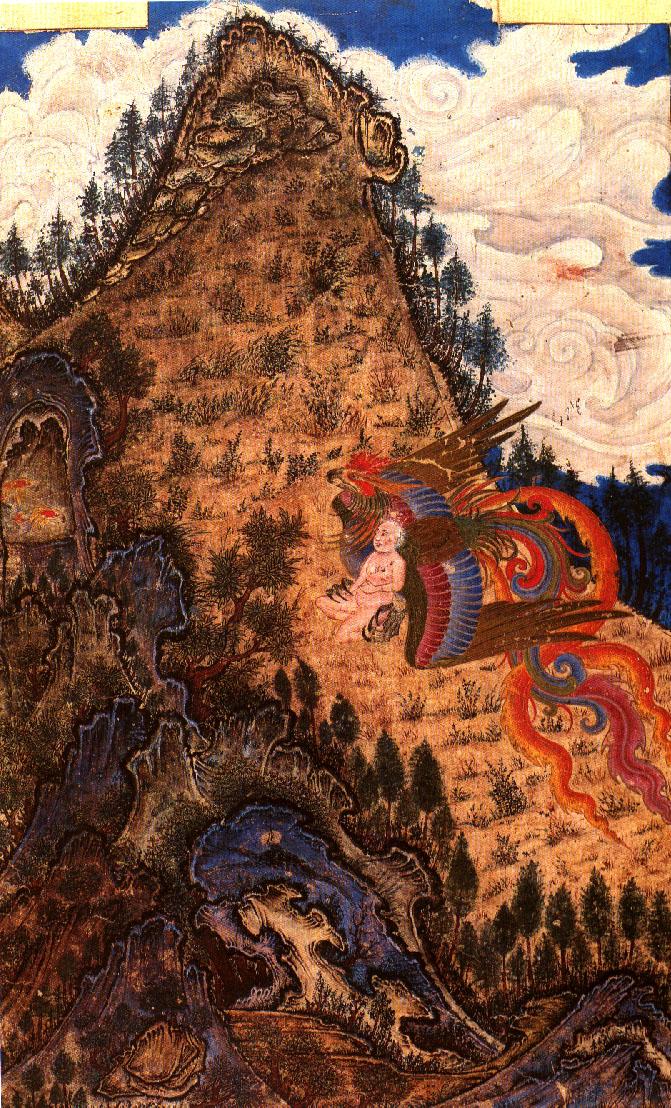
Zal and the Simurgh on Mount Qaf. (From the Sarai Albums Tabriz, c. 1370. Source: Wikimedia Commons.)
9. Even the Mount Qaf of myth and mysticism, and the abode of unattainable phoenix, is no match for Pir Panjal in Qudsi's elegy for the latter:
ز وهمش قاف در کنجی نشسته
Next to the summits of Pir Panjal, Mount Qaf cowers in fear
For the poet, it seems there is only one way to communicate the untameable, frightening and sublime nature of these mountains: through metaphor.
فتادی گر به این کوهش سر و کار
ز شیرین، کوهکن میگشت بیزار
If Farhad were asked to dig through this mountain,
he would already be sick of Shirin
Or,
بود عمر طبیعی سخت کوتاه
حیات خضر بایستی درین راه
The natural lifetime is too short,
for this path one needs the life of khizr
And even after all the metaphors are mobilised, the mountain remains unmappable in language. To speak about it is to fail. Qudsi’s tongue has turned into stone after singing the praise of these terrible and majestic mountains. He is exhausted—body and soul. But the profundity of this landscape is inexhaustible, even in a poem, even when the story has been narrated to the end.
مرا زین قصه تن فرسود و جان هم
دلم زین حرف سنگین شد زبان هم
نفس شد منقطع در قطع این راه
درازست این حکایت قصه کوتاه
This tale has withered my body and soul
Its words have hardened my tongue and my heart
Traversing this path has cut short my breath
While the story is brief, its wisdom is endless
10. From Bhaderwah to Kishtwar, the landscape Bourne traverses and encounters is relentless in immensity. He speaks of “gloomy solitude of interminable mountains.” The scale and magnitude leave no scope for detached and distant observation. The landscape, too vast for the lens, begins to etch itself into the photographer’s interior. Paul Klee—that German sorcerer of line and colour—once felt that it wasn't he who was looking at the forest, it was the forest that was looking at him. He felt seen. “Attempt to grasp their extent was impossible… and the aching mind could only retire into itself…”, says Bourne. In this moment of collapse, the camera is impotent—and a different mode of seeing emerges.
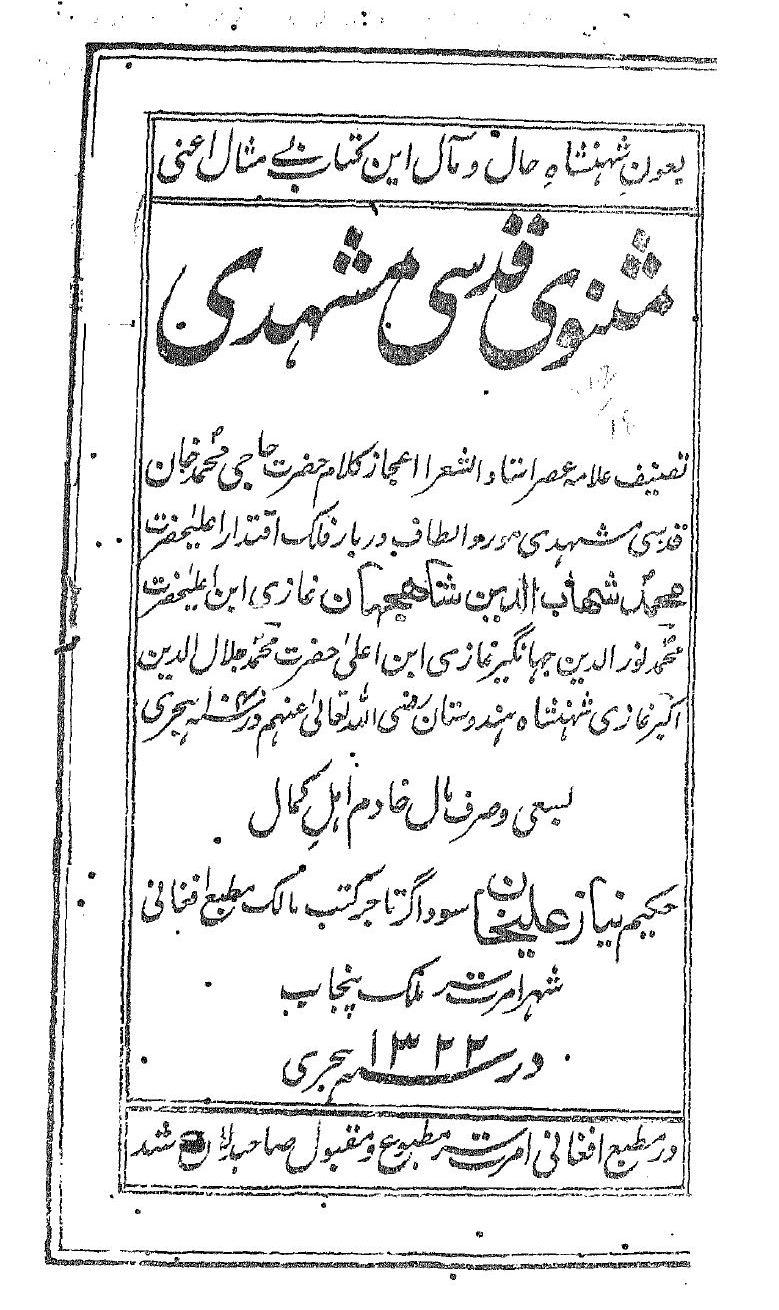
The coverpage of Masnavi Qudsi Mashhadi. (Printed in Amritsar, 1904. Source: Wikimedia Commons.)
11. The scale and magnitude conveyed by Pir Panjal is interpreted by Qudsi as tamkeen (تمکین), a word from the tradition of Islamic spirituality that invokes gravity, dignity, submission and silent repose. Is it possible to perambulate such a landscape without letting it seep into the deepest recesses of your being? The rigours of the path chisel the seeker’s soul. So, when the old and the young attain its heights, they become more steadfast on the path of nobility.
چو آیی بر فراز کوه ازین راه
گذاری آسمان را بر کمرگاه
نزد بر هم شکوه آسمان را
چه تمکین است این کوه گران را
چو برخردان، بزرگان دست یابند
ز قانون مروت سر نتابند
به پیشش از بزرگی گر زند لاف
ز دامن سنگ ریزد بر سر قاف
When you take this path to the mountain's top,
You look down upon the sky
Even the heavens draws near in awe
What dignity this mighty mountain bears!
When the wise and noble reach such heights,
They learn honor and kindness
Should arrogance boast in front of such majesty,
The mountain rains a volley of its stones upon them
12. The immensity of distances refuses to be captured by the frontiers of a photograph; the hazy depths fall flat on its surface. Only painters can render these mountains and distances, Bourne writes. Painters, the conjurers of depth, restorers of vision when it has been hollowed out by the image. Where does this depth belong, and how is it summoned? Is it merely the technique—of colour and outline—as Bourne suggests? Or is it the profundity of the duration that a painting reveals and a photograph re-veils? Isn't time a presence that painting embodies?
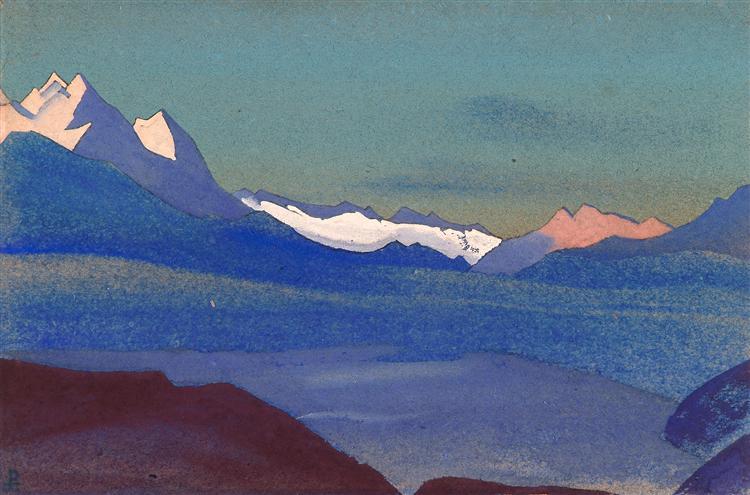
Kashmir. (Nicholas Roerich. 1936. Source: Wikimedia Commons.)
13.
شبیهش را سزد گر هفت کشور
پی قدر و شرف بندند بر سر
ولیکن هر مصور کی تواند
قلم بر صورت این خطه راند
کسی را بر شبیهش دسترس نیست
که نقاش قضا مزدور کس نیست
It’s worth it, if seven realms strive with their lives,
To match its honor and glory
But what painter has the skill,
To trace the image of such a garden?
None can dare to draw its likeness,
For fate's own painter is no mortal’s slave
For the poet, Kashmir and its landscape refuse all representation. The scenes can hardly be reduced to visual frames. Vision alone will not reveal the landscape. What of the air—crisp, bearing the chill—that if you inhale it in the morning hours, it will set your breast ablaze? Qudsi's breath is almost snuffed out by the path: نفس شد منقطع در قطع این راه. Breathless. And blind. The sun is merely a feeble lamp that the mountain hides under its cloak, conjuring indistinguishable shades of darkness and light. Vision struggles when the path is dyed in twilight hues, even though the valleys are adorned with tulips.
14. Journeying through the imposing, icy and magnificent landscapes of the upper Chenab valley, Bourne is convinced that the “camera is powerless to cope with the ideal scenes.” What is impossible to capture in the photograph, Bourne attempts to convey in the prose that borders on poetry:
“...it is when the monarch of day is retiring behind one of their frowning, shadowy masses, with a halo of crimson light around him, gilding their summits with his level rays, and leaving the valleys in gloom, that the poetry and sublimity of this sublimest part of earth are learnt and felt. The haze of day has then given place to that bewitching purple indistinctness which seems at once to fill with silence and sublimity every open valley and every deep recess, rendering obscurity more obscure, and impressing a majestic awe upon the hills…”
Was it Merleau-Ponty, the French phenomenologist, who claimed that all vision urges towards dissolution? And that the visible and the invisible are intertwined?
The scenes described by Bourne are not the scenes of clear daylight. They belong to the liminal. Sunsets and twilights, when details disappear and distances begin to merge, emerge and vanish. The landscape engulfs the photographer’s being. Senses are awakened and the imagination bursts forth. This is a participation with the landscape without the mediating eye of the camera. Primal perception.
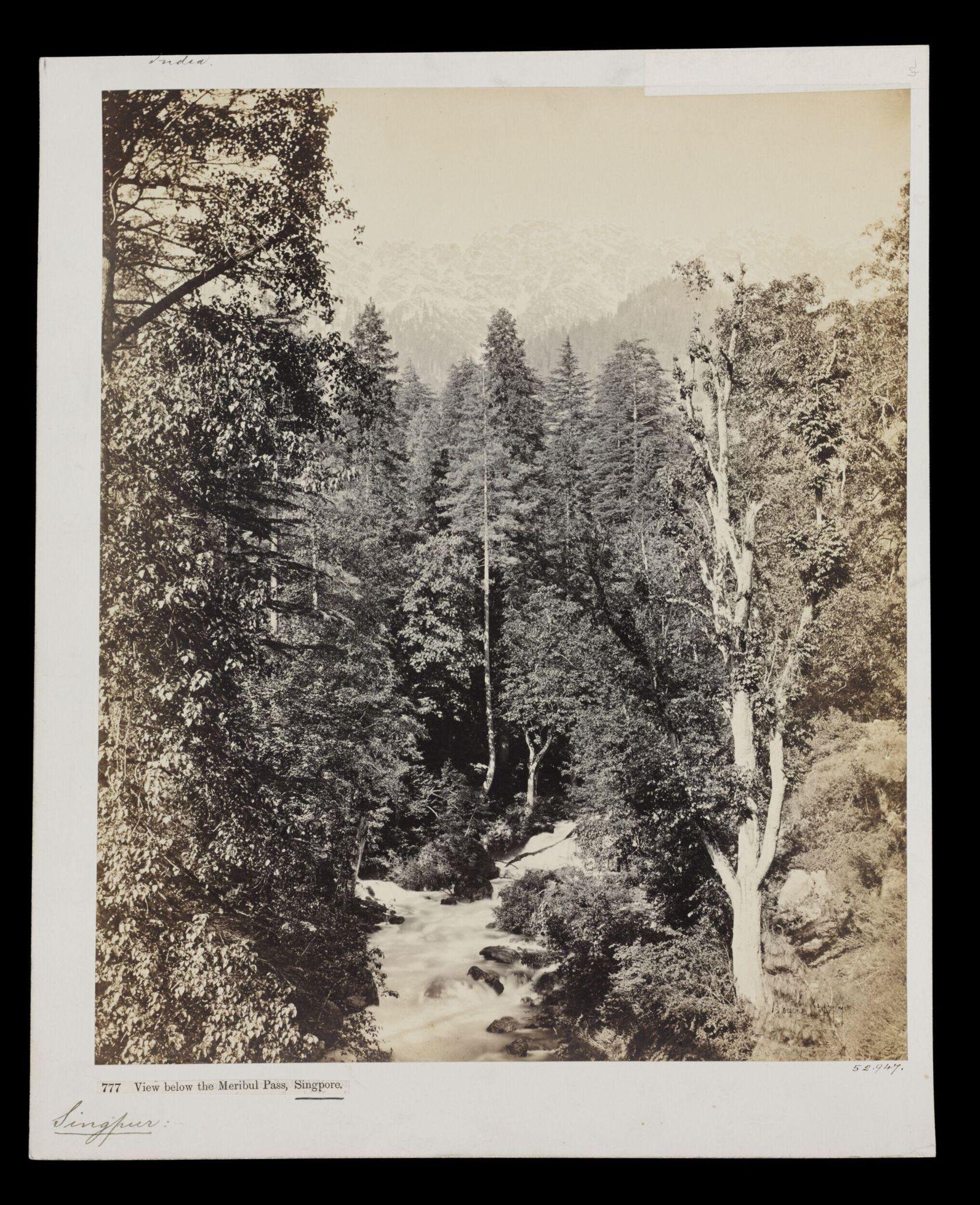
View below the Meribul Pass, Singpore. (Samuel Bourne. 1864. Source: Victoria and Albert Museum.)
15. Qudsi, weak, infirm and bone-weary, cries in the moment of exaggeration:
جوان گر پوید این راه پر اندوه
به پیری میرسد، پیش از سر کوه
If a young man walks this sorrowful path,
He will grow old before he reaches the summit
And when he has crossed Pir Panjal, he sings:
برون شد کوه را دامن ز چنگم
که چون فرسنگ، آمد پا به سنگم
چو بگذشتی ز کوه پیرپنجال
همان ساعت دگرگون میشود حال
The mountain pulled its hem away from my grasp,
At every mile, my feet struck stone and rock
But once you’ve passed the Pir Panjal,
In that moment, your state begins to change
Those moments of transition, where the mountains open into a sea of expansive green, trigger a series of intense upheavals in the innermost being of our poet. Hal (حال) is a presence, and every moment brings about a new one. And once the valley is glimpsed while descending from the Pir Panjal pass, all the hardships endured on the path are worth it:
اگر این است نزهتگاه کشمیر
هزاران جان فدای راه کشمیر
If this be the holy sanctuary of Kashmir
My thousand lives be sacrificed for the path that brings me here
The path that almost killed him has also made him worthy of the garden:
ز راهش کی چرا دلتنگ باشد؟
زمرد در میان سنگ باشد
Why curse the path that seems to never end?
Emerald, we know lies hidden in the stone
چرا افسردهای قدسی و دلگیر؟
نظر بگشای، کشمیرست، کشمیر
Why are you depressed, O Qudsi, why so melancholy?
Open your eyes, you have arrived in Kashmir!
16. From Kishtwar, Bourne’s arduous ascent to the Meribul (Sinthan) Pass through steep, snow-laden paths culminates in a solitary vigil at the summit. Bourne leaves his coolies behind and paces ahead up the trackless snow, taking the riskier way but finally getting to the top, exhausted and cold.
From the top, he catches the first glimpse of the Valley of Kashmir. The overcast sky, he writes, adds to the “gloomy grandeur” of the scene. A sublime panorama. Bourne acknowledges that unlike Ruskin or Macaulay, he cannot summon words or metaphors to describe the view. Stuck between the experience of poetic amplitude and spectacle complex (Bachelard’s terms), he contemplates it for an hour. But what is safeguarded in reflection will never yield to the camera.
In case you missed the first part, you can read it here.
To learn more about artists engaging with the representation of Kashmir, read Sukanya Deb’s interview with Siva Sai Jeevanantham on his series In the Same River (2017–21), Najrin Islam’s reflections on Moonis Ahmad Shah’s series Gul-e-Curfew (2021), and Senjuti Mukherjee’s interviews with Alana Hunt on her book Cups of nun chai (2020) and Sanjay Kak on editing Witness: Kashmir 1986–2016 (2017).
All translations are by the author.