

Rust, Reverence, Resistance: Zahra Malkani’s Noorani Metal Sound

At Auto Italia in London, the encounter with Zahra Malkani’s first major UK solo exhibition, Noorani Metal Sound (27 March–21 June 2026), begins on the street. Outside, a kitsch poster, reminiscent of a shop-front or billboard invitation, appears as a collage crowded with images of speakers, cassettes, an under-repair concrete shrine and fish with water, along with exhibition details in Urdu—marking the entrance as both a visual and symbolic threshold. This signals a departure from the sterile neutrality of the traditional white cube into an environment where the sonic and the sacred are inextricably linked.
Upon entering, the gallery’s typical austerity is turned into a sacralised environment. A metal scaffolding structure acts as an itinerant shrine, carrying Malkani’s Noorani Echo Sound (2026) archive. The atmosphere is thick with the unmistakable scent of diyas (earthen oil lamps) kept continually lit. This sensory shift is accompanied by the soundscape of the back gallery—an audio-visual installation titled The Wanderers Taught Me Longing, The Mystics Taught Me Lament—which pours into the first room, blurring the boundaries between the exhibition’s two modest spaces.

The core of the exhibition is an archive of field-based research and recordings gathered over five years across Pakistan’s heavily militarised coastal and delta regions. Malkani’s work traces oral traditions of lament, devotion and resistance among communities facing ecological dispossession in the Indus River delta and along the Makran Coast. These landscapes bear the marks of rerouted waters, transformed coastlines and communities rendered vulnerable through the intertwined forces of extractive development, state violence and climate breakdown. Moving between lullabies, devotional zikr (remembrance), protest songs and collective lament, the recordings position the voice as both an intimate register of memory and an insurgent form of resistance.

Many of these sounds emerge from women-only spaces, where the sonic field is expansive rather than clean: babies crying, animals moving, women speaking over one another, as well as lullabies carrying both the wonder of new life and the fear of brutality. Along the Makran Coast and in Balochistan, where men are vulnerable to disappearance and murder, women have become central to movements of protest, remembrance and mourning. Malkani’s choice to employ sound recordings as a means of archiving, likely seen as being the least invasive method, is further layered with the complex realities of domestic and social spaces. It raises questions about how women come to inhabit these collective spaces of mourning and remembrance, and whether such visibility can ever be disentangled from the gendered burdens and violent absences that necessitate it.

This archival work is physically housed in a three-part cassette box set, Noorani Echo Sound, a collaboration with designer Rose Nordin, which elevates the carrier of sound into a talismanic art object. Comprising two cassettes and a guidebook, the work is presented alongside cloth and textual devotional objects across the metal structure. The shrine Malkani invokes is not the quaint, colourful shrine often dreamt up in the Orientalist imaginary. It is hard-edged and metallic, capable of invoking the more difficult associations of mourning, exorcism, ecstatic devotion and the labour of the dead. Perhaps this is why the installation’s sacred atmosphere does not seem to soften the political violence it holds; instead, it gives that violence a ritual form.

Jute pouffes laid around the central structure invite visitors to sit around and engage intimately with the analogue technology. Notably, the archive refuses literal translation; while the accompanying book provides texture and orientation, the specific invocations remain partially inaccessible to the uninitiated listener. This is a considered position: knowing is often irrelevant to the power of invocation itself, and providing a sanitised translation would risk converting sacred experience into mere information. In a London gallery context, such refusal interrupts the expectation that material from elsewhere must arrive already decoded, translated and made available for easy comprehension. Yet it also asks something difficult of the visitor: can one listen ethically without comprehension, or does opacity risk becoming another form of distance?
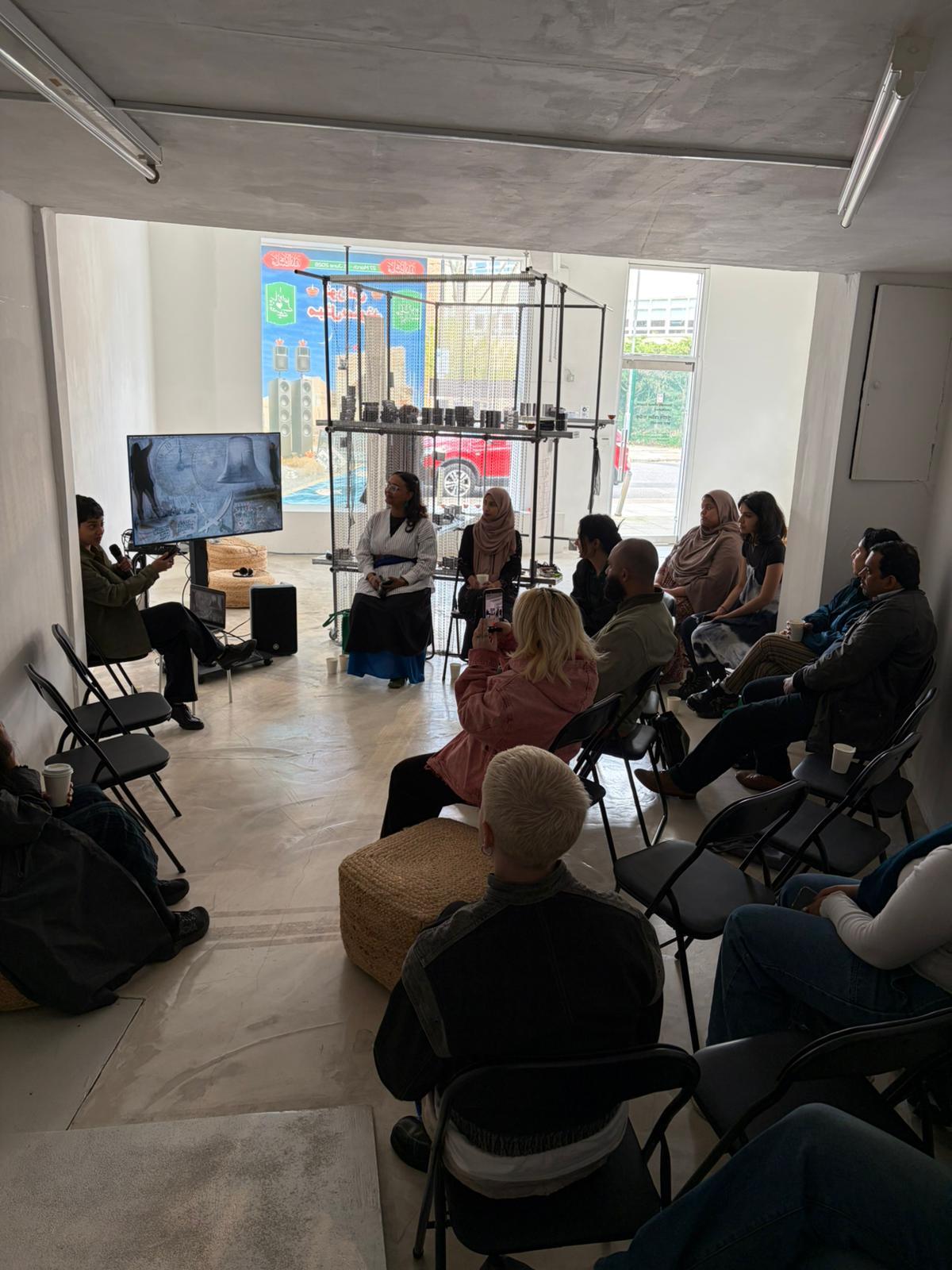
In a conversation with curator Mariam Elnozahy and Syma Tariq, Malkani positioned her choice of documentation as deeply political. Under brutal surveillance, voice memos and phone recordings are among the most inconspicuous and viable means. Yet the archive here is never innocent. Malkani spoke of the anxiety that to record a sound is also to petrify it: to fix something that lives through repetition, gathering and bodily transmission. The cassette, then, does not resolve the violence of preservation but makes it visible; its re-recordable, portable form keeps the archive unstable, closer to circulation than possession. Still, the question remains: can any recorded archive fully avoid fixing the very practices it seeks to keep alive?
Extending the exhibition’s concerns into the social realm of East London is the parallel public programme, Metal on Metal, curated by Tariq. A longtime collaborator of Malkani, Tariq is a researcher, writer and sound practitioner whose doctoral research has developed around Partition, post/colonial violence, archival silence and erasure. The extended programme, spread across the exhibition’s run, does not serve as a collateral space or an afterthought meant to “activate” a static show. Rather, responding to the spirit invoked by the exhibition, the talks, performances and workshops merge with the physical installation, positioning the shrine structure as a space of convening.
Tariq’s curation interrogates listening as a mode of liberation, exploring signal capture, radio technologies and epistemic breaks through feminist politics. In her account, sound emerges where paper archives have been burnt, withheld or rendered hostile: not as a pure alternative to evidence, but as a haunted medium through which histories of annihilation continue to press on the present. As Tariq suggested, speech itself is not a guarantor of freedom, and listening is not equally accessible to all. The programme’s strength lies in keeping this proposition unsettled: asking when listening gathers, when it extracts and when it fails.
.jpeg)
The sessions purposefully localise the urgencies of the Indus Delta and Malkani’s work within the lived realities of communities around Auto Italia. By engaging organisations such as Nijjor Manush, a Bengali/Bangladeshi-led campaigning and solidarity organisation, the programme attempts to create a corridor, albeit fragile, between the gallery and the world, linking South Asian histories of resistance to local struggles around displacement and gentrification, as well as community survival and joy. Other sessions expand this framework through different registers of listening: Shortwave Collective’s exploration of radio signals turns metal towards the electromagnetic and the feminist-fugitive, while Fatima Lahham and Bint Mbareh’s gathering of voices returns to the cassette as a collective medium through which the departed—by migration, strife or death—continue to haunt the present. Vocal and movement artist Elaine Mitchener’s commissioned performance, Metal Mark Time, draws on research conducted in the local archives with Tariq on the nearby Whitechapel Bell Foundry, grounding the exhibition’s motifs of metal and resonance in local industrial history and its contemporary loss, sounding out racialised and working-class labour and the foundry’s uncertain future in a striking rendition.
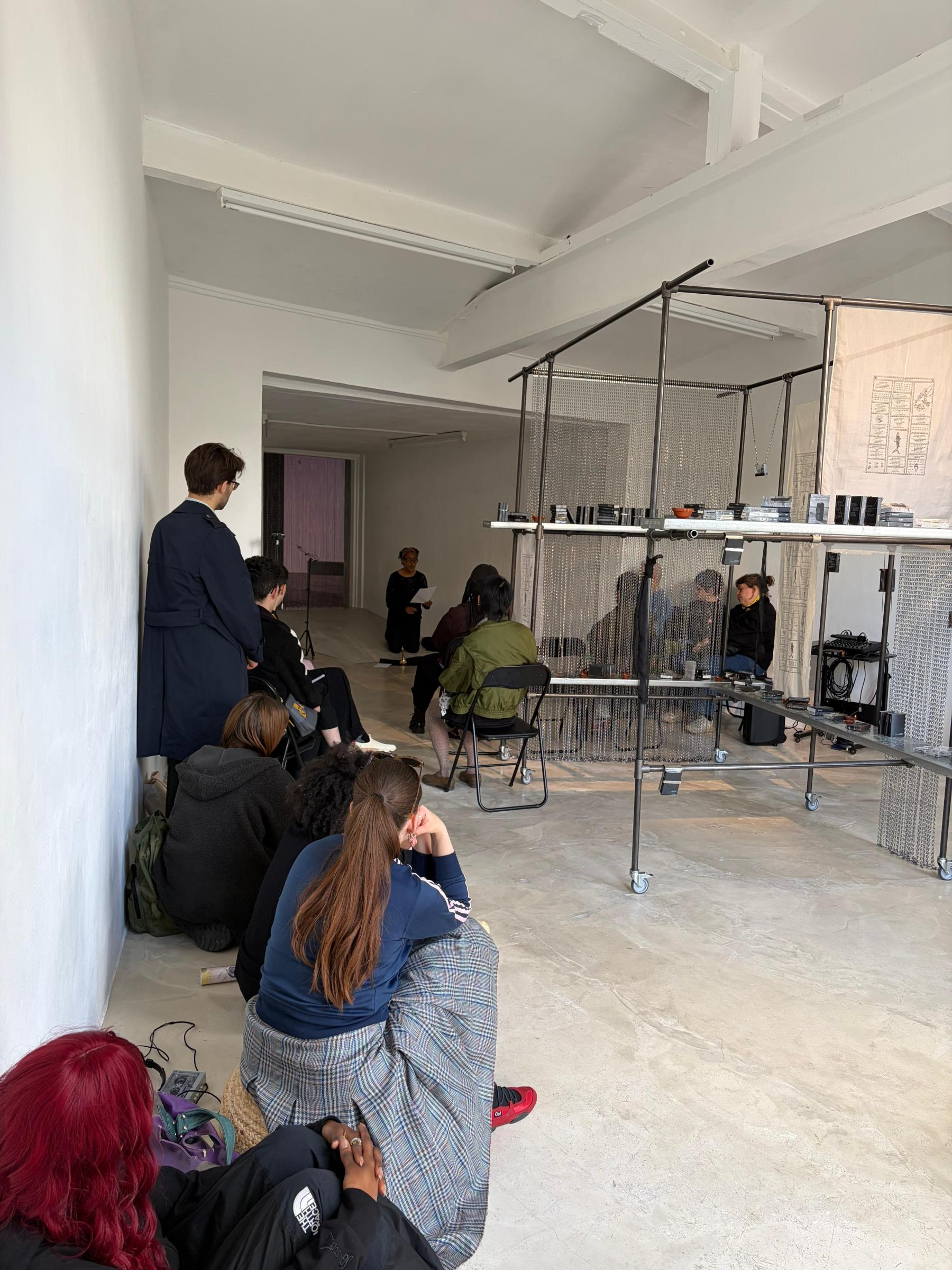
Ultimately, Noorani Metal Sound and Metal on Metal do not offer listening as an easy reparative act but rather problematise it in the face of destroyed archives, transformed landscapes and communities forced to remember through disappearance. Malkani’s shrine-like installation attempts to sacralise the gallery, but the question remains whether a white cube can only briefly host the sacred under fragile conditions. Tariq’s programme carries this instability outward, placing the exhibition’s sonic world in relation to local experiences of migration, labour and resistance—both historically and in the present. Yet can such acts of circulation evade the symbolic and economic structures through which contemporary cultural production gains value, or do they inevitably risk being folded back into the very systems they critique? What holds the exhibition and programme apart from this collapse, perhaps, is the clarity of their intention: to make listening less an act of comprehension than an encounter with the conditions that make listening possible, uneven and precarious.

To learn more about Zahra Malkani’s practice, read Radhika Saraf’s two-part conversation with Malkani and Shahana Rajani on their work as the arts collective Karachi Lajamia, Mallika Visvanathan’s observations on the show 28° North and Parallel Weathers (2024), Pamudu Tennakoon’s reflections on the panel “Seeding a Grove of South Asian Solidarities” at Colomboscope: Way of the Forest (2024) and Anisha Baid’s three-part conversation with the team of Exhausted Geographies (2017).
To learn more about Syma Tariq’s practice, read Ankan Kazi’s reflections on the curated radio programme for Colomboscope: Language is Migrant titled A Thousand Channels (2022).
To learn more about artists exploring sound and listening as a medium, read Upasana Das’ essay on Poulomi Desai’s music practice, Anisha Baid’s conversation with Farah Mulla on the invisible agency of sound and Annalisa Mansukhani’s reflections on artists encounters focusing on acts of listening as part of Colomboscope: Language is Migrant (2022). Also listen to an episode of ASAP Cast by Upasana Das featuring Hind Meddeb on underground music as resistance in her films, featured as part of Colomboscope: Rhythm Alliances (2026).
All images courtesy of Zahra Malkani and Auto Italia.